
Items related to The Weaver's Scar: For Our Rwanda
Synopsis
VOYA Magazine’s Top Shelf Fiction for Middle School Readers
Skipping Stones Honor Award
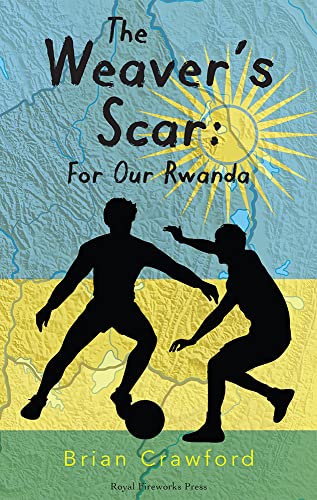
The Weaver’s Scar is a profoundly moving, gripping, horrifyingly beautiful story of one boy’s escape from the atrocities of the Rwandan genocide. It is the first young adult novel written in English for an American audience dealing directly with the 1994 genocide of the Tutsis by the Hutus, an event that resulted in the slaughter of nearly a million people. The novel is stunning in its eloquence, heartrending in its poignancy, and exquisite in its revelations, both of the characters’ personal lives and of the history of a nation torn apart by ethnic divisions.
Faustin is a normal schoolboy who excels at running and soccer. But dark secrets of the past hang over his family, and his father disapproves of his friends and his soccer games. Things only start to make sense when the teachers at school begin to emphasize the division between the Tutsis and the Hutus—a division that even makes its way to the soccer field.
As the terrible events of the genocide unfold, Faustin experiences first-hand the horror of neighbor against neighbor. With his family slain, his only chance of survival lies in his running and his sheer courage to outwit the enemy. He does not have to do it alone, however; he discovers the value and courage of an unlikely friend. Their journey to safety unfolds in a compelling narrative that ends with both heartbreak and, later, inspiration.
"synopsis" may belong to another edition of this title.
Reviews
Gr 7 Up—In the prologue, Faustin Kazubwenge introduces himself as a Lincoln High student who eats French fries, drinks Coke, and goes to movies. "To the parents, friends, and relatives," he notes, "I'm just one of 236 seniors about to get their diplomas. What I'm not is one of the million who died." The story then flashes back to Rwanda in 1993, right before the genocide. Faustin, a young teen, is Tutsi and is thus considered to be an inyenzi (cockroach) by the government-supported Hutu majority. Short chapters, clipped sentences, and nonstop action move the story quickly as he escapes the massacre, flees with an unlikely friend, and eludes the Hutu gangs that are searching for survivors. Crawford paints a vivid picture of both the horrifying events that Faustin survives and his fortuitous rescue and later immigration to America. Kinyarwanda words appear in conversation and are defined in the text. A map, however, would have helped readers follow the journey of the two friends down the Nyabarongo River to safety in Burundi. The dramatic first-person narrative allows readers to experience the story through Faustin's eyes, encouraging empathy and understanding.—Toby Rajput, National Louis University, Skokie, IL
"About this title" may belong to another edition of this title.
Search results for The Weaver's Scar: For Our Rwanda

Stock Image
The Weaver's Scar: For Our Rwanda
Published by
Royal Fireworks Publishing Company, 2013
ISBN 10: 0898244773
ISBN 13: 9780898244779
Used
paperback
Seller: Gulf Coast Books, Cypress, TX, U.S.A.
Seller rating 5 out of 5 stars

paperback. Condition: Good. Seller Inventory # 0898244773-3-36669051
Stock Image
The Weaver's Scar: For Our Rwanda
Published by
Royal Fireworks Publishing Company, 2013
ISBN 10: 0898244773
ISBN 13: 9780898244779
Used
Paperback
Seller: World of Books (was SecondSale), Montgomery, IL, U.S.A.
Seller rating 5 out of 5 stars
Paperback. Condition: Good. Seller Inventory # 00028406839
Stock Image
The Weaver's Scar : For Our Rwanda
Published by
Royal Fireworks Publishing Company, 2013
ISBN 10: 0898244773
ISBN 13: 9780898244779
Used
Softcover
Seller: Better World Books, Mishawaka, IN, U.S.A.
Seller rating 5 out of 5 stars
Condition: Good. Former library copy. Pages intact with minimal writing/highlighting. The binding may be loose and creased. Dust jackets/supplements are not included. Includes library markings. Stock photo provided. Product includes identifying sticker. Better World Books: Buy Books. Do Good. Seller Inventory # 5722531-6
Stock Image
The Weaver's Scar: For Our Rwanda
Published by
Royal Fireworks Publishing Company, 2013
ISBN 10: 0898244773
ISBN 13: 9780898244779
Used
Paperback
Seller: World of Books Inc, Montgomery, IL, U.S.A.
Seller rating 4 out of 5 stars

Paperback. Condition: Good. Seller Inventory # CIN0898244773G