
Items related to How to Hit the Ground Running: A Quick-Start Guide...
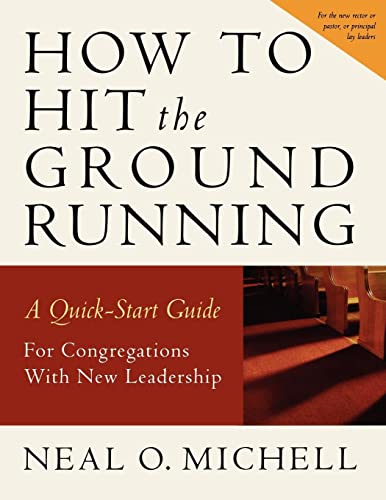
How to Hit the Ground Running: A Quick-Start Guide for Congregations with New Leadership - Softcover
Synopsis
The quick-start program described in this book is designed for the new rector or pastor who wants to "hit the ground running." It is also designed for principal lay leaders who will be instrumental in the transition to new leadership.
The program takes the new pastor, vestry, or other leadership bodies from one month prior to the new leader's arrival through the first eighteen months afterward. Organized in a user-friendly workbook format, this guide gives step-by-step suggestions on how the sometimes stalled and directionless period of transition in a faith community can be made dynamic and purposeful - a time of true congregational development.
"synopsis" may belong to another edition of this title.
About the Author
An Episcopal priest and consultant for congregational development, Neal O. Michell has served as the Canon to the Ordinary and Canon for Strategic Development in the Episcopal Diocese of Dallas. A former practicing attorney, he has been a priest at churches of various sizes in Texas and in Tennessee, where he planted a church in Germantown that grew rapidly. He has led vestry retreats and workshops, focusing on vision-casting and leadership development. He holds a D.Min. in Church Growth from Fuller Seminary, where he researched contemporary Anglican worship. He has also gone on short-term mission trips to Ukraine, South Africa, Mexico, and Honduras. He is the author of How to Hit the Ground Running: A Quick-Start Guide for Congregations with New Leadership and Beyond Business as Usual: Vestry Leadership Development, in addition to numerous articles. He lives in Dallas, Texas.
Excerpt. © Reprinted by permission. All rights reserved.
HOW TO HIT the GROUND RUNNING
A Quick-Start Guide For Congregations With New Leadership
By NEAL O. MICHELLChurch Publishing Incorporated
Copyright © 2005 Neal O. Michell
All rights reserved.
ISBN: 978-0-89869-475-8All rights reserved.
Contents
| Foreword................................................................... | ix |
| Acknowledgments............................................................ | xi |
| Introduction: How to Use This Book......................................... | xiii |
| Section 1: Understanding the Congregation.................................. | 1 |
| Chapter 1 Understanding Congregational Size Dynamics....................... | 3 |
| Chapter 2 Understanding Church Growth Factors.............................. | 17 |
| Chapter 3 Understanding Leadership......................................... | 23 |
| Chapter 4 Establishing Yourself as die Pastor: How to Connect with the Congregation............................................................... | 33 |
| Chapter 5 Discerning Your Congregation's Genesis Story to Further the Mission of the Church...................................................... | 41 |
| Section 2: Bringing About Change........................................... | 49 |
| Chapter 6 Bringing About Change (Without Wreaking Havoc)................... | 51 |
| Section 3: Working with Leaders............................................ | 59 |
| Chapter 7 Developing a Vestry That Makes People Want to Come to Vestry Meetings................................................................... | 61 |
| Chapter 8 Moving Your Vestry from a Micromanaging Vestry to a Permission-Giving Vestry................................................... | 69 |
| Chapter 9 Developing a Staff That Will Expand the Ministry................. | 85 |
| Section 4: Using Administrative Changes to Effect Healthy Change........... | 95 |
| Chapter 10 Building Trust through Financial Accountability................. | 97 |
| Chapter 11 Building Credibility with Tangible Results by Improving Your Buildings.................................................................. | 103 |
| Chapter 12 Using the Annual Parish Meeting as an Opportunity for Motivation and Challenge................................................... | 119 |
| Section 5: Expanding Your Congregation's Reach............................. | 123 |
| Chapter 13 Developing Worship That Helps People Engage the Presence of God........................................................................ | 125 |
| Chapter 14 Reaching Beyond Your Church by Raising Your Church's Profile in the Community.............................................................. | 137 |
| Chapter 15 Reaching Beyond Your Church by Using Missions and Outreach as a Catalyst for Growth........................................................ | 145 |
CHAPTER 1
Understanding Congregational Size Dynamics
For which of you, intending to build a tower,does not first sit down and estimate the cost,to see whether he has enough to complete it?
—Luke 14:28
Developing a congregation is simply the task of developing people; making disciples. However,there are really two levels of disciple-making: one is the micro level, the one-on-one process ofhelping a person grow in faith; the other is the macro level, that is, the process of mobilizing people.Most churches that get stuck often do so at the macro level. Clergy are trained in seminaryto think theologically and to provide pastoral care to individuals; they are not trained, however, tomobilize people. They are trained to write theological papers and to conduct liturgy; they are nottrained to develop ministries. This chapter provides a way of looking at the local congregationthrough the lens of congregational size dynamics to help leaders understand their church as a corporateentity. Groups of people when gathered together in various numbers relate to their leaderand to each other in fairly predictable ways. Certain practices that make a group effective at onesize will make it ineffective at a different size.
Although there are many factors that will affect a church's growth, one of the most commonis the ability or lack of ability of the pastoral leader to adapt her style of leadership to the size ofcongregation that she is serving. Often, churches will find their growth limited because of invisiblebut very real size dynamics that keep the church at that certain size. The church has gottenused to being a certain size and will perpetuate the practices that make them effective at that size;they have grown comfortable with their ways of relating to one another as a congregation.Although they may articulate a desire to grow, they often want to grow only while maintaining thecurrent way of relating to the pastoral leader and to one another. Some churches will grow becausethey are able to adapt their system to mobilize the laity effectively. Other churches will plateauor decline in size to fit the comfort level of the system and leader that is in place.
This way of viewing the church as a system is theologically blind. These unseen limiters affectboth "liberal" and "conservative" churches as well as "broad" churches. No church is immune.You may have the best theology in the world—from your perspective—but your church will belimited in its ability to grow because of its inability to change the way the leadership and congregationrelate to each another.
Many times when church leaders first learn about congregational size dynamics, they getawfully excited. For example, they will write that their mission is to become a program-sized congregation.Attaining a larger church size does not constitute a valid mission. Lay people are notreally motivated by growing their church larger. Mission is about reaching people with the goodnews of Jesus Christ; it is not about growing to a particular size. There is nothing intrinsically holyor salvific by being one size and not another. The real need is for churches to be good stewardsof the gifts and resources that God has given them in fulfilling the Great Commission and theGreat Commandments that Jesus gave his Church. Understanding congregational size dynamicsis a tool for facilitating more effective ministry.
A Comment about Attendance versus Membership
Often when people talk about the size of their church they will say, "We have more than 400 members"or "250 families." That is a particularly unhelpful statement. In my experience, most of ourchurch membership rolls are terribly out of date. I know of one church that had more than 150members on their rolls for whom they had no current address.
The number of baptized members listed in a typical mainline denominational church bears noreal relationship to the everyday dynamics of that congregation. Most churches will have manymore members listed than those who are actively involved in the life of the congregation. A churchthat has 650 members with 150 average Sunday attendance is vastly different from a congregationwith 500 members and 350 average Sunday attendance. The larger membership church withthe smaller attendance will generally have fewer financial resources, fewer leaders, and fewer programs—andeffectively fewer people to minister to—than the church with fewer members butmore people actually attending. Scratch below the surface of the first church and you'll likely findmany members who have moved away, died, or are no longer meaningfully connected to thechurch.
We therefore concern ourselves with active participants rather than active or inactive members.Leaders may feel a need to be concerned about inactive members as a pastoral concern;however, the leaders who want to develop their congregation will be wise if they focus first ondiscipling and mobilizing the people who are actively attending before addressing their concernsabout inactive people.
Realizing that the church has a large number of "phantom" members, the new pastor may betempted to "clean the rolls" in order to begin her ministry with a clean slate. Don't do that.
There are several reasons not to clean the church's membership rolls in the first several yearsof a new pastor's tenure. First, a large reduction in membership at the beginning of a pastoratesends a wrong message to the congregation that the pastor is more concerned about the number ofmembers than about the members as individuals. Also, an initial first-year reduction in membershipsilently communicates to the congregation that the church is in decline. A further problem isthat the new pastor might drop people off the rolls that need to be visited, hence sending the messagethat she does not really care for those who may have been hurt in the past. It is better to ignorethe membership numbers altogether than to fix it early in the pastor's tenure.
Sizing Up the Congregation
Why did our approach to congregational development change? Why did we begin to consider congregationalsize dynamics as a way of analyzing our churches? First, in the early 1980s, we beganto notice that our denomination had been in serious membership decline for more than 15 yearssince its high membership mark in 1965. Second, more than two thirds of our churches at that timewere either plateauing or declining. Third, clergy trained in the fast-growth 1950s were serving inthe no-growth 1980s. They were not prepared for pastoring in this changed context. Fourth, wedrastically reduced the number of new churches we were planting as a denomination and settledinto a consolidation mode. Finally, we found that we were growing older as a denomination andnot drawing younger families and individuals. So, a few forward-thinking people began to askwhat was really going on inside our churches. Arlin Rothauge, former CongregationalDevelopment Officer for the Episcopal Church, and then Kevin Martin, then Canon forCongregational Development in the Diocese of Texas, helped Episcopal churches—as well asmany other denominational churches—understand that this decline could actually be stemmedand that we could help lead our churches to greater health and growth through an understandingof congregational dynamics.
In 1982, Arlin Rothauge published a little booklet, Sizing Up the Congregation, which openedup a whole new way of understanding congregations from the perspective of size dynamics. Thisbooklet categorized churches according to numbers of active members and showed the dynamicsof the relationships between the leader and the congregation. He suggested four sizes, as shownin the table below:
Name Active members
Family 0–50
Pastoral 50–150
Program 150–350
Corporation 350+
Rothauge's analysis helped congregational leaders understand the interplay between leadersand followers and evangelism.
In 1995, Kevin Martin did a little fine tuning of Rothauge's analysis. First, he changed thebasic subject group from active members to average Sunday attendance. Determining activemembers was difficult and led to analyses that simply did not fit Rothauge's otherwise insightfulparadigm. Second, he changed the numerical categories based on his observations of churches thathe had worked with in the Diocese of Texas. Third, and most significantly, he observed that manychurches had a difficult time moving from the pastoral to program size. In response, he positeda fifth size category: the transitional-sized church. Finally, he changed the designation of corporate-sizedchurch to resource-sized. Designating a church as corporate, he reasoned, seemed a bitsterile and, well, corporate-sounding rather than pastoral, and the significant aspect of this largersized church is that it has an abundance of resources. Martin's size categories are as follows:
Name Average Sunday
Attendance
Family 5–75
Pastoral 76–140
Transitional 141–225
Program 226–400
Resource 401+
So, let's look at these size dynamics a bit more closely using Kevin Martin's analysis.
The Family-Sized Church
The family-sized church has an average Sunday attendance of up to 75. These churches are typicallylocated in smaller towns. They function much as a family does and are often made up of a couple ofinterrelated families in the leadership of the church. Not everyone in the church is a member of theextended family, but one prominent extended family is often at the center of influence.
The ordained person in this size of church is not the head of the congregation (family). Instead,the ordained person functions as the chaplain to the congregation. The congregation expects onlypastoral care from the pastor—counseling, prayers at appropriate occasions, hospital visits, weddings,funerals, and so on—but the real decisions affecting the church are made by long-standingmembers of the congregation. The true leader in this congregational family system is designated asthe matriarch or patriarch. This person is usually a long-term member of both the congregation andthe community and will typically have children and grandchildren in the congregation. The churchis really a set of a few extended family units with a few other friends as well.
Although the vestry is the stated lay leadership circle, usually the vestry will defer to thematriarch/patriarch. It is not unusual to have a vestry make a decision only to have the same vestryreverse itself a month later after everyone has talked to the matriarch/patriarch of the congregation.Woe be to the pastor who serves a family-sized church who really believes that she is theleader of the congregation.
The strength of this congregation is in its stability. The weakness is its low expectations.Success for this church is in keeping the doors open.
The Pastoral-Sized Church
The pastoral-sized church has an average Sunday attendance of 76 to 140. The first major shiftoccurs in terms of leadership. This church is clergy-centered. The role of the ordained person canbe described as the pater familias. That is, instead of functioning primarily as the chaplain in thecongregation, this ordained person is the focal point of all activities.
The pastor is, indeed, the leader of the congregation (however, be sure to read Chapter 3 onleadership levels and Chapter 6 on managing change before feeling too overconfident about whatit means to be the leader of the congregation). The pastor in this size of church is usually expectedto give her opinion on flower arrangements and paint colors, to assign the setting up of chairs,pray before parish gatherings, be the first to the hospital, and so on. The pastoral-sized church pastoris the primary evangelist in the congregation as well. She will be the primary drawing card tobring new people into the congregation.
This is the "friends" church, where everybody among the group of friends knows everyoneelse. Lives are intertwined. People are attracted to this church because of the intimacy among thecongregation. A person can miss church one Sunday, return the next, and five different people willask what they have been doing or how their trip was. A church of this size can give to its membersa real sense of belonging and family.
The role of the vestry at this level is to serve as the unpaid staff of the church. Because achurch at this size generally has only one full-time staff member, namely, the pastor, the vestrymembers are often the ones who carry out the plans of the rector and the congregation. When thevestry of the pastoral-sized church sees itself as simply decision makers for the congregation, thepastor becomes overworked, and the church is not set up for the appropriate and healthy transitionto the larger size.
The strength of this congregation is in its stability. Assuming that the physical property of thechurch is in good repair, this church can sustain itself for a long time. It is tremendously enjoyableand fulfilling to be in a pastoral-sized church—as long as your expectations are not too high.Worship services are provided on a regular basis, and the congregants generally know what toexpect in them. Individuals can rise in leadership and responsibility. Each member expects, and canusually get, equal access to the pastor. She is always available for counseling as well as for morepersonal social occasions.
The weakness of this congregation is in its predictability. The programs offered by this congregationare generic and small. Don't expect a very large choir or for the choir to sing very challengingmusic. The youth group is often no larger than a Bible study. Planning for this church isusually based on "what did we do last year?" This year's budget looks suspiciously like last year's,and like the year before that, and the year before that one.... Often leaders are tired, becausethere are more leadership positions than there are emerging leaders, so people are often wearyfrom having too many church responsibilities.
Further, the pastor has the primary responsibility of incorporating newcomers into the ongoinglife of the church. The key to making newcomers feel like they belong is for them to have a relationshipwith the pastor. In this size of church, the pastor is the glue that holds all these relationshipstogether—both newcomers as well as long-time members.
The Program-Sized Church
We now jump ahead in the order of Martin's categories to look at the program-sized church,because we have to understand the program-sized church before we can understand the intermediatetransitional-sized church.
The program-sized church has an average Sunday attendance of 226 to 400. Whereas the spiritualnourishment in a pastoral-sized church occurs primarily through a relationship with the pastor,in the program-sized church most spiritual nourishment takes place though the programs of thechurch—and supplemented by the pastor. This church is noted by the presence of activity and programofferings. There is a place to land for just about everyone in this size of church.
The typical parishioner in a program-sized church knows the same number of people as thetypical parishioner in a pastoral-sized church; however, there are simply more people for theparishioner in the program-sized church not to know. The quality of relationships is no less significantor meaningful, although it may seem so to the average pastoral-sized church member.One often hears people in a pastoral-sized church say, "Now, we don't want to become one ofthose megachurches."
The role of the pastor changes from the pater familias in the pastoral-sized church to the chiefadministrator in the program-sized church. The pastor is still at the center of the life of the congregation,but her role has shifted. Newcomers in a program-sized church don't expect to knowthe senior pastor on a personal basis. They may be in church five times before exchanging morethan 25 words with the pastor. Likewise, parishioners don't usually expect a hospital visit from thesenior pastor; although it is expected in a time of crisis or real need. The senior pastor spends hertime planning with other staff members and lay leaders in the congregation, recruiting new leaders,facilitating the activities in the congregation, and keeping the programs running smoothly.
(Continues...)
Excerpted from HOW TO HIT the GROUND RUNNING by NEAL O. MICHELL. Copyright © 2005 Neal O. Michell. Excerpted by permission of Church Publishing Incorporated.
All rights reserved. No part of this excerpt may be reproduced or reprinted without permission in writing from the publisher.
Excerpts are provided by Dial-A-Book Inc. solely for the personal use of visitors to this web site.
"About this title" may belong to another edition of this title.
Search results for How to Hit the Ground Running: A Quick-Start Guide...

Stock Image
How to Hit the Ground Running: A Quick Start Guide for Congregations with New Leadership
Seller: World of Books (was SecondSale), Montgomery, IL, U.S.A.
Seller rating 5 out of 5 stars

Paperback. Condition: Good. The quick-start program described in this book is designed for the rector or pastor who wants to hit the ground running. It is also designed for principle lay leaders who will be instrumental in the transition to leadership. Seller Inventory # CIN0898694752G
Stock Image
How to Hit the Ground Running : A Quick Start Guide for Congregations with New Leadership
Published by
Church Publishing Incorporated, 2005
ISBN 10: 0898694752
ISBN 13: 9780898694758
Used
Softcover
Seller: Better World Books: West, Reno, NV, U.S.A.
Seller rating 5 out of 5 stars
Condition: Very Good. Pages intact with possible writing/highlighting. Binding strong with minor wear. Dust jackets/supplements may not be included. Stock photo provided. Product includes identifying sticker. Better World Books: Buy Books. Do Good. Seller Inventory # 15688335-75
Stock Image
How to Hit the Ground Running : A Quick Start Guide for Congregations with New Leadership
Published by
Church Publishing Incorporated, 2005
ISBN 10: 0898694752
ISBN 13: 9780898694758
Used
Softcover
Seller: Better World Books: West, Reno, NV, U.S.A.
Seller rating 5 out of 5 stars
Condition: Very Good. Former library copy. Pages intact with possible writing/highlighting. Binding strong with minor wear. Dust jackets/supplements may not be included. Includes library markings. Stock photo provided. Product includes identifying sticker. Better World Books: Buy Books. Do Good. Seller Inventory # 51652441-6
Stock Image
How to Hit the Ground Running: A Quick-Start Guide for Congregations with New Leadership
Published by
CHURCH PUBLISHING INC (edition ), 2005
ISBN 10: 0898694752
ISBN 13: 9780898694758
Used
Paperback
Seller: BooksRun, Philadelphia, PA, U.S.A.
Seller rating 5 out of 5 stars
Paperback. Condition: Very Good. It's a well-cared-for item that has seen limited use. The item may show minor signs of wear. All the text is legible, with all pages included. It may have slight markings and/or highlighting. Seller Inventory # 0898694752-11-1
Stock Image
How to Hit the Ground Running: A Quick Start Guide for Congregations with New Leadership
Seller: World of Books Inc, Montgomery, IL, U.S.A.
Seller rating 4 out of 5 stars

Paperback. Condition: Good. The quick-start program described in this book is designed for the rector or pastor who wants to hit the ground running. It is also designed for principle lay leaders who will be instrumental in the transition to leadership. Seller Inventory # CIN0898694752G
Seller Image
How to Hit the Ground Running: A Quick-Start Guide for Congregations with New Leadership
Seller: ZBK Books, Carlstadt, NJ, U.S.A.
Seller rating 5 out of 5 stars
Condition: very_good. Fast & Free Shipping â" Very Good condition book with a firm cover and clean pages. Shows normal use and some light wear or limited notes markings. A solid, nice copy to enjoy. Seller Inventory # ZWV.0898694752.VG
Stock Image
How to Hit the Ground Running: A Quick-Start Guide for Congregations with New Leadership
Seller: HPB-Emerald, Dallas, TX, U.S.A.
Seller rating 5 out of 5 stars
Paperback. Condition: Very Good. Connecting readers with great books since 1972! Used books may not include companion materials, and may have some shelf wear or limited writing. We ship orders daily and Customer Service is our top priority! Seller Inventory # S_469589080
Stock Image
How to Hit the Ground Running: A Quick-Start Guide for Congregations with New Leadership
Seller: HPB-Movies, Dallas, TX, U.S.A.
Seller rating 4 out of 5 stars
Paperback. Condition: Very Good. Connecting readers with great books since 1972! Used books may not include companion materials, and may have some shelf wear or limited writing. We ship orders daily and Customer Service is our top priority! Seller Inventory # S_472860935
Stock Image
How to Hit the Ground Running: A Quick-Start Guide for Congregations with New Leadership
Seller: HPB Inc., Dallas, TX, U.S.A.
Seller rating 5 out of 5 stars
Paperback. Condition: Very Good. Connecting readers with great books since 1972! Used books may not include companion materials, and may have some shelf wear or limited writing. We ship orders daily and Customer Service is our top priority! Seller Inventory # S_480427580
Seller Image
How to Hit the Ground Running: A Quick-Start Guide for Congregations with New Leadership
Seller: clickgoodwillbooks, Indianapolis, IN, U.S.A.
Seller rating 4 out of 5 stars
Condition: acceptable. Used - Acceptable: All pages and the cover are intact, but shrink wrap, dust covers, or boxed set case may be missing. Pages may include limited notes, highlighting, or minor water damage but the text is readable. Item may be missing bundled media. Seller Inventory # CSIV.0898694752.A