
Items related to Reclaiming Our Health: Exploding the Medical Myth and...
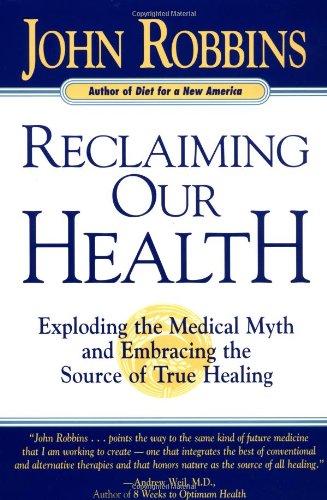
Reclaiming Our Health: Exploding the Medical Myth and Embracing the Source of True Healing - Softcover
Synopsis
The author calls for a revolution in health care, criticizing its hostility to alternative medicine and its bias against women
"synopsis" may belong to another edition of this title.
About the Author
John Robbins is the author of the international bestseller Diet for a New America: How Your Food Choices Affect Your Health, Happiness, and the Future of Life on Earth, and Reclaiming Our Health: Exploding the Medical Myth and Embracing the Source of True Healing. Widely considered to be one of the world's leading experts on the dietary link to the environment and health, he is the founder of EarthSave International, a nonprofit organization that supports healthy food choices, preservation of the environment, and a more compassionate world. John and his work have been the subject of cover stories and feature articles in The San Francisco Chronicle, The San Francisco Examiner, Chicago Life, The Washington Post, The New York Times, The Philadelphia Inquirer, and many of the nation's other major newspapers and magazines.
His life and work have been featured in an hour-long PBS special entitled Diet for a New America. Many of the nation's leading authorities on alternatives in health and ecology have called John's work among the most important events of the century.
The only son of the founder of the Baskin-Robbins ice cream empire, John Robbins walked away from a life of immense wealth to . . . pursue the deeper American Dream . . . the dream of a society at peace with its conscience because it respects and lives in harmony with all life forms, a dream of a society that is truly healthy, practicing a wise and compassionate stewardship of a balanced ecosystem.
Considered to be one of the most eloquent and powerful spokespersons in the world for a sane, ethical, and sustainable future, John has been a featured and keynote speaker at major conferences sponsored by Physicians for Social Responsibility, Beyond War, Oxfam, the Sierra Club, the Humane Society of the United States, the United Nations Environmental Program, UNICEF, and many other organizations dedicated to the public interest. He is the recipient of the 1994 Rachel Carson Award. The widespread media attention he has received has included numerous appearances on Oprah, Donahue and Geraldo, and other national shows. When John spoke at the United Nations, he received a standing ovation.
From the Back Cover
A Prescription for Real Health Care Reform In his rousing and inspirational style, John Robbins, author of the acclaimed best-seller, Diet for a New America, turns his attention to the national debate on health care. Calling for nothing short of a revolution in the basic beliefs on which health care is based, he convincingly demonstrates the enormous human and financial costs of the polarization of conventional and alternative medicine.
Although Americans spend far more money on health care than any other people in the world, many of us cannot afford the most basic coverage. We rank 25th amount the worlds nations in infant mortality; the toll in human suffering from degenerative disease continues to rise; the danger from virulent communicable diseases is increasing daily; and, meanwhile, women are growing increasingly frustrated with the care they receive from a male-dominated system.
With a foreword by Marianne Williamson and an introduction by Riane Eisler, Reclaiming Our Health offers a brilliant, refreshing and uplifting new vision of what health care in America might be, as well as practical solutions for us as individual and for a health-care system gone awry.
Excerpt. © Reprinted by permission. All rights reserved.
Once upon a time these was a large and rich country where people kept falling over a steep cliff. They'd fall to the bottom and be injured, sometimes quite seriously, and many of them died. The nations medical establishment responded to the situation by positioning, at the base of the cliff, the most sophisticated and expensive ambulance fleet ever developed, which would immediately rush those who had fallen to modern hospitals that were equipped with the latest technological wizardry. No expense was too great, they said, when people's health was at stake.
Now it happened that it occurred to certain people that another possibility would be to erect a fence at the top of the cliff. When they voiced the idea, however, they found themselves ignored. The ambulance drivers were not particularly keen on the idea, nor were the people who manufactured the ambulances, nor those who made their living and enjoyed prestige in the hospital industry. The medical authorities explained patiently that the problem was far more complex than people realized, that while building a fence might seem like a fine and interesting idea it was actually far from practical, and that health was too important to be left in the hands of people who were not experts. Leave it to us, they said, for with enough money we will soon be able to genetically engineer people who do not bruise or become injured from such falls.
So no fences were built, and as time passed this nation found itself spending an ever-increasing amount of its financial resources on hospitals and high-tech medical equipment. In fact, it came to spend far more money on medical services than any nation had ever done in the history of the world. Money that could have gone to community services, decent housing, education, and good food was not available to the people, for it was being spent on ambulances and hospitals. As the costs of treating people kept rising, growing numbers of people could not afford medical care.
There were increasing numbers of homeless, and ever more hungry people and families torn apart by the stress. As a result of these and similar misallocations of the national energy and resources, violence, gangs and inner-city riots welled up as outlets for the frustration and despair people felt.
The more people kept falling of the cliff, the more a sense of urgency and tension developed, and the more of the country's money was poured into the heroic search for a drug that could be given to those who had fallen to cure their injuries. When some people pointed out how fruitless the search had been thus far, and questioned whether a cure would ever be found, the research industry answered with massive public relations campaigns showing men in white coats holding the broken bodies of children who had fallen, pleading, "Don't quit on us now, were almost there."
When a few families who had lost loved ones tried to erect a warning signs at the top of the cliff, they were arrested for trespassing. When some of the more enlightened physicians began to say that the medical authorities should publicly warn people that falling off the cliff was dangerous, representative from powerful industries denounced them as health police. A fierce battle ensued, and finally , after many compromises, the medical establishment did issue warning. Anyone, they said, who had already broken both arms and both legs in previous falls should exercise utmost caution when falling.
Of course, this is just a fable.
Awakening from the Medical Myth
Like most people in our society, I grew up believing in the medical myth. I grew up believing that health comes form the doctor, the drugstore, and the hospital.
I never suspected that illness might be a messenger, or that our experience of our bodies, whether well or ill, could provide us with self-understanding. I did not know that I could create a life style that would support the radiant health of my body, mind and spirit. I did not understand that the choices I made and the way I lived could make a tremendous difference to the quality of life I experienced. I never imagined that the source of true healing lay within each of us.
But over the years I have come to realize that while doctors and medical technology have an important role to play in health care, they do not hold the ultimate secrets to health. Taken together, factors such as the food we eat, whether and how we exercise, the way we give voice to our feeling, the attitudes we hold, and the quality of the environment in which we live are far more important to the quality of health we experience that even the most sophisticated medical technologies. It has been liberating to see that health comes from learning to live in vibrant harmony with ourselves, with the natural world, and with one another.
In our society, the medical myth has led to an emphasis on intervention instead of prevention that has generated a crisis in health care of epic proportions. The current level of dissatisfaction and frustration with the U.S. medical system is enormous. Corporate health-care expenditures now exceed corporate profits. Doctors and patients alike feel depersonalized and used. Year after year, the difference between our system and that of other nations becomes more embarrassing and disturbing. We spend far more money for health care than any other country in the world, and yet we are the only nation in the industrialized world that does not guarantee minimum health care to every single citizen. Increasing numbers of Americans - 42 million at last count - have no health coverage. We lead the world in malpractice suits, but continue to fall further behind in infant morality rates, life expectancy, and the other indicators used to measure the health of a people.
"About this title" may belong to another edition of this title.
Search results for Reclaiming Our Health: Exploding the Medical Myth and...

Seller Image
Reclaiming Our Health: Exploding the Medical Myth and Embracing the Source of True Healing
Seller: Zoom Books Company, Lynden, WA, U.S.A.
Seller rating 5 out of 5 stars

Condition: very_good. Book is in very good condition and may include minimal underlining highlighting. The book can also include "From the library of" labels. May not contain miscellaneous items toys, dvds, etc. . We offer 100% money back guarantee and 24 7 customer service. Seller Inventory # ZBV.0915811804.VG
Stock Image
Reclaiming Our Health: Exploding the Medical Myth and Embracing the Source of True Healing
Seller: World of Books (was SecondSale), Montgomery, IL, U.S.A.
Seller rating 5 out of 5 stars
Paperback. Condition: Fair. A provocative commentary on the issue of national health care today, this book examines the human and financial polarization of traditional and alternative medicine. The author calls for a revolution in the basic beliefs on which health care is provided, and offers a vision of what it might be. Seller Inventory # 00104609732
Stock Image
Reclaiming Our Health: Exploding the Medical Myth and Embracing the Source of True Healing
Seller: World of Books (was SecondSale), Montgomery, IL, U.S.A.
Seller rating 5 out of 5 stars
Paperback. Condition: Good. A provocative commentary on the issue of national health care today, this book examines the human and financial polarization of traditional and alternative medicine. The author calls for a revolution in the basic beliefs on which health care is provided, and offers a vision of what it might be. Seller Inventory # 00106910177
Seller Image
Reclaiming Our Health: Exploding the Medical Myth and Embracing the Source of True Healing
Seller: Dream Books Co., Denver, CO, U.S.A.
Seller rating 5 out of 5 stars
Condition: good. Gently used with minimal wear on the corners and cover. A few pages may contain light highlighting or writing, but the text remains fully legible. Dust jacket may be missing, and supplemental materials like CDs or codes may not be included. May be ex-library with library markings. Ships promptly! Seller Inventory # DBV.0915811804.G
Stock Image
Reclaiming Our Health: Exploding the Medical Myth and Embracing the Source of True Healing
Seller: World of Books Inc, Montgomery, IL, U.S.A.
Seller rating 4 out of 5 stars

Paperback. Condition: Good. A provocative commentary on the issue of national health care today, this book examines the human and financial polarization of traditional and alternative medicine. The author calls for a revolution in the basic beliefs on which health care is provided, and offers a vision of what it might be. Seller Inventory # CIN0915811804G
Stock Image
Reclaiming Our Health: Exploding the Medical Myth and Embracing the Source of True Healing
Seller: World of Books Inc, Montgomery, IL, U.S.A.
Seller rating 4 out of 5 stars
Paperback. Condition: Fair. A provocative commentary on the issue of national health care today, this book examines the human and financial polarization of traditional and alternative medicine. The author calls for a revolution in the basic beliefs on which health care is provided, and offers a vision of what it might be. Seller Inventory # CIN0915811804A
Stock Image
Reclaiming Our Health: Exploding the Medical Myth and Embracing the Source of True Healing
Seller: ThriftBooks-Reno, Reno, NV, U.S.A.
Seller rating 5 out of 5 stars
Paperback. Condition: Good. No Jacket. Pages can have notes/highlighting. Spine may show signs of wear. ~ ThriftBooks: Read More, Spend Less. Seller Inventory # G0915811804I3N00
Stock Image
Reclaiming Our Health: Exploding the Medical Myth and Embracing the Source of True Healing
Seller: ThriftBooks-Phoenix, Phoenix, AZ, U.S.A.
Seller rating 5 out of 5 stars
Paperback. Condition: Very Good. No Jacket. May have limited writing in cover pages. Pages are unmarked. ~ ThriftBooks: Read More, Spend Less. Seller Inventory # G0915811804I4N00
Stock Image
Reclaiming Our Health: Exploding the Medical Myth and Embracing the Source of True Healing
Seller: ThriftBooks-Reno, Reno, NV, U.S.A.
Seller rating 5 out of 5 stars
Paperback. Condition: Very Good. No Jacket. May have limited writing in cover pages. Pages are unmarked. ~ ThriftBooks: Read More, Spend Less. Seller Inventory # G0915811804I4N00
Stock Image
Reclaiming Our Health: Exploding the Medical Myth and Embracing the Source of True Healing
Seller: ThriftBooks-Dallas, Dallas, TX, U.S.A.
Seller rating 5 out of 5 stars
Paperback. Condition: Very Good. No Jacket. May have limited writing in cover pages. Pages are unmarked. ~ ThriftBooks: Read More, Spend Less. Seller Inventory # G0915811804I4N00