
Items related to An Elegy on the Death of Cesar Chavez: By Rudolfo Anaya...
An Elegy on the Death of Cesar Chavez: By Rudolfo Anaya ; Illustrations by Gaspar Enriquez - Hardcover
Synopsis
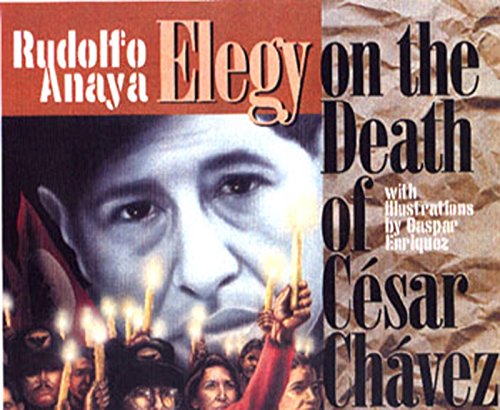
<div>The heroic life of labor and civil rights activist César Chavéz greatly influenced the political and creative thinking of famed Chicano novelist Rudolfo Anaya. After Chavéz’ death in 1992, Anaya wrote this poem eulogizing the man and his life’s work. Echoing Shelley’s elegy on the death of John Keats, the poem expresses the grief of la gente, but closes by calling all peoples together to continue the non-violent struggle for freedom and justice. The book—endorsed by the César Chavéz Foundation—includes an essay by Anaya detailing the effect that Chavéz had on his own vision and a chronology of Chavéz’ life. Powerful super realistic illustrations by Gaspar Enriquez bring home the significance of César Chavéz to the American cultural landscape.<br><br>"César Chavéz’ accomplishments in fighting for the rights of farm workers, civil rights, environmental justice, and non-violence stand next to two of the 20th century's greatest leaders—Mahatma Gandhi and Dr. Martin Luther King Jr."—Carlos Santana<br><br><b>Rudolfo Anaya</b> (his classic novel <i>Bless Me, Ultima</i> has 1,000,000-plus in print) has earned international acclaim for his skillful mingling of realism, fantasy and myth while exploring the experiences of Hispanics in the American Southwest. Besides being the author of numerous novels and children’s books, Mr. Anaya has been called "the godfather of Chicano literature" and "un hijo del pueblo" for his work as an activist for the literature of his people and his region. He lives in Albuquerque, New Mexico.<br><br>Artist <b>Gaspar Enriquez</b> is nationally known for his super-realistic, airbrush paintings of young men and women from the barrios of his hometown El Paso. Using the same technique, he collaged images of César Chavéz, farm workers, police, newspaper article, fields of grapes and icons of La Raza and Aztlán to create the ambiance of the life and times of this hero.</div>
"synopsis" may belong to another edition of this title.
About the Author
<div>GASPAR ENRIQUEZ, whose super-realistic paintings are exhibited all over the country, was born and grew up on the south side of El Paso, Texas. He illustrated Elegy on the Death of César Chávez by Rudolfo Anaya. He lives in San Elizario, a small village near the border of the United States and Mexico, in a 250-year-old house built by his wife's great-great grandfather. He has a fine arts degree from the University of Texas at El Paso and a master's degree from New Mexico State University. He is an art instructor at Bowie High School in El Paso. In 1994, he received a Mid-America Arts Alliance Fellowship. His work was included in the important and ground-breaking Chicano Art / Resistance and Affirmation show that traveled throughout the United States in the early 90s.</div>
From the Inside Flap
Rudolfo Anaya s elegy captures in beautiful metaphors the emotions of pain and grief felt with the loss of César and the abysmal emptiness of his absence. It captures the love of farm workers and the Latino community, all who yearn for justice and for this irreplaceable hero. César s life, as the elegy describes, is the lucero, the light that provides vision to the path, with the glow of energy generated by the struggle. This elegy invites all to march in César s path, to attain the hope and promise of his legacy a legacy made simple by César so everyone can participate in the quest for justice. César s lucero spotlighted the attainable victory, the solution to end the suffering of farm workers, a union, the farm workers house of justice, where those that feed the world can end their suffering and have a final voice over their lives and destinies. Dolores Huerta
César Chávez accomplishments in fighting for the rights of farm workers, civil rights, environmental justice, and non-violence stand next to two of the 20th century's greatest leaders Mahatma Gandhi and Dr. Martin Luther King Jr. Carlos Santana
Reviews
Gr 4-7-This poetic expression of mourning and hope is a heartfelt commentary on history and greatness. Anaya tells about the life of this crusader for justice and how his ideals shaped his life's work. Ch vez's impact on both the Hispanic community and American society is made manifest by repeated expressions of grief and loss, and by the final conclusion that, despite his death, his work goes on. Skillful use of meter and repetition give the text a mesmerizing formality that imparts the gravity of Ch vez's labor and magnitude of his loss. It is perfectly matched by Enriquez's accomplished mixed-media collages. Photographs and watercolor paintings are skillfully combined with handmade-paper backgrounds to produce arresting images. A page of text faces each illustration; each of these pages is ornamented with a small insert from the facing collage along with one line of the text in enlarged typeface, creating a poem within a poem. Comparable to Alma Flor Ada's Gathering the Sun (Lothrop, 1997) in poetic and artistic power, this fine example of elegiac verse serves both poetry and biography well, while elucidating the struggles of migrant workers in this country.-Ann Welton, Terminal Park Elementary School, Auburn, WA
Copyright 2001 Cahners Business Information, Inc.
Chicano novelist Anaya pens an impassioned poem about the legendary labor leader (1927-1993) that gets bogged down in flowery metaphors. Anaya depicts Ch vez as "a wind of change" whose name is "a soft breeze to cool the campesino's sweat," and describes Ch vez's opponents as "arrogant hounds of hate" living in "a land grown fat with greed." The verses move from grief to hope to a rousing call to action, honoring Ch vez's words in a refrain ("Rise, mi gente, rise!"), and are most effective when rooted in the specific (references to the San Joaqu!n Valley and Sacramento where he organized members of the National Farm Workers Assoc., etc.). The abstract imagery unfortunately detracts from the poem's main thrust ("The future opens itself like the blossom/ That is his soul, the fruit of his labor./ He calls for us to share in the fruit"), and most of the facts are relegated to a note from the author and a chronology at the end. Threaded through with Christ imagery and references to Shakespeare and Shelley, this challenging workAdespite its picture-book formatAmay be best suited for middle and high school-age students. Enriquez's surreal collage illustrations, presented as a series of old snapshots, convey interesting details but lack subtlety: Ch vez marches through oversize heads of lettuce, followed by a crowd of boycotters; the tendrils from a cluster of grapes twine around a policeman's gun as well as his handcuffed captive's wrists. A timeline poster on the back of the dust jacket captures key events in Ch vez's life. Ages 9-12. (Nov.)
Copyright 2000 Reed Business Information, Inc.
Gr. 4-7. With a poem modeled on elegies by Shelley and Whitman, Anaya commemorates the passing of respected labor activist Chavez: "This earth he loved so well is dry and mourning / For Cesar has fallen, our morning star has fallen." Gaspar Enriquez's murallike collages juxtapose significant images, including portraits of adults and children, banners, guns, and grapes, for a running nonverbal commentary on the symbols and events that marked Chavez's struggle for justice. Using Chavez's words, "Rise, mi gente, rise!" Anaya exhorts readers to carry on that struggle, then closes with an uplifting biographical afterword and a detailed chronology. Many books chronicle Chavez's achievements, but this vividly evokes the powerful feelings of love and outrage that he was able to raise in his admirers. John Peters
Copyright © American Library Association. All rights reserved
"About this title" may belong to another edition of this title.
Search results for An Elegy on the Death of Cesar Chavez: By Rudolfo Anaya...

Stock Image
An Elegy on the Death of Cesar Chavez
Seller: World of Books (was SecondSale), Montgomery, IL, U.S.A.
Seller rating 5 out of 5 stars

Condition: Good. Enriquez, Gaspar (illustrator). Item in good condition. Textbooks may not include supplemental items i.e. CDs, access codes etc. Seller Inventory # 00104210936
Stock Image
An Elegy on the Death of Cesar Chavez
Published by
Cinco Puntos Press (edition 0), 2000
ISBN 10: 0938317512
ISBN 13: 9780938317517
Used
Hardcover
Seller: BooksRun, Philadelphia, PA, U.S.A.
Seller rating 5 out of 5 stars
Hardcover. Condition: Very Good. Enriquez, Gaspar (illustrator). 0. It's a well-cared-for item that has seen limited use. The item may show minor signs of wear. All the text is legible, with all pages included. It may have slight markings and/or highlighting. Seller Inventory # 0938317512-8-1
Stock Image
Elegy on the Death of C� sar Ch�¡vez
Published by
Lee & Low Books, Incorporated, 2000
ISBN 10: 0938317512
ISBN 13: 9780938317517
Used
Hardcover
Seller: Better World Books, Mishawaka, IN, U.S.A.
Seller rating 5 out of 5 stars
Condition: Good. Enriquez, Gaspar (illustrator). 0th Edition. Former library copy. Pages intact with minimal writing/highlighting. The binding may be loose and creased. Dust jackets/supplements are not included. Includes library markings. Stock photo provided. Product includes identifying sticker. Better World Books: Buy Books. Do Good. Seller Inventory # 3650539-75
Stock Image
Elegy on the Death of CÃÆ'àsar ChÃÆ'ávez
Seller: Better World Books: West, Reno, NV, U.S.A.
Seller rating 5 out of 5 stars
Condition: Good. 0th Edition. Pages intact with minimal writing/highlighting. The binding may be loose and creased. Dust jackets/supplements are not included. Stock photo provided. Product includes identifying sticker. Better World Books: Buy Books. Do Good. Seller Inventory # 3650538-75
Stock Image
Elegy on the Death of Cesar Chavez
Seller: ThriftBooks-Dallas, Dallas, TX, U.S.A.
Seller rating 5 out of 5 stars
Hardcover. Condition: Very Good. No Jacket. Enriquez, Gaspar (illustrator). Former library book; May have limited writing in cover pages. Pages are unmarked. ~ ThriftBooks: Read More, Spend Less. Seller Inventory # G0938317512I4N10
Stock Image
Elegy on the Death of Cesar Chavez
Seller: ThriftBooks-Atlanta, AUSTELL, GA, U.S.A.
Seller rating 5 out of 5 stars
Hardcover. Condition: Very Good. No Jacket. Enriquez, Gaspar (illustrator). Former library book; May have limited writing in cover pages. Pages are unmarked. ~ ThriftBooks: Read More, Spend Less. Seller Inventory # G0938317512I4N10
Stock Image
Elegy on the Death of Cesar Chavez
Seller: ThriftBooks-Atlanta, AUSTELL, GA, U.S.A.
Seller rating 5 out of 5 stars
Hardcover. Condition: Very Good. No Jacket. Enriquez, Gaspar (illustrator). May have limited writing in cover pages. Pages are unmarked. ~ ThriftBooks: Read More, Spend Less. Seller Inventory # G0938317512I4N00
Stock Image
An Elegy on the Death of Cesar Chavez: By Rudolfo Anaya ; Illustrations by Gaspar Enriquez
Published by
Cinco Puntos Press,U.S., 2000
ISBN 10: 0938317512
ISBN 13: 9780938317517
Used
Hardcover
Seller: World of Books Inc, Montgomery, IL, U.S.A.
Seller rating 4 out of 5 stars

Hardback. Condition: Good. Enriquez, Gaspar (illustrator). A full-color picture book illustrating Rudolfo Anaya's poetic tribute to Cesar Chavez, an American hero. Seller Inventory # CIN0938317512G
Stock Image
An Elegy on the Death of Cesar Chavez
Seller: Robinson Street Books, IOBA, Binghamton, NY, U.S.A.
Seller rating 4 out of 5 stars
Hardcover. Condition: As New. Enriquez, Gaspar (illustrator). Prompt Shipment, shipped in Boxes, Tracking PROVIDEDNear fine in near fine dust jacket. First edition. Seller Inventory # Bing61760
Seller Image
ELEGY ON THE DEATH OF CESAR CHAVEZ
Published by
Cinco Puntos Press, El Paso,TX, 2000
ISBN 10: 0938317512
ISBN 13: 9780938317517
Used
Hardcover
First Edition
Seller: Bookfever, IOBA (Volk & Iiams), Ione, CA, U.S.A.
Seller rating 5 out of 5 stars
Condition: FINE. First printing. An account of the life and the accomplishments of Cesar Chavez (1927-1993) in fighting for the rights of farmworkers, for civil rights and environmental justice, written for older children and young adults. Illustrations by Gaspar Enriquez. Oblong format. 32 pp. The verso of the dustjacket is a poster with an illustrated chronology of events in the life of Chavez. Fine in glossy illustrated boards in a near fine dust jacket. Seller Inventory # 89419