
Items related to Golfer's Guide to Gardening
Synopsis
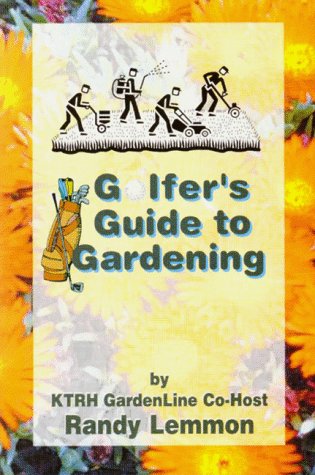
Tells the absolute easiest flowers, trees and shrubs to plant and maintain for extra time to enjoy other activities and still have the most beautiful yard in the neighborhood. The easy month-by-month planning guide insures you will always know when to fertilize, prune, or spray whatever you have in your yard.
"synopsis" may belong to another edition of this title.
About the Author
Born in Whittier, California in 1962, Randy's family moved to Houston when he was five. His father was a Mechanical Engineer and his mom, a housewife. Randy's mom loved gardening and took a lot of pride in the uniqueness of her back yard. Her wish was that everyone who visited felt they were in a Better Homes & Garden setting. One sister, Terri, is married and lives in Pearland. Randy attended Robert E. Lee high school in Houston and Texas A&M University where he received his first degree in Broadcast Journalism. He returned to A&M to work for the College of Agriculture and Life Sciences to produce radio and television material, where he also garnered his Masters degree in Agriculture. Part of his job was a spokesperson for the college where he researched and disseminated information on topics like Africanized Honey Bees and Red Imported Fire Ants. He also produced radio and television pieces on everything from beef cattle to horticulture. In 1986 He worked with Bill Zak and Ben Oldag, who then had the KTRH garden show. When Bill Zak retired in December of 1995, John Burrow suggested Randy as a replacement. Now, he and John have formed a new, exciting team. Judging from ratings and the number of advertisers, they are doing an exceptional job.
From the Back Cover
The absolute easiest flowers, shrubs and trees to plant and maintain -- Ten best trees -- Beautiful annuals -- Mulching materials -- Best shrubs -- Soils -- Native Texas plants -- Lawns -- Month by month things to do
Excerpt. © Reprinted by permission. All rights reserved.
Chapter 2: For most gardeners, annuals mean flowers. Or put another way, they are the ones we plug into a swath of the landscape one or two times a year. But a varied use of annuals is not only aesthetically pleasing, it?s one of the easiest things we can do to the garden, because they grow so profusely and are relatively easy to care for. Let?s talk about annuals. Most annuals are known by horticulturists to spend their entire growing season producing seeds, which, in our landscape, don't always come back. That's why growing annuals is such an interesting proposition for us in this area. While we want the color a couple of times each year, we don't like the idea of reinvesting. Personally, I think it's worth it. And I'm here to tell you that you can spend far less than one hundred dollars each year on a 4x10' square color pocket. There are three distinctive growing seasons here, which makes annuals the most flexible plant material we can work with. Why should we plant annual X every February, annual Y every June and annual Z each November? Because, these are the three best times to cycle out annuals, but do they always have to be in X-Y-Z order? The hardest thing to remember about annuals is how color relationships work. Just because you like this color and that color, doesn't mean they're going to necessarily "work" in your garden. That's because some colors clash and some colors complement each other. If you were to pick out an orange Gerber Daisy, it falls on the color wheel as a warm color?- which is a feeling, not physiological property. A blue/violet flower thus falls on the cool feeling color of a color wheel. The reason this is important is because annual colors need be the opposite of the warm or cool color of your house, deck or window sill. Another way to explain this is if you have a warm colored brick house, a bunch of warm colors like red, yellow and orange make the area even warmer. If you planted violets, blues, yellows or pastels against that warm brick or wood, you now have a considerably cooler feeling that will be much more inviting. Another important consideration is: to the eye, cool colors tend to recede, and warm colors tend to advance; warm colors stand out and shout, helping to bring a distant part of the yard into sharper focus. Generally speaking, cool colors are good for close-up viewing and warm colors are good for dramatic displays further away.
"About this title" may belong to another edition of this title.
Search results for Golfer's Guide to Gardening

Stock Image
Golfer's Guide to Gardening
Seller: HPB-Diamond, Dallas, TX, U.S.A.
Seller rating 5 out of 5 stars

paperback. Condition: Very Good. Connecting readers with great books since 1972! Used books may not include companion materials, and may have some shelf wear or limited writing. We ship orders daily and Customer Service is our top priority! Seller Inventory # S_395738588
Stock Image
Golfer's Guide to Gardening
Seller: HPB-Ruby, Dallas, TX, U.S.A.
Seller rating 5 out of 5 stars
paperback. Condition: Very Good. Connecting readers with great books since 1972! Used books may not include companion materials, and may have some shelf wear or limited writing. We ship orders daily and Customer Service is our top priority! Seller Inventory # S_470625829
Stock Image
Golfer's Guide to Gardening
Seller: Orion Tech, Kingwood, TX, U.S.A.
Seller rating 5 out of 5 stars
paperback. Condition: Very Good. Seller Inventory # 0943629284-2-33572361
Stock Image
Golfer's Guide to Gardening
Seller: Gulf Coast Books, Cypress, TX, U.S.A.
Seller rating 5 out of 5 stars
Paperback. Condition: Very Good. Seller Inventory # 0943629284-2-18886847
Stock Image
Golfer's Guide to Gardening
Seller: Your Online Bookstore, Houston, TX, U.S.A.
Seller rating 5 out of 5 stars
paperback. Condition: Very Good. Seller Inventory # 0943629284-2-35036665
Stock Image
Golfer's Guide to Gardening
Seller: Orion Tech, Kingwood, TX, U.S.A.
Seller rating 5 out of 5 stars
paperback. Condition: Fair. Seller Inventory # 0943629284-4-36643846
Stock Image
Golfer's Guide to Gardening
Seller: ThriftBooks-Dallas, Dallas, TX, U.S.A.
Seller rating 5 out of 5 stars
Paperback. Condition: Good. No Jacket. Pages can have notes/highlighting. Spine may show signs of wear. ~ ThriftBooks: Read More, Spend Less. Seller Inventory # G0943629284I3N00
Stock Image
Golfer's Guide to Gardening
Seller: Your Online Bookstore, Houston, TX, U.S.A.
Seller rating 5 out of 5 stars
paperback. Condition: New. Seller Inventory # 0943629284-11-29500173
Seller Image
Golfer's Guide to Gardening
Seller: ThriftBooksVintage, Tukwila, WA, U.S.A.
Seller rating 5 out of 5 stars
Paperback. Condition: Very Good. No Jacket. Later printing. Minor shelf and handling wear, overall a clean solid copy with minimal signs of use. CLEAN CONTENT PAGES. Secure packaging for safe delivery. Seller Inventory # 833209445