Items related to Reinventing a Continent: Writing and Politics in South...
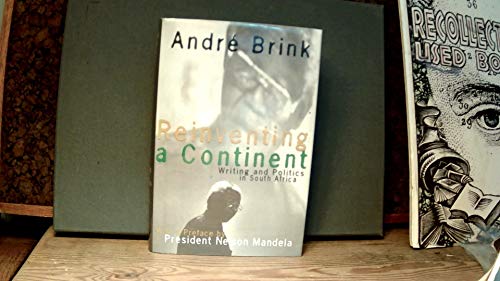
Synopsis
Ranging in tone from dispassionate historical overview to bare-knuckles polemic, these essays chronicle South Africa's willful transformation from repressive police state to emerging democracy.
"synopsis" may belong to another edition of this title.
From Kirkus Reviews
Like slightly stale bread, these essays (most from the 1980s and early 1990s) by one of South Africas leading novelists examining the role of that countrys literature have seen better days. The end of apartheid struck South African artists particularly hard, remarks Brink. So much of their work had been premised on bravely decrying myriad injustices, on supporting the ``struggle'' as a weapon of liberation. Within these confines, hemmed in by censorship and oppression, extraordinary creativity flourished. But as Brink (Imaginings of Sand, 1996, etc.) notes, ``imagination remained predicated on the presence of prison bars.'' As soon as the bars started to lift, many artists were overwhelmed by the burden of freedom. But Brink is an optimist. Unlike some of his contemporaries, he has avoided the deconstructionist obscurity or thinly veiled despair that characterizes so much white South African writing today. In fact, many of these essays revolve around potential new directions and roles for art. He goes as far as to compare apartheids end to photographys freeing of 19th-century painting from the constraints of realism. Other essays are taken up with that perennial big issue: the role of art and the artist in societyespecially a society where art, at first glance, looks like a luxury. Brink also examines Afrikaner society, rugby, and the minutiae of political developments. There are some embarrassingly adulatory encomiums to the African National Congress and its various politicos (though his accolades from the 1990s are a little more evenhanded). Brink has a clear and forceful, passionate style. But unlike an Orwell or a Greene, he is unable to transform the timeliness of most of these essays into something more timeless. Nelson Mandela contributes the books preface. As a record of liberal white South African thought ten years ago, this is a peerless collection, but by almost any other criteria, most of these essayswith a few notable exceptionsare fast slipping into irrelevance. -- Copyright ©1998, Kirkus Associates, LP. All rights reserved.
From Publishers Weekly
In essays spanning the turbulent period 1982-97, South African novelist Brink (The Ambassador) explores his country's transformation from racist pariah to multiracial democracy. Brink is primarily concerned here with the role of the writer in an unjust society and the role of literature in combating oppression. He is at his most convincing when discussing concrete events and people. His essay on Afrikaners?"the white tribe of Africa," descendants of the Dutch colonists who settled South Africa?is keen and sympathetic, though hardly uncritical. Brink's piece on the freeing of Nelson Mandela conveys the excitement and anticipation of that historical moment. Reflecting on the situation in his troubled homeland leads Brink to ask profound questions: If all power corrupts, as he believes it does, how can a writer marshal the "power of the word" in the quest for justice? How do writers who have dedicated their lives and careers to the struggle against apartheid find their voice following its demise? Unfortunately, the caliber of the essays varies widely. Some seem like papers presented at an academic conference, filled with dizzying abstractions ("Violence is the language culture speaks when no other valid articulation is left open to it") and citations of other works. Nevertheless, Brink provides a thoughtful and humane response to injustice. Several of these pieces were originally published in South Africa and/or in England.
Copyright 1998 Reed Business Information, Inc.
"About this title" may belong to another edition of this title.
- PublisherZoland Books
- Publication date2000
- ISBN 10 0944072895
- ISBN 13 9780944072899
- BindingHardcover
- LanguageEnglish
- Edition number1
- Number of pages288
- Rating
Search results for Reinventing a Continent: Writing and Politics in South...

Stock Image
Reinventing a Continent: Writing and Politics in South Africa 1982 - 1998
Seller: Wonder Book, Frederick, MD, U.S.A.
Seller rating 5 out of 5 stars

Condition: As New. Like New condition. Like New dust jacket. A near perfect copy that may have very minor cosmetic defects. Seller Inventory # N24L-00424
Quantity: 1 available
Stock Image
Reinventing a Continent: Writing and Politics in South Africa 1982 - 1998
Seller: Wonder Book, Frederick, MD, U.S.A.
Seller rating 5 out of 5 stars
Condition: Very Good. Very Good condition. Like New dust jacket. A copy that may have a few cosmetic defects. May also contain a few markings such as an owner's name, short gifter's inscription or light stamp. Seller Inventory # K11A-02475
Quantity: 1 available
Stock Image
Reinventing a Continent: Writing and Politics in South Africa 1982 - 1998
Published by
Zoland Books (edition First U.S. Edition), 2000
ISBN 10: 0944072895
ISBN 13: 9780944072899
Used
Hardcover
Seller: BooksRun, Philadelphia, PA, U.S.A.
Seller rating 5 out of 5 stars
Hardcover. Condition: Good. First U.S. Edition. Ship within 24hrs. Satisfaction 100% guaranteed. APO/FPO addresses supported. Seller Inventory # 0944072895-11-1
Quantity: 1 available
Stock Image
Reinventing a Continent: Writing and Politics in South Africa 1982-1998
Seller: ThriftBooks-Atlanta, AUSTELL, GA, U.S.A.
Seller rating 5 out of 5 stars
Hardcover. Condition: Very Good. No Jacket. May have limited writing in cover pages. Pages are unmarked. ~ ThriftBooks: Read More, Spend Less 1.1. Seller Inventory # G0944072895I4N00
Quantity: 1 available
Stock Image
Reinventing a Continent: Writing and Politics in South Africa 1982 - 1998
Seller: HPB-Movies, Dallas, TX, U.S.A.
Seller rating 4 out of 5 stars

hardcover. Condition: Very Good. Connecting readers with great books since 1972! Used books may not include companion materials, and may have some shelf wear or limited writing. We ship orders daily and Customer Service is our top priority! Seller Inventory # S_402502627
Quantity: 1 available
Stock Image
Reinventing a Continent: Writing and Politics in South Africa 1982 - 1998
Seller: Midtown Scholar Bookstore, Harrisburg, PA, U.S.A.
Seller rating 5 out of 5 stars
Hardcover. Condition: Very Good. crisp clean w/light shelfwear/edgewear - may have remainder mark Standard-sized. Seller Inventory # 0944072895-01
Quantity: 1 available
Stock Image
Reinventing A Continent Writing and Politics in South Africa
Published by
Zoland Books, Cambridge, MA, 1998
ISBN 10: 0944072895
ISBN 13: 9780944072899
Used
Hardcover
First Edition
Seller: Willis Monie-Books, ABAA, Cooperstown, NY, U.S.A.
Seller rating 5 out of 5 stars
Hardcover. Condition: Very Good. Dust Jacket Condition: Very Good. 1st US Printing. . 5cm chip at bottom of spine in book and dust jacket. Seller Inventory # 29543
Quantity: 1 available
Stock Image
Reinventing a Continent: Writing and Politics in South Africa 1982 - 1998
Published by
Zoland Books August 2000, 2000
ISBN 10: 0944072895
ISBN 13: 9780944072899
Used
Hardcover
Seller: Montclair Book Center, Montclair, NJ, U.S.A.
Seller rating 5 out of 5 stars
Hardcover. Condition: USED Good. Seller Inventory # 547823
Quantity: 1 available
Stock Image
Reinventing a Continent: Writing and Politics in South Africa 1982 - 1998
Seller: Chaparral Books, Portland, OR, U.S.A.
Seller rating 5 out of 5 stars
Hardcover. Condition: Very Good. Dust Jacket Condition: Very Good. First U.S. Edition. The binding is tight, corners sharp. Text and images are unmarked. The dust jacket shows some light general handling, in a mylar cover. xiv, 274pp. Seller Inventory # NOWbriRC
Quantity: 1 available
Stock Image
Reinventing a Continent: Writing and Politics in South Africa 1982 - 1998
Seller: MusicMagpie, Stockport, United Kingdom
Seller rating 5 out of 5 stars
Condition: Very Good. 1710277577. 3/12/2024 9:06:17 PM. Seller Inventory # U9780944072899
Quantity: 1 available