
Items related to Rheumatoid Arthritis the Infection Connection: Targeting...
Rheumatoid Arthritis the Infection Connection: Targeting and Treating the Cause of Chronic Ilness - Softcover
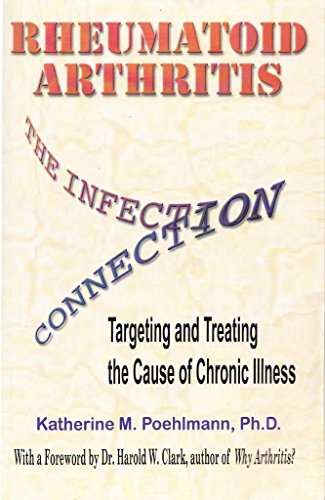
Synopsis
Foreword by Dr. Harold Clark, author of "Why Arthritis?" and lab manager for Dr. Thomas McPherson Brown, author of "The Road Back."
Appendices by Dr. Joseph Mercola, D.O. (www.mercola.com) and Dr. Garth Nicolson (www.immed.org)
IN THIS BOOK YOU WILL DISCOVER:
-- Actions of microorganisms that cause RA-mycoplasmas, mycobacteria, molds, spirochetes (e.g., Lyme), viruses, bacteria and their cell wall deficient L-forms;
-- Their role in other chronic illnesses with arthritis-like symptoms such as Fibromyalgia, Lupus, Multiple Sclerosis, and Chronic Fatigue Syndrome;
-- Online authoritative medical information and support organizations;
-- The best Internet sites to research health, drugs, treatments, and disease;
-- What diagnostic tests are available and where to get them;
AND LEARN WAYS TO:
-- Recognize and suppress pathogenic microorganisms;
-- Destroy or eliminate the toxins they produce;
-- Control the allergies that trigger RA reactions;
-- Strengthen the immune system using natural, non-toxic methods;
-- Locate a health care professional to work with you.
Conventional RA treatments include toxic drugs that reduce painful symptoms but do not treat the root cause, namely, bacterial infection. An immune system weakened by drugs (e.g., antidepressants or antihistamines), improper diet, stress, and multiple infections is unable to produce the quantity and quality of natural antibodies to stave off new attacks.
This book describes the steps necessary to:
-- Identify, attack, and remove the cause(s) of the infection(s);
-- Neutralize pathogen-generated wastes (toxins and harmful enzymes);
-- Flush these wastes from the body; and
-- Restore the body's systems to normal, healthy function.
*******************************
Until recently, testing methods to identify these microorganisms precisely and to prescribe effective treatments have not been available. Traditional treatments with immunosuppressing drugs often breed stronger, more resistant bacterial organisms, which mutate and grow, overwhelming the immune system's resources. Undiagnosed food and chemical allergies can also amplify the severity of arthritis symptoms. In this book, both the lay reader and physician will find an effective course of treatment possibly leading to a cure for RA and other chronic illnesses with arthritis-like symptoms.
FOR REVIEWS:
http://www.amazon.com/Rheumatoid-Arthritis-Infection-Connection-Targeting/dp/0961726865
Other descriptions are found at our website:
URL = www.ra-infection-connection.com
For those who wish to buy this 2nd edition in quantities for bulk/drop shipments: See our website, URL above.
"synopsis" may belong to another edition of this title.
About the Author
Dr. Katherine Poehlmann is a professional researcher and a systems engineer with a magna cum laude degree in mathematics and an MBA with a specialty in technology management. She has authored more than a dozen scientific reports on space technology, defense policy analysis, and aircraft logistics.
She used her research skills, honed at the RAND Corporation as a senior analyst from 1984-1994, to obtain a Ph.D. in health counseling in 1997. The goal was to find the cause of a debilitating case of rheumatoid arthritis (RA) which developed in both ankles soon after a fall down stairs. She saw that the usual course of treatment involved using powerful drugs with harmful side effects. These medications only masked the painful RA symptoms but did not target the root cause of the RA condition. Although her research began with a study of RA, she soon realized that many other chronic illnesses could be traced to bacterial infection as either a cause or co-factor. This led to the comprehensive analysis presented in her book.
Dr. Poehlmann has progressed from being "25% disabled," as determined by several physicians and rheumatologists in 1993, to being completely ambulatory and pain-free, using the regimen described in this book. She became a certified hypnotherapist in order to learn techniques for stress control and pain management and teach them to others.
Since recovery from RA, she has hiked in Tibet, Chile, and over sections of the Great Wall of China.
Excerpt. © Reprinted by permission. All rights reserved.
We know from the study of many forms of life that metamorphic changes during the lifespan of an organism run from initial seed through several shape and structure changes, with interim stable forms that adapt to the particular life phase and to the environment, and then change back to seed form again. This ability to alter shape and structure is called pleomorphism. It is probably the combined result of evolution and the many climatic and environmental changes the evolving organism has faced and to which it has had to adapt over hundreds of millions of years and perhaps trillions of trillions of generations. Thus, the vulnerability of one shape or form to an attack or environment change can be circumvented by a shape change so that the organism will evolve specific R-factors to ensure resistance to an attack.
In the laboratory, L-forms so closely resemble mycoplasmas because both lack cell walls that at one time all mycoplasmas were referred to as L-form bacteria. We know now that mycoplasmas have no enzymes, a feature required to transition to an L-form.
We carry mycoplasmas and L-forms with us as remnants of childhood infections such as pneumonia, strep throat, bronchitis, rheumatic fever, or other early illnesses. Mycoplasmas are not viruses, since they do not require living cells in which to grow. Mycoplasmas are included within a separate class (Mollicutes) of bacteria because they have lost the ability to develop a cell wall. This makes them harder to see and much harder to culture in vitro. They are specifically adapted to certain cellular environments by their genetic nature, which is quite robust in its complexity, having adapted and evolved over millions of years. Micro-organisms such as mycoplasmas often lie dormant, waiting for conditions to be favorable for propagation. This would explain conditions such as rheumatoid arthritis, Chronic Fatigue Syndrome (CFS), or Gulf War Illness, which seem to strike suddenly.
It is not necessary for the whole mycoplasma microorganism to be present for a reaction in a joint or tissue to be provoked. Mere fragments are sufficient to create a powerful antigenic reaction that causes the body to produce antibodies to counter it. These antigens are constructed by the host s cells from bits of pathogenic protein and cellular proteins called major histocompatibility complex (MHC) molecules. The processing and assembly of antigens are the keys to understanding the flexibility, specificity, and thor-oughness of all immune responses. The antibody reaction may be mainly against a "host antigen" carried on the mycoplasmal membrane.
Affinity of mycoplasmas or L-forms of cellular bacteria for the tissue and fluid of the joints has been recognized since the 1890s. Experiments by Dr. Thomas McPherson Brown and Jack Nunemaker in the 1930s demonstrated that the L-form they studied was a variant of the Streptobacillus organism. The cellular bacteria was able to lose its capsule and cell wall and enter a state in which it could become invisible, pass through a filter, and return to the parent form, re-growing its cell walls. Chlamydia is another example of a bacterial organism capable of both walled and wall-less states. L-forms can reproduce but the rates are slower than that of the cellular form.
This cloaking capability explains how L-forms are able to "go underground," transmutate, and reemerge after the immune system attack on the bacterial form has subsided, returning to assault injured cells aggressively. An immune system weakened by addictive drugs, anti-depressants, or improper diet is unable to produce the quantity and quality of natural antibodies to stave off this new attack.
Studies in 1994-1996 on ear infections in children concluded that L-forms as atypical forms of bacteria may play an important role in the bacteriologic aspect of secretory Otitis media. Both Turkish and New Zealand research groups point out the failure of conventional culture methods to identify the responsible pathogen(s). Further, the researchers admit that some agents are capable of changing bacterial behavior and consequently the clinical course of action. A Russian study identified persistent forms of bacteria that performed antigenic mimicry or otherwise protected themselves against the host s immune system response.
These studies indicate that a comprehensive reexamination of L-forms is long overdue. This could open up a whole new field of infectious-disease pathology where new methods are developed for the isolation and identification of causative agents in bacterial infections.
"About this title" may belong to another edition of this title.
Search results for Rheumatoid Arthritis the Infection Connection: Targeting...

Seller Image
Rheumatoid Arthritis the Infection Connection: Targeting and Treating the Cause of Chronic Ilness
Seller: Zoom Books Company, Lynden, WA, U.S.A.
Seller rating 5 out of 5 stars

Condition: very_good. Book is in very good condition and may include minimal underlining highlighting. The book can also include "From the library of" labels. May not contain miscellaneous items toys, dvds, etc. . We offer 100% money back guarantee and 24 7 customer service. Seller Inventory # ZBV.0961726865.VG
Stock Image
Rheumatoid Arthritis the Infection Connection: Targeting and Treating the Cause of Chronic Ilness
Seller: World of Books (was SecondSale), Montgomery, IL, U.S.A.
Seller rating 5 out of 5 stars
Paperback. Condition: Very Good. Seller Inventory # CIN0961726865VG
Stock Image
Rheumatoid Arthritis the Infection Connection: Targeting and Treating the Cause of Chronic Ilness
Seller: World of Books (was SecondSale), Montgomery, IL, U.S.A.
Seller rating 5 out of 5 stars
Paperback. Condition: Good. Seller Inventory # 00105358998
Stock Image
Rheumatoid Arthritis the Infection Connection: Targeting and Treating the Cause of Chronic Ilness
Published by
Satori Press (edition ), 2012
ISBN 10: 0961726865
ISBN 13: 9780961726867
Used
Paperback
Seller: BooksRun, Philadelphia, PA, U.S.A.
Seller rating 5 out of 5 stars
Paperback. Condition: Very Good. It's a well-cared-for item that has seen limited use. The item may show minor signs of wear. All the text is legible, with all pages included. It may have slight markings and/or highlighting. Seller Inventory # 0961726865-11-22
Stock Image
Rheumatoid Arthritis the Infection Connection: Targeting and Treating the Cause of Chronic Ilness
Published by
Satori Press (edition ), 2012
ISBN 10: 0961726865
ISBN 13: 9780961726867
Used
Paperback
Seller: BooksRun, Philadelphia, PA, U.S.A.
Seller rating 5 out of 5 stars
Paperback. Condition: Very Good. It's a well-cared-for item that has seen limited use. The item may show minor signs of wear. All the text is legible, with all pages included. It may have slight markings and/or highlighting. Seller Inventory # 0961726865-11-1
Seller Image
Rheumatoid Arthritis the Infection Connection: Targeting and Treating the Cause of Chronic Ilness
Seller: Greenworld Books, Arlington, TX, U.S.A.
Seller rating 5 out of 5 stars
Condition: like_new. Fast Free Shipping â" Excellent condition book with clean cover and pages. Barely handled, with minimal wear. An outstanding copy, close to enjoy! Seller Inventory # GWV.0961726865.LN
Stock Image
Rheumatoid Arthritis: The Infection Connection {Targeting and Treating the Cause of Chronic Illness}
Seller: HPB-Diamond, Dallas, TX, U.S.A.
Seller rating 5 out of 5 stars
Paperback. Condition: Very Good. Connecting readers with great books since 1972! Used books may not include companion materials, and may have some shelf wear or limited writing. We ship orders daily and Customer Service is our top priority! Seller Inventory # S_456716867
Stock Image
Rheumatoid Arthritis the Infection Connection: Targeting and Treating the Cause of Chronic Ilness
Seller: HPB-Ruby, Dallas, TX, U.S.A.
Seller rating 5 out of 5 stars
Paperback. Condition: Very Good. Connecting readers with great books since 1972! Used books may not include companion materials, and may have some shelf wear or limited writing. We ship orders daily and Customer Service is our top priority! Seller Inventory # S_459053601
Stock Image
Rheumatoid Arthritis the Infection Connection: Targeting and Treating the Cause of Chronic Ilness
Seller: World of Books Inc, Montgomery, IL, U.S.A.
Seller rating 4 out of 5 stars

Paperback. Condition: Good. Seller Inventory # CIN0961726865G
Stock Image
Rheumatoid Arthritis the Infection Connection: Targeting and Treating the Cause of Chronic Ilness
Seller: World of Books Inc, Montgomery, IL, U.S.A.
Seller rating 4 out of 5 stars
Paperback. Condition: Very Good. Seller Inventory # CIN0961726865VG