Items related to Doris Day and Kitschy Melodies
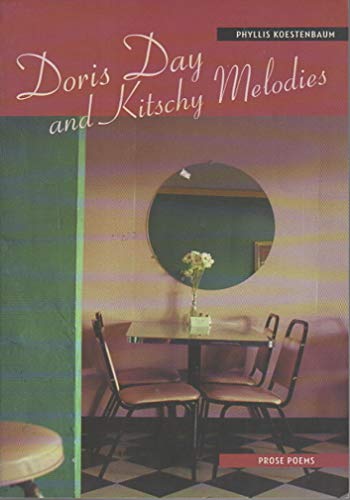

Doris Day and Kitschy Melodies is a book of prose poems that captures the reader as a novel would. The book is full of the quirky details of life and memory. The book covers the author's life from World War II until the 1990's.
"synopsis" may belong to another edition of this title.
About the Author:
Koestenbaum, a native of Brooklyn, is the author of seven poetry books and chapbooks. Her awards include fellowships from the National Endowment for the Arts, and the Arts Council of Santa Clara County among others. Koestenbaum is a senior scholar at the Institute for Research on Women and Gender, Stanford University, California.
From Publishers Weekly:
The details of a richly recalled life mingle with more abstract speculation about memory, gender and reading in these pleasantly associative, and occasionally striking, prose poems. Though they range in subjects from Hitler to the '50s icon of the title, from nail salons and optometrists to California, Judaism, opera, Gide and the nature of consciousness, Koestenbaum's one- and two-page works share a mode of construction: flat sentences about people, places and events mingle sometimes charmingly, sometimes at random with lyrical or lightly ironic abstractions. The poems seek a tone, and a cultural space, somewhere between Grace Paley's prose and Lyn Hejinian's influential My Life, though they do not always equal those models. Koestenbaum (Criminal Sonnets) can sound unduly startled by her memories: "Patti LuPone played Maria Callas on Broadway: from nowhere comes Patti LuPone." Elsewhere she simply unrolls bits of autobiography: youthful fears of Hitler, grown-up meals in Cambridge, Mass., a cancer scare, grown sons and "the suburban neighborhood where I was a conventional mother and wife" all remain of interest in themselves, but are rarely transformed by style. (One of her sons is the poet and cultural critic Wayne Koestenbaum.) At her best, as in "Rembrandt" or "Cassandra and Irene" (from which the collection takes its title), Koestenbaum's understated prose blocks explore neat hypotheses about life stories (her own and others'): "painters on townhouses... paint and pain and talk and talk. When they've moved on to their next job, what will distract me, what outside interference that becomes as much the main narrative as the main narrative." Main or not, these narratives will find their fans.
Copyright 2001 Cahners Business Information, Inc.
"About this title" may belong to another edition of this title.
- PublisherLA Questa Pr
- Publication date2001
- ISBN 10 0964434849
- ISBN 13 9780964434844
- BindingPaperback
- Edition number1
- Number of pages82
- Rating
Top Search Results from the AbeBooks Marketplace

Stock Image
Doris Day and Kitschy Melodies
Published by
LA Questa Pr
(2001)
ISBN 10: 0964434849
ISBN 13: 9780964434844
Used
Softcover
Quantity: 1
Seller:
Rating

Book Description Condition: Very Good. paperback A well-cared-for item that has seen limited use but remains in better than average cosmetic condition. The item is complete, and without major damage. It may have limited signs of use. Packed with care, shipped promptly. Seller Inventory # Y-006-2224
Buy Used
US$ 3.99
Convert currency
Stock Image
Doris Day and Kitschy Melodies (Questa Press Poetry Series)
Published by
LA Questa Pr
(2001)
ISBN 10: 0964434849
ISBN 13: 9780964434844
Used
Softcover
Quantity: 1
Seller:
Rating
Book Description Condition: Good. Item in good condition. Textbooks may not include supplemental items i.e. CDs, access codes etc. Seller Inventory # 00054346300
Buy Used
US$ 8.87
Convert currency
Stock Image
Doris Day and Kitschy Melodies
Published by
Questa Press
(2001)
ISBN 10: 0964434849
ISBN 13: 9780964434844
Used
Paperback
Quantity: 1
Seller:
Rating
Book Description Paperback. Condition: Good. No Jacket. Pages can have notes/highlighting. Spine may show signs of wear. ~ ThriftBooks: Read More, Spend Less 0.35. Seller Inventory # G0964434849I3N00
Buy Used
US$ 8.91
Convert currency
Stock Image
Doris Day and Kitschy Melodies (Questa Press Poetry Series)
Published by
LA Questa Pr
(2001)
ISBN 10: 0964434849
ISBN 13: 9780964434844
Used
Paperback
Signed
Quantity: 1
Seller:
Rating
Book Description Paperback. Condition: Near Fine. Signed La Questa Press softcover, 2001. Near Fine, w/ clean text, tight binding, straight and uncreased spine. Light corner wear. Signed by author on title page. Free delivery confirmation. Signed by Author(s). Seller Inventory # SKU1021332
Buy Used
US$ 16.00
Convert currency
Doris Day and Kitschy Melodies (Questa Press Poetry Series)
Published by
LA Questa Press
(2001)
ISBN 10: 0964434849
ISBN 13: 9780964434844
Used
Soft cover
First Edition
Quantity: 1
Seller:
Rating
Book Description Soft cover. Condition: Very Good. 1st Edition. Book in very good condition: No markings/writings on text. All pages are clean and intact. Front and back cover in very good condition. WILL SHIP WITHIN 24-48 HOURS. Seller Inventory # 3101
Buy Used
US$ 20.64
Convert currency
Doris Day and Kitschy Melodies (Signed First Edition)
Published by
La Questa Press, Woodside, CA
(2001)
ISBN 10: 0964434849
ISBN 13: 9780964434844
Used
Softcover
First Edition
Signed
Quantity: 1
Seller:
Rating
Book Description First edition. Softcover. 82 pages. A paperback original collection of prose poems. An about near fine copy in wrappers. Signed and inscribed by Koestenbaum on the title page to poet Marie Ponsot. Also includes a laid in handwritten and signed note from Koestenbaum to Marie Ponsot as well. Seller Inventory # 177852
Buy Used
US$ 35.00
Convert currency