
Items related to Friendly Fire
Synopsis
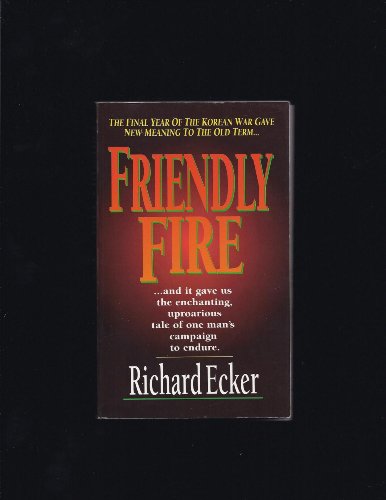
The most revealing histories of wartime are not narratives about blood and glory on the battlefields. Much more revealing are the personal stories of men engaged in the day-to- day business of survival. With humor and insight, Friendly Fire tells how that business played out for men fighting the third year of the war in Korea. A delightful tale of an unconventional hero coming of age in an unconventional war, Friendly Fire offers an irreverent and often hilarious insider's view of how military command--"The Brass" to use the author's words--carried on a war that couldn't be won.
"synopsis" may belong to another edition of this title.
About the Author
Dr. Richard Ecker is a retired medical scientist and educator now living in the Chicago area with the girl he left behind to go to war in 1952. He has published two previous books, both both related to his interest in health management, and continues an active career as consultant, author and lecturer. He also maintains the most complete and comprehensive database of U.S. Army casualties from the Korean War.
From the Back Cover
The regimental commander asked me to be at ease and take a seat.
"Lieutenant, I'd like you to take command of the regimental Intelligence and Reconnaissance Platoon. I use the I&R Platoon to carry out special missions--infiltrating enemy positions to gather intelligence and capture prisoners. The men in this platoon were all hand-picked by the former platoon leader. I believe you are the ideal man to take his place."
"Former platoon leader," I repeated to myself silently, trying not to reveal my growing apprehension. "I wonder what happened to him--as if I couldn't guess."
In the third year of the Korean War, a young army officer arrived in Korea for combat duty. He was assigned to the U.S. 31st Infantry Regiment, code name Bearcat. For almost two years he had been preparing to lead infantry soldiers in combat. Little of that training, however, had equipped him for what now awaited him as the new commander of Bearcat I&R--a unit best described in retrospect as a cross between "F-Troop" and "The Dirty Dozen."
Excerpt. © Reprinted by permission. All rights reserved.
In many ways, the third year of the Korean War was as different from the opening year of the conflict as it was different from the great world war that had come to an end seven years earlier. The soldiers who carried on this final year of the war were not battle-seasoned veterans striving to conquer an aggressor nation. They were "time-clock warriors"--reluctantly engaged in a conflict that was going nowhere and impatiently counting the days until they could earn enough rotation points to escape from the hostilities. Most of them had little interest in who--if anyone--was declared the ultimate winner.
The fighting that did occur during that year involved only small objectives--mostly individual hills. Yet none of those hills was strategic enough to make a difference in the outcome of the war. That outcome would be determined by the peace negotiators meeting at Panmunjom.
There are probably few tasks more frustrating for military commanders than to have to fight a war they are not allowed to win. And there are few circumstances more hazardous to the welfare of fighting men than to serve under combat commanders faced with that frustration. In that final year of the Korean War, this unfortunate scenario gave new meaning to the old term "friendly fire."
Friendly fire is usually understood to mean the accidental targeting of your own troops by fire that was intended for the enemy. However, during that last year of the war, such accidents were not the only threat to life and limb that our combat troops suffered at the hands of the "friendlies." All too often their greatest peril came from a military command with a lot of time on its hands and a strategic situation in which small objectives took on vastly inflated importance.
"About this title" may belong to another edition of this title.
Search results for Friendly Fire

Seller Image
Friendly Fire
Seller: Greenworld Books, Arlington, TX, U.S.A.
Seller rating 5 out of 5 stars

Condition: good. Fast Free Shipping â" Good condition. It may show normal signs of use, such as light writing, highlighting, or library markings, but all pages are intact and the book is fully readable. A solid, complete copy that's ready to enjoy. Seller Inventory # GWV.0965229106.G
Stock Image
Friendly Fire
Seller: ThriftBooks-Dallas, Dallas, TX, U.S.A.
Seller rating 5 out of 5 stars
Unknown. Condition: Good. No Jacket. Pages can have notes/highlighting. Spine may show signs of wear. ~ ThriftBooks: Read More, Spend Less. Seller Inventory # G0965229106I3N00
Stock Image
Friendly Fire Ecker, Richard E.
Published by
Omega Communications, 1999
ISBN 10: 0965229106
ISBN 13: 9780965229104
New
Mass Market Paperback
Seller: GridFreed, San Diego, CA, U.S.A.
Seller rating 5 out of 5 stars
Mass Market Paperback. Condition: New. In shrink wrap. Seller Inventory # 10-04433
Stock Image
Friendly Fire
Seller: HPB-Ruby, Dallas, TX, U.S.A.
Seller rating 5 out of 5 stars
mass_market. Condition: Very Good. Connecting readers with great books since 1972! Used books may not include companion materials, and may have some shelf wear or limited writing. We ship orders daily and Customer Service is our top priority! Seller Inventory # S_465814372