
Items related to Style Meister: The Quick-Reference Custom Style Guide
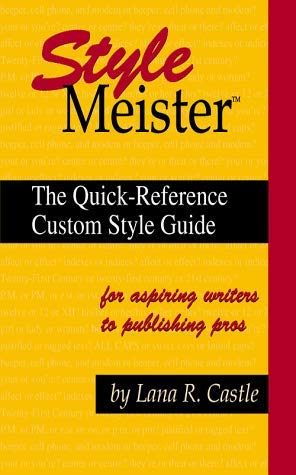
Synopsis
Writing for writers, publishing professionals, office personnel, and others who deal regularly with the written word, the author guides readers through a process to customize style for their particular audience, market, medium, organization, publication, or product. The information appears in tables which include example sentences or phrases. Annotation c. by Book News, Inc., Portland, Or.
"synopsis" may belong to another edition of this title.
About the Author
Lana Castle truly is the Style Meister! For over twenty years, she has written, edited, and produced communications in a variety of media for a variety of clients: publishers, publication service bureaus, colleges and universities, high-tech companies, medical organizations, government agencies, associations, consulting firms, and individual authors.
Ms. Castle has edited the work of more than one hundred U.S., European, Australian, and African authors. She works as a freelance writer and editor, and teaches workshops on publication topics for businesses, colleges and universities, and other organizations. Her advice column, "Style Meister," has appeared regularly in writing- and office-related publications since 1994.
From the Back Cover
A good publication style guide helps you produce consistent, professional communications. An even better guide helps you customize communications for each audience, market, medium, product, publication, or organization. That better style guide is available at last!
Style Meister
* Presents a variety of widely accepted guidelines in quick-reference format
* Steers you through the process of creating custom style guides
* Supplies tools that help you organize, communicate, and track style decisions
Excerpt. © Reprinted by permission. All rights reserved.
Why I Wrote This Book
This book evolved out of my personal frustrations. The concept began to surface when I was working at a desktop publishing bureau. Our company served a large variety of clients: high-tech firms, retail stores, colleges, government agencies, nonprofits--all with different style preferences. Like many people, I mistakenly believed that the English language involves absolute "rights" and "wrongs" (though what those rights and wrongs were wasn't always clear). I'd placed my faith in a few well-known authorities, but I soon learned the inadequacy of a "one-size-fits-all" approach to publication style. It simply didn't meet our clients' needs. Everyone had their own style preferences. Exceptions popped up in every project. How could we ever keep on top of such diversity?
We needed tools for identifying preferences, recording decisions, and communicating standards. We needed tools to help us locate answers at a glance. We needed tools to help us organize production information: page layouts, type specifications, and special formats. And, because style tends to change--even during the life of a single project--we also needed tools we could update easily.
After moving on to other jobs, I learned just how prevalent such needs are. Every new organization, new client, and new project required a new approach. The most effective communications were therefore customized.
These experiences guided the direction of this book. While you should find Style Meister informative, even entertaining, you'll gain the greatest benefit through active application--using the forms in this book and applying its information time and time again.
THE Answer
Most people I've encountered view style the way I used to--as an either/or proposition. They want THE answer to whatever question they currently confront. They seek a rule they can apply to any situation, any time. They want an authority to back up their decisions. They want certainty where certainty rarely exists.
It's time we trotted the truth out of the closet: What's "right" is simply a matter of style. Period! Often, the most honest answer to a style question is, It depends. Exceptions can emerge for any rule because what's "right" depends on the situation--especially in this age of global communications and accelerated change. The truth is, THE answer varies with the audience, market, medium, organization, publication, product, personal taste, and the writer's intent. It also varies from country to country. Besides all that, style simply changes over time, adapting as our language changes. Just like the rest of life, publication style is a work in progress.
The Reality
Many style guides prescribe one option over another--not because that option is inherently "right," but because most style guides are written for very specific markets. Often, such guides don't acknowledge that, in other situations, a different guideline may be preferable.
The rules in style guides are not universal. The style that works for book publishers often counters that used for magazines and newspapers. Large organizations often scorn styles that work for smaller firms. U.S. style often differs from British. So, using one style guide for every situation rarely does the trick.
You may work in more than one medium. Or, you may use a primary style guide but need to make occasional exceptions. Style Meister fills the void that such needs present. This book--
* Helps writers write successfully for different audiences,
* Helps editors deal with subtle differences between projects or publishers,
* Helps production people manage physical formatting issues and individual preferences, and
* Helps office personnel deal with all of the above.
Style Meister provides a foundation to help you develop custom style guides and make solid style decisions.
"About this title" may belong to another edition of this title.
Search results for Style Meister: The Quick-Reference Custom Style Guide

Stock Image
Style Meister: The Quick-Reference Custom Style Guide
Seller: The Book Cellar, LLC, Nashua, NH, U.S.A.
Seller rating 4 out of 5 stars

paperback. Condition: Very Good. Great used condition.Over 1,000,000 satisfied customers since 1997! Choose expedited shipping (if available) for much faster delivery. Delivery confirmation on all US orders. Seller Inventory # 10454359
Stock Image
Style Meister: The Quick-Reference Custom Style Guide
Published by
Castle Communications, Chicago, IL, 1998
ISBN 10: 0966292618
ISBN 13: 9780966292619
Used
Trade paperback
Seller: Nelsons Books, Chazy, NY, U.S.A.
Seller rating 4 out of 5 stars
Trade paperback. Condition: Fine. Trade paperback (US). Glued binding. 325 p. Audience: General/trade. As new. Seller Inventory # Alibris.0012912
Stock Image
Style Meister: The Quick-Reference Custom Style Guide
Seller: GoldBooks, Denver, CO, U.S.A.
Seller rating 5 out of 5 stars

Paperback. Condition: new. New Copy. Customer Service Guaranteed. Seller Inventory # 12J9_11_0966292618