
Items related to How Golf Clubs Really Work and How to Optimize Their...
Synopsis
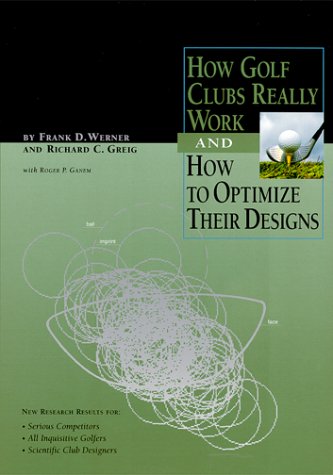
Explains what goes on in a golf shot, from impact until the ball stops, and backs it up with good science. Contains 37 short chapters with general information for golfers and technical notes for club designers, plus definitions and illustrations. Topics covered include characteristics of the scatter of hits on the faces of clubs, full and partial shots with irons, factors that affect distance, and aiming. The authors are affiliated with product development firms in the private sector. Much material was adapted from some 70 articles written for the Japanese monthly publication Golf Equipment World . Annotation c. Book News, Inc., Portland, OR (booknews.com)
"synopsis" may belong to another edition of this title.
About the Author
DR. FRANK D. WERNER
Werner was born in Kansas in 1922. His education includes B.S. degree in physics at Kansas State University, and M.S. and Ph.D. degrees in aerospace engineering at the University of Minnesota.
He first worked at the Johns Hopkins University’s Applied Physics Laboratory, in Silver Spring, Maryland, on proximity fuse research for anti-aircraft artillery and radar improvements. From 1947 to 1956, he was a researcher in addition to his graduate work, at the University of Minnesota, Department of Aerospace Mechanics. His specialty was aeronautical measuring instruments at U of M’s Rosemount Aeronautical Laboratories.
In 1956 Werner was the principal founder and president of Rosemount Engineering Company in Minneapolis, Minnesota, now a part of Fischer-Rosemount, a major division of Emerson Electric. Rosemount’s early products were measuring instruments for the aeronautical and space industry-still widely used. The firm has since become a leader in industrial experimentation.
Werner moved to Jackson Hole, Wyoming in 1968 and founded Origin Inc, a small product development firm. One of Origin’s several significant products was windshield repair system now used worldwide.
In the late 1980’s, for various reasons, he and Dick Greig, vice president of Origin Inc and president of Tech Line Corp, undertook a highly refined and technical analysis of exactly what happens when a putter hits the golf ball. Next, they applied these analytical methods to the design of innovative drivers which are on the market today.
Werner’s creative thinking has produced 80 patents. While his hobbies have included golf, skiing, fishing and the mountains (he lives at the foot of the Teton Range), Werner says his greatest enjoyment is in problem solving. “Good solutions often require extensive creative thinking.”
He and his wife, Alice, have 3 children and 8 grandchildren. RICHARD C. GREIG
Dick Greig was born in New Jersey in 1943, and raised in Minnesota from early childhood. His education includes B.S. and M.S. degrees in aerospace engineering from the University of Minnesota. He completed the coursework and the requirements for a Ph.D. degree in the same field
He has over 30 years of research and developments of technical products along with extensive managing and marketing experience at Origin Inc. Mathematical analysis and modeling has been a special interest. His major areas of study were fluid mechanics, kinetic theory of gases, applied mathematics and thermodynamics.
While at the university, Greig taught courses in fluid dynamics, dynamics, statics and deformable body mechanics at the undergraduate level and worked part time in research at the aeronautics lab.
Greig left the university to work for Origin Inc in 1971. He continues that association and is president of Tech Line Corp. He applied his expertise to the thermal and economic modeling of domestic solar heating systems, economic trend analysis, and golf club design. He gained considerable experience in developing extrusion and injection molding and metal machining operations, and has a number of patents.
He and his wife Judy have 3 children.
From the Inside Flap
A unique book! Much new and basic information is presented in a novel and useful format- each chapter has A general section for golfers and most have Technical Notes for club designers.
This book confirms much of what golfers know, adds much previously unknown information, helps one to understand what goes on in a golf shot, and backs it all up with good science. The back-up work includes numerous measurements with golfers and analysis of all that happens from impact until the ball stops.
Excerpt. © Reprinted by permission. All rights reserved.
Excerpt from Chapter 1
By Roger P. Ganem
It Highlights the Insights and Oversights and All Golfers Should Exercise Their Rights
Have you ever borrowed a friend s club and hit a sensational shot, making you wonder what is wrong with yours? A Ph.D. and a near Ph.D. in aerospace engineering have dedicated themselves and more than a decade of experimental research and design of golf clubs. They are now offering to you their intriguing analysis based on fundamental physics and mathematics, as well as their extensive and amazing new kinds of tests. You will be able to read, for perhaps the very first time, about the whys and wherefores of the flight of the ball and how to maneuver it, as well as the definitive part your clubs play in this often frustrating but fascinating sport.
You will also become more enlightened about the real importance of face curvature (bulge and roll) and whether your driver is ideal for you AND what is the best club length, head weight and loft angle for maximum distance AND why the face surfaces of irons are not curved AND correct head design will not only keep the ball in play, but add precious distance AND the scatter of your stop points (hit more fairways and greens).
How Golf Clubs Really Work and How to Optimize Their Designs- while highly technical and scientific, contains the answers to many of the problems that the sport of golf often throws away. Dr. Frank Werner and Richard Greig of Tech Line have gone to great lengths to de-mystify the factors that play a part in your efforts, whether you are the gifted professional, a golf instructor or the beleaguered amateur. Much of this information has never been published, and much is unknown to must of us.
This excerpt, written by Roger P. Ganem, is taken from the introductory chapter. Ganem is a former executive for A.G. Spalding, a former Instruction-Editor for Golf Magazine and has been the author of three golf books.
"About this title" may belong to another edition of this title.
Search results for How Golf Clubs Really Work and How to Optimize Their...

Seller Image
How Golf Clubs Really Work and How to Optimize Their Designs
Seller: 2nd Life Books, Burlington, NJ, U.S.A.
Seller rating 5 out of 5 stars

Condition: very_good. Used book in very good condition. May have some minor wear. May NOT include discs, or access code or other supplemental material. Ships directly from Amazon and is eligible for Prime or super saver FREE shipping. We ship Monday-Saturday and respond to inquiries within 24 hours. Seller Inventory # BXM.CPGD
Seller Image
How Golf Clubs Really Work and How to Optimize Their Designs
Seller: Zoom Books East, Glendale Heights, IL, U.S.A.
Seller rating 5 out of 5 stars
Condition: very_good. Book is in very good condition and may include minimal underlining highlighting. The book can also include "From the library of" labels. May not contain miscellaneous items toys, dvds, etc. . We offer 100% money back guarantee and 24 7 customer service. Seller Inventory # ZEV.0967762502.VG
Seller Image
How Golf Clubs Really Work and How to Optimize Their Designs
Seller: Zoom Books East, Glendale Heights, IL, U.S.A.
Seller rating 5 out of 5 stars
Condition: good. Book is in good condition and may include underlining highlighting and minimal wear. The book can also include "From the library of" labels. May not contain miscellaneous items toys, dvds, etc. . We offer 100% money back guarantee and 24 7 customer service. Seller Inventory # ZEV.0967762502.G
Stock Image
How Golf Clubs Really Work and How to Optimize Their Designs
Seller: GoldBooks, Denver, CO, U.S.A.
Seller rating 5 out of 5 stars
Paperback. Condition: new. New Copy. Customer Service Guaranteed. Seller Inventory # 32J15_6_0967762502
Stock Image
How Golf Clubs Really Work and How to Optimize Their Design
Seller: BennettBooksLtd, Los Angeles, CA, U.S.A.
Seller rating 5 out of 5 stars
paperback. Condition: New. In shrink wrap. Looks like an interesting title! Seller Inventory # Q-0967762502