
Items related to Inventory Management Explained: A focus on Forecasting,...
Inventory Management Explained: A focus on Forecasting, Lot Sizing, Safety Stock, and Ordering Systems. - Hardcover
Synopsis
Inventory Management isn't easy. If it were, more companies would be good at it. But being competent at managing your inventory isn't all that difficult either. It just requires that you invest the time to develop an understanding of the factors that should be affecting your inventory management decisions. Then use this understanding to start to put together the calculations and decision logic you will use to manage your inventory.
Explained. Calculations for forecasting, lot sizing, and safety stock are well known to the inventory management community, but are generally not understood to the level necessary to effectively use them. This lack of understanding results in incomplete calculations, incorrect inputs, flawed logic, or a fall-back to less effective, keep-it-simple approaches.
Inventory Management Explained helps readers build a solid understanding of the key planning aspects of inventory management. It does this by clearly explaining what inventory management is, but then goes well beyond typical inventory management books by tearing apart the calculations and logic we use in inventory management and exposing the hidden (or not so hidden) flaws and limitations. It then builds on this by showing readers how they can use their understanding of inventory management and their specific business needs to modify these calculations or develop their own calculations to more effectively manage their inventory. The emphasis on practical solutions means readers can actually use what they've learned.
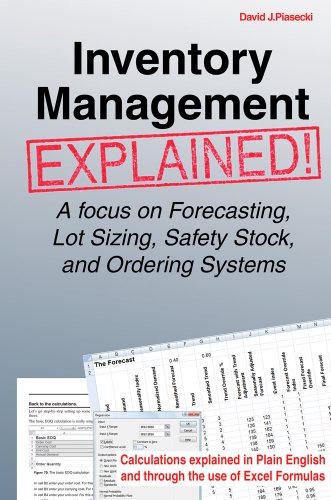
For those new to inventory management, the author includes highly detailed explanations and numerous examples. Instead of archaic mathematical syntax, the author explains the calculations in plain English and uses Excel formulas and spreadsheet examples for many of them.
For the experienced practitioner, the author provides insights and a level of detail they likely have not previously experienced. Overall, Inventory Management Explained does actually explain inventory management, and in doing so, exposes the good, the bad, and the ugly aspects of it. But more importantly, it leaves the readers knowing enough to be able to start making smart decisions about how they manage their inventory.
Topics covered include:
- History-based forecasting methods including Exponential Smoothing, Adaptive Smoothing, Moving Average, and Weighted Moving Average.
- Seasonality Indexes , Trend Adjustments, and Forecast Overrides.
- Excel's Regression Analysis tool, Forecast Function, and Solver Add-in.
- Why Keep-it-simple methods for calculating safety stock don't work.
- The Normal Distribution model and why it applies to safety stock calculations.
- How to modify your safety stock calculation to account for your forecast, lead time, and order cycles.
- What EOQ is, where it came from, and what all the numbers mean.
- What goes into Order Cost and Carrying Cost.
- Setting up an order quantity calculation in Excel that takes into account Quantity Discounts.
- Dealing with seasonality and trend in your order quantity calculations.
- Periodic Review, Fixed Order Point, Min-Max, Multi-bin, Kanban, and ordering systems that directly utilize your forecast.
- The real difference between Push Systems and Pull Systems.
- Materials Requirements Planning (MRP) and Distribution Requirements Planning (DRP)
- Gross Requirements, Net Requirements, Planned Orders, Bills of Materials, Routings, Master Production Scheduling (MPS)
- How to put together an effective Fair-Share Distribution system.
- Fill Rates, On-Time Delivery, ABC stratification, Out-of-stock analysis, Excess and Obsolete inventory.
"synopsis" may belong to another edition of this title.
About the Author
David J Piasecki is a consultant and author with over three decades of experience working in inventory management, manufacturing, and warehouse operations as both a practitioner and consultant. His popular website Inventoryops.com has been providing related information for over 20 years. He has authored three books and numerous articles on various related topics.
"About this title" may belong to another edition of this title.
Search results for Inventory Management Explained: A focus on Forecasting,...

Stock Image
Inventory Management Explained : A focus on Forecasting, Lot Sizing, Safety Stock, and Ordering Systems
Seller: Better World Books, Mishawaka, IN, U.S.A.
Seller rating 5 out of 5 stars

Condition: Good. Pages intact with minimal writing/highlighting. The binding may be loose and creased. Dust jackets/supplements are not included. Stock photo provided. Product includes identifying sticker. Better World Books: Buy Books. Do Good. Seller Inventory # 15933566-6
Stock Image
Inventory Management Explained
Seller: World of Books (was SecondSale), Montgomery, IL, U.S.A.
Seller rating 5 out of 5 stars
Hardback. Condition: Fair. Seller Inventory # 00105506046
Stock Image
Inventory Management Explained
Seller: World of Books (was SecondSale), Montgomery, IL, U.S.A.
Seller rating 5 out of 5 stars
Hardback. Condition: Very Good. Seller Inventory # CIN0972763112VG
Stock Image
Inventory Management Explained
Seller: World of Books Inc, Montgomery, IL, U.S.A.
Seller rating 4 out of 5 stars

Hardback. Condition: Fair. Seller Inventory # CIN0972763112A
Stock Image
Inventory Management Explained
Seller: World of Books Inc, Montgomery, IL, U.S.A.
Seller rating 4 out of 5 stars
Hardback. Condition: Very Good. Seller Inventory # CIN0972763112VG
Stock Image
Inventory Management Explained: A focus on Forecasting, Lot Sizing, Safety Stock, and Ordering Systems.
Seller: ThriftBooks-Dallas, Dallas, TX, U.S.A.
Seller rating 5 out of 5 stars
Hardcover. Condition: Good. No Jacket. Pages can have notes/highlighting. Spine may show signs of wear. ~ ThriftBooks: Read More, Spend Less. Seller Inventory # G0972763112I3N00
Stock Image
Inventory Management Explained: A focus on Forecasting, Lot Sizing, Safety Stock, and Ordering Systems.
Seller: GoldBooks, Denver, CO, U.S.A.
Seller rating 5 out of 5 stars
Hardcover. Condition: new. New Copy. Customer Service Guaranteed. Seller Inventory # 22X64_81_0972763112