
Items related to A Life in Print: Selections from the work of a reporter,...
Synopsis
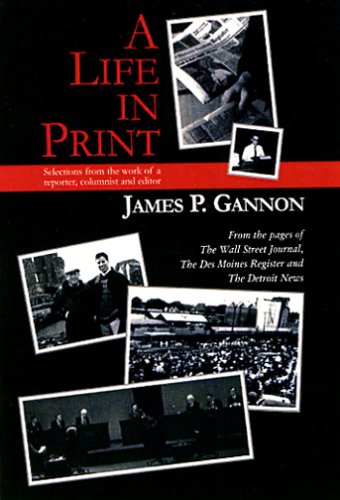
A collection of columns and essays is a writer's treasure chest—here are gems from The Wall Street Journal, the Des Moines Register and the Detroit News. A distinguished journalist displays his wit, feeling, and passion for language in these columns on family, newspaper life, politics, Irish heritage, his Iowa farm and Minnesota boyhood, which read like chapters of a life fully lived, from his coverage of presidents and politics to his poignant pieces on his daughter's wedding and his son's death. Original.
"synopsis" may belong to another edition of this title.
About the Author
James P. Gannon, author of A Life in Print: Selections from the Work of a Reporter, Columnist and Editor, is an award-winning journalist and writer. He spent 33 years in daily newspaper work at The Wall Street Journal, The Des Moines Register, and The Detroit News.
Mr. Gannon reported for The Wall Street Journal for 17 years, in Chicago, Pittsburgh, New York and Washington, DC. In Washington, he covered a variety of assignments, including the White House, Congress, national politics and campaigns. For 10 years, Mr. Gannon served as Editor of The Des Moines Register, Iowa’s largest daily newspaper, which during his tenure won three Pulitzer Prizes and was named to Time magazine’s list of the ten best daily newspapers in America. He also served as the Washington Bureau Chief for The Detroit News and a columnist for Gannett Newspapers.
He is also the author of Irish Rebels, Confederate Tigers: A History of the 6th Louisiana Volunteers, 1861-1865. This is the history of a Confederate infantry regiment composed mainly of Irishmen from New Orleans who fought in Gen. Robert E. Lee’s army in Virginia. A native of Minneapolis and a graduate of Marquette University in Milwaukee, Mr. Gannon is the father of six children and grandfather of eleven. He lives in Rappahannock County, Virginia.
Excerpt. © Reprinted by permission. All rights reserved.
On Father s Day, the remembrance of ordinary things
Des Moines Sunday Register, June 15, 1980:
He was tall and thin, and had straight, white hair which he slicked back with Vaseline hair oil that left a permanent greasy spot on the upholstery of the high-backed chair where he seemed to live, reading his newspapers.
When I was small and didn't want to go upstairs alone to bed, I would drag out my pillow and lie down beside his chair, and fall asleep while he puffed his Chesterfields and silently devoured the news. I don't remember him carrying me up to bed, though he certainly did so many times.
We didn't play ball together or go fishing or pal around. He was always giving me quarters to go to the movies, or sometimes a dollar for no reason at all, and I would say, "Dad, I don't need this," and he would just say "Take it" and I would take it.
When he wasn't in his chair reading his newspapers, he usually was gone, at work in a Minneapolis office, doing things I didn't understand, or else traveling by train to the Dakotas, going from one small town to another, drumming up business for his grain firm at dingy country elevators. There were a few times, in the summers of my adolescence, when I accompanied him, and I recall sitting in those dusty offices of small-town elevators, wondering how anyone could stand making a living in such drudgery.
We didn't take vacations, but we had a modest cottage near Lake Minnetonka where we spent much of the summer. He would drive out there after work in his 1940 Chevrolet, or later, his 1948 Dodge, and spend the night, before driving back into the city for another day at the office. Sometimes he would cut the grass, but mostly he just brought his newspapers and sat on a rocker on the porch, where I would play in a hammock that smelled musty from being in a closed-up cottage all winter. The hammock was strung up on the screened porch because the mosquitoes were so thick outside that you couldn't go out in the evening.
There wasn't much conversation. It was mostly about baseball or the weather. There was a 50-year gap between us, and that is hard to bridge when one is 10 and the other 60. But the gap seemed much narrower later, when I was 25 and he was 75 and we could talk of adult things.
The gap narrowed steadily in those last few years, and as we both grew older and I gained some perspective on his life, there wasn't much of a gap at all. He ever knew his father, who had died in 1890, the year after he was born, so he was coming at this father-son relationship with no experience, either good or bad. When I think that my grandfather died in the previous century, nearly 50 years before I was born, I get an odd, disconnected feeling, as if one whole generation in my family had been mysteriously skipped. Some people my age still have living grandfathers, but my father's father never saw the 20th century.
"I never knew my father," he would say, but that's about all he could say on the subject. How that affected him, I suppose I'll never know. But every time Father's Day rolls around, and I think of him, I am thankful for a rich store of mundane memories, the remembrance of ordinary things, like the pillow by his chair, the quiet of screened porch, and a quarter to go to the movies.
"About this title" may belong to another edition of this title.
Search results for A Life in Print: Selections from the work of a reporter,...

Stock Image
A Life in Print: Selections from the work of a reporter, columnist and editor
Published by
Blackwater Publications, 2005
ISBN 10: 0976452804
ISBN 13: 9780976452805
Used
Paperback
First Edition
Signed
Seller: Larry W Price Books, Portland, OR, U.S.A.
Seller rating 5 out of 5 stars

Paperback. Condition: VG. 1st Edition. 207 pp., Photos, Blk Photos Illus Paperback, Fine, 1st ed (Inscribed by Author). Inscribed by Author(s). Seller Inventory # 007292
Stock Image
A Life in Print: Selections from the work of a reporter, columnist and editor
Published by
Blackwater Publications, 2005
ISBN 10: 0976452804
ISBN 13: 9780976452805
Used
Paperback
Seller: ThriftBooks-Dallas, Dallas, TX, U.S.A.
Seller rating 5 out of 5 stars
Paperback. Condition: Very Good. No Jacket. May have limited writing in cover pages. Pages are unmarked. ~ ThriftBooks: Read More, Spend Less. Seller Inventory # G0976452804I4N00
Stock Image
A Life in Print: Selections from the work of a reporter, columnist and editor
Published by
Blackwater Publications, Castleton, VA, 2004
ISBN 10: 0976452804
ISBN 13: 9780976452805
Used
Soft cover
First Edition
Signed
Seller: RW Books, Strasburg, VA, U.S.A.
Seller rating 5 out of 5 stars
Soft cover. Condition: Very Good. 1st Edition. Very Good condition. Content clean and unmarked, binding strong. Author's inscription and signature on front end sheet. Black & white photos. Personal memoir of a newspaper journalist. Signed & Inscribed By Author. Seller Inventory # 018601
Stock Image
A Life in Print: Selections from the work of a reporter, columnist and editor
Published by
Blackwater Publications, 2005
ISBN 10: 0976452804
ISBN 13: 9780976452805
Used
Paperback
Seller: Book Lover's Warehouse, Johnson City, TN, U.S.A.
Seller rating 4 out of 5 stars

Paperback. Condition: Very Good. This book is inscribed by the author on the title page. The covers are clean with light shelf wear. The spine remains free of creasing. The pages of this book are clean and unmarked. FAST SHIPPING & FREE TRACKING! Seller Inventory # 159318
Stock Image
A Life in Print: Selections from the work of a reporter, columnist and editor
Seller: BennettBooksLtd, Los Angeles, CA, U.S.A.
Seller rating 5 out of 5 stars
Paperback. Condition: New. In shrink wrap. Looks like an interesting title! Seller Inventory # Q-0976452804