
Items related to Someone Would Have Talked: The Assassination of President...
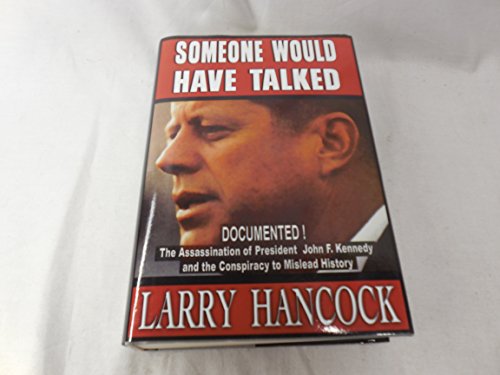
Someone Would Have Talked: The Assassination of President John F. Kennedy and the Conspiracy to Mislead History - Hardcover
Synopsis
Someone Would Have Talked goes beyond proving a conspiracy to murder President Kennedy. Over 14.000 documents, White House diaries, telephone logs, and executive tape recordings detail how the new president, Lyndon B. Johnson, managed a cover-up that changed the future of our country. A second conspiracy designed to mislead the nation, the world, indeed, history. Someone Would Have Talked was written to demonstrate with available information, the cover-up, the leaks, Lee Oswald, Jack Ruby and the people that did talk, providing a cohesive and coherent explanation of events. And in doing so this book gives the reader an introduction to the history of the secret war against Castro and against Communism during the 1960s, an introduction that is vital to an appreciation of the individuals, and their motivations. Someone Would Have Talked deals with specific people who talked about their personal knowledge of a conspiracy in the murder of a President. These individuals include four men associated with the CIA s JM WAVE station in Miami Florida. Two of them were senior CIA officers, one a veteran of three years of Castro assassination projects and the other a three year prisoner of Castro - and an organizer and participant, along with a former U.S. Ambassador, in one of the most potentially explosive Cuban penetration missions ever conducted.
"synopsis" may belong to another edition of this title.
About the Author
Larry Hancock is a leading historian-researcher in the JFK assassination. Co-author with Connie Kritzberg of November Patriots and author of the 2003 research analysis publication titled also Someone Would Have Talked. In addition, Hancock has published several document collections addressing the 112th Army Intelligence Group, John Martino, and Richard Case Nagell. In 2000, Hancock received the prestigious Mary Ferrell New Frontier Award for the contribution of new evidence in the Kennedy assassination case. In 2001, he was also awarded the Mary Ferrell Legacy Award for his contributions of documents released under the JFK Act.
From the Back Cover
They have talked ... you need to know what they said ... "They're going to kill him. They're going to kill him when he gets to Texas." John Martino, former Cuban prisoner and anti-Castro activist "We were getting all sorts of rumors that the President was going to be assassinated in Dallas; there were no if's, and's or but's about it." Marty Underwood, Democratic National Committee Political Advance Man "...the threat of November 18 was posed by a mobile, unidentified rifleman with a high-powered rifle and scope" Secret Service Agent Memorandum "Now they're going to find out about Cuba, the guns, New Orleans and everything." Jack Ruby to his Jailer "Washington's word to me was that it would hurt foreign relations if I alleged conspiracy - whether I could prove it or not. I was just to charge Oswald with plain murder and go for the death penalty. Johnson had Cliff Carter call me three or four times that weekend." Dallas District Attorney Henry Wade "If I told you what I really know, it would be very dangerous to the country. Our whole political system could be disrupted." FBI Director Hoover In response to whether or not Oswald had killed the President "Well, we took care of that S.O.B." David Morales, former Chief of Operations, CIA Miami JM/WAVE station and Consultant to the Deputy Director of the Joint Chiefs for Operational Counter Insurgency and Special Operations following a tirade against John Kennedy for his treachery at the Bay of Pigs.
From the Inside Flap
Unlike most books on this topic, Someone Would Have Talked bases its analysis of the Kennedy assassination on clear evidence of facts contained in direct conversations with those involved in the plot and documents containing evidence of what really took place. Assumptions, speculation and fantasy have allowed the truth to elude the American public.
Someone Would Have Talked pulls back the curtain on these far-fetched theories with unfettered access and clear and convincing evidence never discussed before. Someone Would Have Talked ignores the fiction of past books on the subject and provides nothing more than what America has been seeking for 40 years... the TRUTH! Those that deny a conspiracy scoff, stating if there was a conspiracy someone would have talked after all this time.
Someone Would Have Talked tackles that objection head on, examining a number of examples of credible people who have talked. Real people, many of them involved in the secret war against Castro and the U.S. Government project intended to assassinate JFK. Someone Would Have Talked evaluates these leaks and confessions, showing the connections between the individuals involved and demonstrating the evolution of a conspiracy.
Someone Would Have Talked goes beyond just proving a conspiracy to murder JFK. Over 14,000 documents, White House diaries, telephone logs and executive tape recordings detail how the new President managed a cover-up which changed the future of our country. A second conspiracy designed to mislead the nation, the world, indeed, history itself.
Excerpt. © Reprinted by permission. All rights reserved.
CHAPTER 1 "THEY'RE GOING TO KILL KENNEDY!"
Miami Florida, November 22, 1963.
John Martino knew that President Kennedy was going to be killed in Dallas. He didn't know the details but he knew the people that were doing it - and he had helped them in small ways during his trips to Dallas that fall.
Martino was nervous that day, wanting to distance himself from what was going to happen and knowing that he couldn't. He announced to his family that he would paint the breakfast room in his house. But he had also asked his son, Edward, to stay home from school that Friday. No reason given and no explanation offered. During the morning, John asked Edward not to help paint but instead to watch television and to notify him immediately of any special news or bulletins.
Later, while catching a piece of coverage of the President's travels on the radio, John Martino exclaimed to his wife, "Flo, they're going to kill him. They're going to kill him when he gets to Texas."
That afternoon when Edward ran to his father with the news of an attack on the President, he watched his father turn white as a sheet. As the afternoon passed, John Martino began receiving an ongoing series of telephone calls from Texas.
Martino's wife, Florence, and other members of his family kept John Martino's words of November 22 strictly to themselves for decades, initially denying anything of the sort when questioned by the House Select Committee on Assassinations. The Committee had been given a lead by one of Martino's close friends.
However, months before her death, Florence Martino related the truth and details to author Anthony Summers, with confirmation from her son. Martino's actual involvement only became popularly known with the publication of Anthony Summers' article in Vanity Fair magazine in 1994.
John Martino provided more details about the conspiracy to murder President Kennedy than were indicated by his remarks to his family on November 22. He did so only to two people. One was a close friend and business partner; the other was one of the reporters who covered Martino's return from imprisonment in Cuba. In both cases, he talked about the matter almost in the manner of a confession and only in the last months of his life. In order to appreciate and evaluate Martino's remarks, it is necessary to fully understand the life of John Martino, his associates, his activities in 1963 and his activities immediately following the assassination.
In 1963 and 1964, Martino very publicly told a much different story - a story of Lee Oswald as a Castro-sponsored assassin. That same story was repeated so frequently that it eventually began to sound very much like a "script," with other individuals touting similar claims. At the time, it was striking enough to bring John Martino to the attention of J. Edgar Hoover and the FBI. This was fortunate for us, since it is the FBI inquiry and its related documents that provide us with much of the background we need to put Martino in the proper historical perspective.
"About this title" may belong to another edition of this title.
Search results for Someone Would Have Talked: The Assassination of President...

Stock Image
Someone Would Have Talked
Published by
JFK Lancer Productions & Publications, 2006
ISBN 10: 0977465713
ISBN 13: 9780977465712
Used
Hardcover
Seller: World of Books (was SecondSale), Montgomery, IL, U.S.A.
Seller rating 5 out of 5 stars

Hardback. Condition: Fair. Someone Would Have Talked, the new third edition by historian Larry Hancock, goes beyond just proving a conspiracy to murder JFK. Over 14,000 documents, White House diaries, telephone logs and executive tape recordings detail how the new President managed a cover-up which changed the future of our country -- A second conspiracy designed to mislead the nation, the world, indeed, history itself. Someone Would Have Talked tackles the assassination head on, examining a number of examples of credible people who have talked. Real people, many of them involved in the secret war against Castro and the U.S. Government project intended to assassinate JFK. Someone Would Have Talked evaluates these leaks and confessions, showing the connections between the individuals involved and demonstrating the evolution of a conspiracy. Seller Inventory # CIN0977465713A
Stock Image
Someone Would Have Talked
Published by
JFK Lancer Productions & Publications, 2006
ISBN 10: 0977465713
ISBN 13: 9780977465712
Used
Hardcover
Seller: World of Books Inc, Montgomery, IL, U.S.A.
Seller rating 4 out of 5 stars

Hardback. Condition: Fair. Someone Would Have Talked, the new third edition by historian Larry Hancock, goes beyond just proving a conspiracy to murder JFK. Over 14,000 documents, White House diaries, telephone logs and executive tape recordings detail how the new President managed a cover-up which changed the future of our country -- A second conspiracy designed to mislead the nation, the world, indeed, history itself. Someone Would Have Talked tackles the assassination head on, examining a number of examples of credible people who have talked. Real people, many of them involved in the secret war against Castro and the U.S. Government project intended to assassinate JFK. Someone Would Have Talked evaluates these leaks and confessions, showing the connections between the individuals involved and demonstrating the evolution of a conspiracy. Seller Inventory # CIN0977465713A
Stock Image
Someone Would Have Talked: The Assassination of President John F. Kennedy and the Conspiracy to Mislead History
Published by
JFK Lancer Productions & Publications (edition ), 2006
ISBN 10: 0977465713
ISBN 13: 9780977465712
Used
Hardcover
Seller: BooksRun, Philadelphia, PA, U.S.A.
Seller rating 5 out of 5 stars
Hardcover. Condition: Very Good. With dust jacket. It's a well-cared-for item that has seen limited use. The item may show minor signs of wear. All the text is legible, with all pages included. It may have slight markings and/or highlighting. Seller Inventory # 0977465713-11-1-29
Seller Image
Someone Would Have Talked: The Assassination of President John F. Kennedy and the Conspiracy to Mislead History
Published by
JFK Lancer Productions & Publications, 2006
ISBN 10: 0977465713
ISBN 13: 9780977465712
Used
Hardcover
Seller: Big River Books, Powder Springs, GA, U.S.A.
Seller rating 5 out of 5 stars
Condition: good. This book is in good condition. The cover has minor creases or bends. The binding is tight and pages are intact. Some pages may have writing or highlighting. Seller Inventory # BRV.0977465713.G
Seller Image
Someone Would Have Talked: The Assassination of President John F. Kennedy and the Conspiracy to Mislead History
Published by
JFK Lancer Productions & Publications, 2006
ISBN 10: 0977465713
ISBN 13: 9780977465712
Used
Hardcover
Seller: Greenworld Books, Arlington, TX, U.S.A.
Seller rating 5 out of 5 stars
Condition: very_good. Fast Free Shipping â" Very Good condition book with a firm cover and clean pages. Shows normal use and some light wear or limited notes markings. A solid, nice copy to enjoy. Seller Inventory # GWV.0977465713.VG
Stock Image
Someone Would Have Talked: The Assassination of President John F. Kennedy and the Conspiracy to Mislead History
Published by
JFK Lancer Productions & Publica, 2006
ISBN 10: 0977465713
ISBN 13: 9780977465712
Used
Hardcover
Seller: HPB-Ruby, Dallas, TX, U.S.A.
Seller rating 5 out of 5 stars
hardcover. Condition: Very Good. Connecting readers with great books since 1972! Used books may not include companion materials, and may have some shelf wear or limited writing. We ship orders daily and Customer Service is our top priority! Seller Inventory # S_488916877
Stock Image
Someone Would Have Talked: The Assassination of President John F. Kennedy and the Conspiracy to Mislead History
Published by
JFK Lancer Productions & Publications, 2006
ISBN 10: 0977465713
ISBN 13: 9780977465712
Used
Hardcover
Seller: Eatons Books and Crafts, Owatonna, MN, U.S.A.
Seller rating 5 out of 5 stars
Hardcover. Condition: Fine. Dust Jacket Condition: Very Good. Hardcover, with dust jacket, in Fine condition, there are no stamps writing or marks, some scuffing on the glossy jacket, no tears, book itself looks like new, Seller Inventory # 070164
Stock Image
Someone Would Have Talked: The Assassination of President John F. Kennedy and the Conspiracy to Mislead History
Published by
JFK Lancer Productions & Pub, 2006
ISBN 10: 0977465713
ISBN 13: 9780977465712
Used
Hardcover
Seller: Robinson Street Books, IOBA, Binghamton, NY, U.S.A.
Seller rating 4 out of 5 stars
Hardcover. Condition: Very good. Prompt Shipment, shipped in Boxes, Tracking PROVIDEDTrue Crime Biographies; Very good hard cover with dust jackets,slightly bumped tips, prompt shipping with tracking, clean pages, slight creasing on dust jacket, one page slightly nicked. Seller Inventory # Bing735SD028
Seller Image
Someone Would Have Talked: The Assassination of President John F. Kennedy and the Conspiracy to Mislead History
Published by
JFK Lancer Productions & Publications, USA, 2006
ISBN 10: 0977465713
ISBN 13: 9780977465712
Used
Hardcover
Seller: EFR-JFK, South Windsor, CT, U.S.A.
Seller rating 5 out of 5 stars
Hardcover. Condition: Near Fine. Dust Jacket Condition: Near Fine. Used book at great price. Most economical, best, fastest, most reliable and top quality book. All pages and covers are readable. Spine and cover may show signs of wear. Seller Inventory # 000116
Stock Image
Someone Would Have Talked: The Assassination of President John F. Kennedy and the Conspiracy to Mislead History
Published by
JFK Lancer Productions & Publications, 2006
ISBN 10: 0977465713
ISBN 13: 9780977465712
Used
Hardcover
Seller: WorldofBooks, Goring-By-Sea, WS, United Kingdom
Seller rating 5 out of 5 stars
Hardback. Condition: Very Good. The book has been read, but is in excellent condition. Pages are intact and not marred by notes or highlighting. The spine remains undamaged. Seller Inventory # GOR002367541
Buy Used
US$ 30.06
US$ 7.50 shipping
Ships from United Kingdom to U.S.A.
Ships from United Kingdom to U.S.A.
Quantity: 1 available