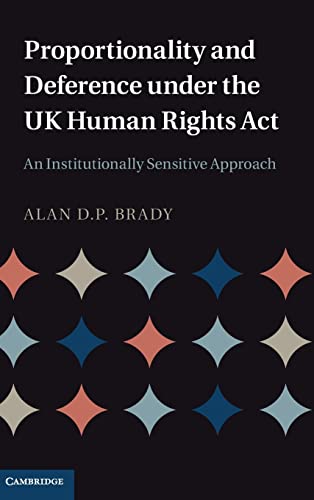
Proportionality and Deference under the UK Human Rights Act: An Institutionally Sensitive Approach - Hardcover
Synopsis
The courts use the proportionality test to assess the Convention-compatibility of the full range of government action, from administrative decisions to primary legislation. In applying the test, the courts are often conscious of the need to pay some deference to the expertise and competence of other branches of government. This rigorous analysis of the relationship between proportionality and deference under the Human Rights Act sets out a model of proportionality, drawn from existing case-law, which integrates deference within the multi-stage proportionality test. The model is 'institutionally sensitive', and can be applied to proportionality-based judicial review of all forms of government activity. The model is shown in operation in three fields that span the full range of government activity: immigration (administrative action), criminal justice (legislation) and housing (multi-level decisions).
"synopsis" may belong to another edition of this title.
About the Author
Alan D. P. Brady is an Adjunct Lecturer in Law at Trinity College Dublin and a practising barrister. He currently lectures judicial review and human rights on the Trinity College LLM programme. During his doctoral studies at the London School of Economics he was an LSE Fellow. His research is in the fields of public law, human rights and criminal law.
"About this title" may belong to another edition of this title.
Search results for Proportionality and Deference under the UK Human Rights...

Stock Image
Proportionality and Deference under the UK Human Rights Act: An Institutionally Sensitive Approach
Published by
Cambridge University Press, 2012
ISBN 10: 1107013003
ISBN 13: 9781107013001
Used
Hardcover
Seller: Wonder Book, Frederick, MD, U.S.A.
Seller rating 5 out of 5 stars

Condition: As New. Like New condition. A near perfect copy that may have very minor cosmetic defects. Seller Inventory # B13B-02748
Stock Image
Proportionality and Deference under the UK Human Rights Act: An Institutionally Sensitive Approach
Published by
Cambridge University Press, 2012
ISBN 10: 1107013003
ISBN 13: 9781107013001
Used
Hardcover
Seller: AMM Books, Gillingham, KENT, United Kingdom
Seller rating 5 out of 5 stars
Hardcover. Condition: Very Good. In stock ready to dispatch from the UK. Seller Inventory # mon0000253899
Buy Used
US$ 36.83
US$ 16.42 shipping
Ships from United Kingdom to U.S.A.
Ships from United Kingdom to U.S.A.
Quantity: Over 20 available
Stock Image
Proportionality and Deference under the UK Human Rights Act: An Institutionally Sensitive Approach
Published by
Cambridge University Press, 2012
ISBN 10: 1107013003
ISBN 13: 9781107013001
New
Hardcover
Seller: AMM Books, Gillingham, KENT, United Kingdom
Seller rating 5 out of 5 stars
Hardcover. Condition: New. In stock ready to dispatch from the UK. Seller Inventory # mon0000255974
Buy New
US$ 47.90
US$ 16.42 shipping
Ships from United Kingdom to U.S.A.
Ships from United Kingdom to U.S.A.
Quantity: 5 available
Stock Image
Proportionality and Deference under the UK Human Rights Act: An Institutionally Sensitive Approach
Published by
Cambridge University Press, 2012
ISBN 10: 1107013003
ISBN 13: 9781107013001
Used
Hardcover
Seller: Labyrinth Books, Princeton, NJ, U.S.A.
Seller rating 5 out of 5 stars
Condition: Very Good. Seller Inventory # 144971
Stock Image
Proportionality and Deference under the UK Human Rights Act: An Institutionally Sensitive Approach
Published by
Cambridge University Press, 2012
ISBN 10: 1107013003
ISBN 13: 9781107013001
Used
Hardcover
First Edition
Seller: Prior Books Ltd, Cheltenham, United Kingdom
Seller rating 5 out of 5 stars
Hardcover. Condition: Very Good. First Edition. Bright and clean, firm and square, just a few minor bumps and rubs. Hence a non-text page is stamped 'damaged'. Despite such this book is better than very good condition. Thus it looks and feels unread with contents that are crisp, fresh and tight. Now offered for sale at a special bargain price. Seller Inventory # 123014
Buy Used
US$ 49.38
US$ 30.13 shipping
Ships from United Kingdom to U.S.A.
Ships from United Kingdom to U.S.A.
Quantity: 1 available
Stock Image
PROPORTIONALITY AND DEFERENCE UNDER THE UK HUMAN RIGHTS ACT : AN INSTITUTIONALLY SENSITIVE APPROACH
Published by
Cambridge University Press, 2012
ISBN 10: 1107013003
ISBN 13: 9781107013001
New
Hardcover
Seller: Basi6 International, Irving, TX, U.S.A.
Seller rating 5 out of 5 stars
Condition: Brand New. New. US edition. Expediting shipping for all USA and Europe orders excluding PO Box. Excellent Customer Service. Seller Inventory # ABEOCT25-140269
Stock Image
Proportionality and Deference under the UK Human Rights Act: An Institutionally Sensitive Approach
Published by
Cambridge University Press, 2012
ISBN 10: 1107013003
ISBN 13: 9781107013001
New
Hardcover
Seller: ALLBOOKS1, Direk, SA, Australia
Seller rating 5 out of 5 stars
Brand new book. Fast ship. Please provide full street address as we are not able to ship to P O box address. Seller Inventory # SHAK140269
Stock Image
Proportionality and Deference under the UK Human Rights Act: An Institutionally Sensitive Approach
Published by
Cambridge University Press, 2012
ISBN 10: 1107013003
ISBN 13: 9781107013001
New
Hardcover
Seller: Lucky's Textbooks, Dallas, TX, U.S.A.
Seller rating 5 out of 5 stars
Condition: New. Seller Inventory # ABLIING23Mar2317530263398
Stock Image
Proportionality and Deference under the UK Human Rights Act: An Institutionally Sensitive Approach
Published by
Cambridge University Press, 2012
ISBN 10: 1107013003
ISBN 13: 9781107013001
New
Hardcover
Seller: California Books, Miami, FL, U.S.A.
Seller rating 5 out of 5 stars
Condition: New. Seller Inventory # I-9781107013001
Stock Image
Proportionality and Deference under the UK Human Rights Act (Hardcover)
Published by
Cambridge University Press, Cambridge, 2012
ISBN 10: 1107013003
ISBN 13: 9781107013001
New
Hardcover
Seller: Grand Eagle Retail, Bensenville, IL, U.S.A.
Seller rating 5 out of 5 stars
Hardcover. Condition: new. Hardcover. The courts use the proportionality test to assess the Convention-compatibility of the full range of government action, from administrative decisions to primary legislation. In applying the test, the courts are often conscious of the need to pay some deference to the expertise and competence of other branches of government. This rigorous analysis of the relationship between proportionality and deference under the Human Rights Act sets out a model of proportionality, drawn from existing case law, which integrates deference within the multi-stage proportionality test. The model is 'institutionally sensitive' and can be applied to proportionality-based judicial review of all forms of government activity. The model is shown in operation in three fields that span the full range of government activity: immigration (administrative action), criminal justice (legislation) and housing (multi-level decisions). Alan D. P. Brady develops a new approach to the proportionality test under the Human Rights Act. Through a rigorous theoretical analysis of existing case law, he provides a new and effective explanation of proportionality and deference which will be of particular interest to academics, practitioners and research students. This item is printed on demand. Shipping may be from multiple locations in the US or from the UK, depending on stock availability. Seller Inventory # 9781107013001