
Items related to Natural Language Processing: A Machine Learning Perspective
Synopsis
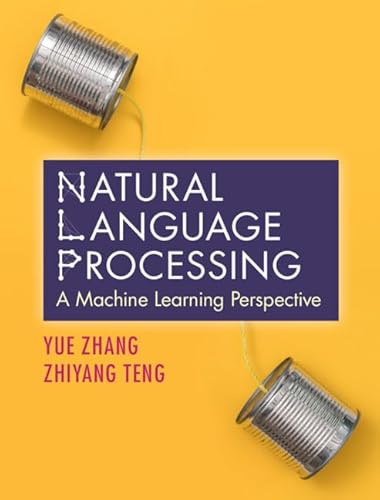
With a machine learning approach and less focus on linguistic details, this gentle introduction to natural language processing develops fundamental mathematical and deep learning models for NLP under a unified framework. NLP problems are systematically organised by their machine learning nature, including classification, sequence labelling, and sequence-to-sequence problems. Topics covered include statistical machine learning and deep learning models, text classification and structured prediction models, generative and discriminative models, supervised and unsupervised learning with latent variables, neural networks, and transition-based methods. Rich connections are drawn between concepts throughout the book, equipping students with the tools needed to establish a deep understanding of NLP solutions, adapt existing models, and confidently develop innovative models of their own. Featuring a host of examples, intuition, and end of chapter exercises, plus sample code available as an online resource, this textbook is an invaluable tool for the upper undergraduate and graduate student.
"synopsis" may belong to another edition of this title.
About the Authors
Yue Zhang is an associate professor at Westlake University. Before joining Westlake, he worked as a research associate at the University of Cambridge and then a faculty member at Singapore University of Technology and Design. His research interests lie in fundamental algorithms for NLP, syntax, semantics, information extraction, text generation, and machine translation. He serves as an action editor for TACL, and as area chairs of ACL, EMNLP, COLING, and NAACL. He gave several tutorials at ACL, EMNLP and NAACL, and won a best paper award at COLING in 2018.
Zhiyang Teng is currently a postdoctoral research fellow in the natural language processing group of Westlake University, China. He obtained his Ph.D. from Singapore University of Technology and Design (SUTD) in 2018, and his Master's from the University of Chinese Academy of Science in 2014. He won the best paper award at CCL/NLP-NABD 2014, and published conference papers for ACL/TACL, EMNLP, COLING, NAACL, and TKDE. His research interests include syntactic parsing, sentiment analysis, deep learning, and variational inference.
"About this title" may belong to another edition of this title.
Search results for Natural Language Processing: A Machine Learning Perspective

Seller Image
Natural Language Processing (Hardcover)
Published by
Cambridge University Press, Cambridge, 2021
ISBN 10: 1108420214
ISBN 13: 9781108420211
New
Hardcover
Seller: Grand Eagle Retail, Bensenville, IL, U.S.A.
Seller rating 5 out of 5 stars

Hardcover. Condition: new. Hardcover. With a machine learning approach and less focus on linguistic details, this gentle introduction to natural language processing develops fundamental mathematical and deep learning models for NLP under a unified framework. NLP problems are systematically organised by their machine learning nature, including classification, sequence labelling, and sequence-to-sequence problems. Topics covered include statistical machine learning and deep learning models, text classification and structured prediction models, generative and discriminative models, supervised and unsupervised learning with latent variables, neural networks, and transition-based methods. Rich connections are drawn between concepts throughout the book, equipping students with the tools needed to establish a deep understanding of NLP solutions, adapt existing models, and confidently develop innovative models of their own. Featuring a host of examples, intuition, and end of chapter exercises, plus sample code available as an online resource, this textbook is an invaluable tool for the upper undergraduate and graduate student. With a machine learning approach and less focus on linguistic details, this natural language processing textbook introduces the fundamental mathematical and deep learning models for NLP in a unified framework. An invaluable, accessible and up-to-date tool for the upper undergraduate and graduate student, with sample code available online. Shipping may be from multiple locations in the US or from the UK, depending on stock availability. Seller Inventory # 9781108420211
Stock Image
Natural Language Processing: A Machine Learning Perspective
Published by
Cambridge University Press, 2021
ISBN 10: 1108420214
ISBN 13: 9781108420211
New
Hardcover
Seller: California Books, Miami, FL, U.S.A.
Seller rating 5 out of 5 stars
Condition: New. Seller Inventory # I-9781108420211
Seller Image
Natural Language Processing
Published by
Cambridge University Press Jan 2021, 2021
ISBN 10: 1108420214
ISBN 13: 9781108420211
New
Hardcover
Seller: Rheinberg-Buch Andreas Meier eK, Bergisch Gladbach, Germany
Seller rating 5 out of 5 stars
Buch. Condition: Neu. Neuware -With a machine learning approach and less focus on linguistic details, this gentle introduction to natural language processing develops fundamental mathematical and deep learning models for NLP under a unified framework. NLP problems are systematically organised by their machine learning nature, including classification, sequence labelling, and sequence-to-sequence problems. Topics covered include statistical machine learning and deep learning models, text classification and structured prediction models, generative and discriminative models, supervised and unsupervised learning with latent variables, neural networks, and transition-based methods. Rich connections are drawn between concepts throughout the book, equipping students with the tools needed to establish a deep understanding of NLP solutions, adapt existing models, and confidently develop innovative models of their own. Featuring a host of examples, intuition, and end of chapter exercises, plus sample code available as an online resource, this textbook is an invaluable tool for the upper undergraduate and graduate student. 484 pp. Englisch. Seller Inventory # 9781108420211
Buy New
US$ 82.49
US$ 25.76 shipping
Ships from Germany to U.S.A.
Ships from Germany to U.S.A.
Quantity: 1 available
Seller Image
Natural Language Processing
Published by
Cambridge University Press Jan 2021, 2021
ISBN 10: 1108420214
ISBN 13: 9781108420211
New
Hardcover
Seller: BuchWeltWeit Ludwig Meier e.K., Bergisch Gladbach, Germany
Seller rating 5 out of 5 stars
Buch. Condition: Neu. Neuware -With a machine learning approach and less focus on linguistic details, this gentle introduction to natural language processing develops fundamental mathematical and deep learning models for NLP under a unified framework. NLP problems are systematically organised by their machine learning nature, including classification, sequence labelling, and sequence-to-sequence problems. Topics covered include statistical machine learning and deep learning models, text classification and structured prediction models, generative and discriminative models, supervised and unsupervised learning with latent variables, neural networks, and transition-based methods. Rich connections are drawn between concepts throughout the book, equipping students with the tools needed to establish a deep understanding of NLP solutions, adapt existing models, and confidently develop innovative models of their own. Featuring a host of examples, intuition, and end of chapter exercises, plus sample code available as an online resource, this textbook is an invaluable tool for the upper undergraduate and graduate student. 484 pp. Englisch. Seller Inventory # 9781108420211
Buy New
US$ 82.49
US$ 25.76 shipping
Ships from Germany to U.S.A.
Ships from Germany to U.S.A.
Quantity: 1 available
Stock Image
Natural Language Processing: A Machine Learning Perspective
Published by
Cambridge University Press, 2021
ISBN 10: 1108420214
ISBN 13: 9781108420211
New
Hardcover
Seller: THE SAINT BOOKSTORE, Southport, United Kingdom
Seller rating 5 out of 5 stars
Hardback. Condition: New. New copy - Usually dispatched within 4 working days. Seller Inventory # B9781108420211
Buy New
US$ 89.72
US$ 29.55 shipping
Ships from United Kingdom to U.S.A.
Ships from United Kingdom to U.S.A.
Quantity: Over 20 available
Seller Image
NATURAL LANGUAGE PROCESSING
Published by
Cambridge University Press, 2021
ISBN 10: 1108420214
ISBN 13: 9781108420211
New
Hardcover
Seller: moluna, Greven, Germany
Seller rating 5 out of 5 stars
Gebunden. Condition: New. With a machine learning approach and less focus on linguistic details, this natural language processing textbook introduces the fundamental mathematical and deep learning models for NLP in a unified framework. An invaluable, accessible and up-to-date tool f. Seller Inventory # 400013196
Buy New
US$ 80.73
US$ 54.87 shipping
Ships from Germany to U.S.A.
Ships from Germany to U.S.A.
Quantity: 1 available
Seller Image
Natural Language Processing : A Machine Learning Perspective
Published by
Cambridge University Press Feb 2021, 2021
ISBN 10: 1108420214
ISBN 13: 9781108420211
New
Hardcover
Seller: AHA-BUCH GmbH, Einbeck, Germany
Seller rating 5 out of 5 stars
Buch. Condition: Neu. Neuware - With a machine learning approach and less focus on linguistic details, this gentle introduction to natural language processing develops fundamental mathematical and deep learning models for NLP under a unified framework. NLP problems are systematically organised by their machine learning nature, including classification, sequence labelling, and sequence-to-sequence problems. Topics covered include statistical machine learning and deep learning models, text classification and structured prediction models, generative and discriminative models, supervised and unsupervised learning with latent variables, neural networks, and transition-based methods. Rich connections are drawn between concepts throughout the book, equipping students with the tools needed to establish a deep understanding of NLP solutions, adapt existing models, and confidently develop innovative models of their own. Featuring a host of examples, intuition, and end of chapter exercises, plus sample code available as an online resource, this textbook is an invaluable tool for the upper undergraduate and graduate student. Seller Inventory # 9781108420211
Buy New
US$ 89.09
US$ 48.37 shipping
Ships from Germany to U.S.A.
Ships from Germany to U.S.A.
Quantity: 1 available
Seller Image
Natural Language Processing | A Machine Learning Perspective
Published by
Cambridge University Press, 2021
ISBN 10: 1108420214
ISBN 13: 9781108420211
New
Hardcover
Seller: preigu, Osnabrück, Germany
Seller rating 5 out of 5 stars
Buch. Condition: Neu. Natural Language Processing | A Machine Learning Perspective | Yue Zhang (u. a.) | Buch | Gebunden | Englisch | 2021 | Cambridge University Press | EAN 9781108420211 | Verantwortliche Person für die EU: Libri GmbH, Europaallee 1, 36244 Bad Hersfeld, gpsr[at]libri[dot]de | Anbieter: preigu. Seller Inventory # 118938149
Buy New
US$ 76.08
US$ 78.40 shipping
Ships from Germany to U.S.A.
Ships from Germany to U.S.A.
Quantity: 1 available
Stock Image
Natural Language Processing: A Machine Learning Perspective
Seller: Revaluation Books, Exeter, United Kingdom
Seller rating 5 out of 5 stars
Hardcover. Condition: Brand New. 470 pages. 9.75x7.25x1.05 inches. In Stock. Seller Inventory # x-1108420214
Buy New
US$ 144.52
US$ 19.82 shipping
Ships from United Kingdom to U.S.A.
Ships from United Kingdom to U.S.A.
Quantity: 2 available
Stock Image
Natural Language Processing: A Machine Learning Perspective
Published by
Cambridge University Press, 2021
ISBN 10: 1108420214
ISBN 13: 9781108420211
New
Hardcover
Seller: brandnewtexts4sale, Houston, TX, U.S.A.
Seller rating 5 out of 5 stars
Condition: New. BRAND NEW. book. Seller Inventory # 9781108420211