Items related to Marco Polo: From Venice to Xanadu
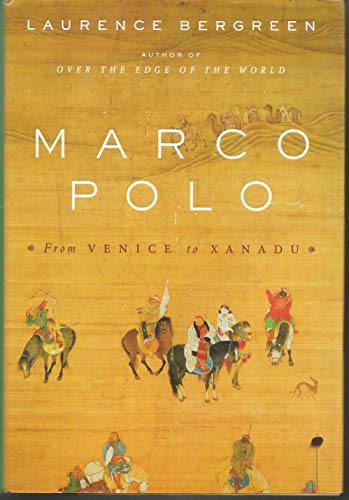
Synopsis
As the most celebrated European to explore Asia, Marco Polo was the original global traveler and the earliest bridge between East and West. A universal icon of adventure and discovery, he has inspired six centuries of popular fascination and spurious mythology. Now, from the acclaimed author of Over the Edge of the World: Magellan’s Terrifying Circumnavigation of the Globe (“Superb . . . A first-rate historical page turner”—The New York Times)—comes the first fully authoritative biography of one of the most enchanting figures in world history. In this masterly work, Marco Polo’s incredible odyssey—along the Silk Road and through all the fantastic circumstances of his life—is chronicled in sumptuous and illuminating detail.
We meet him as a callow young man, the scion of a wealthy Venetian merchant family, only seventeen when he sets out in 1271 with his father and uncle on their journey to Asia. We see him gain the confidence of Kublai Khan, the world’s most feared and powerful leader, and watch him become a trusted diplomat and intelligence agent in the ruler’s inner circle. We are privy to his far-flung adventures on behalf of the Khan, living among the Mongols and other tribes, and traveling to magical cities, some far advanced over the West. We learn the customs of the Khan’s court, both erotic and mercantile, and Polo’s uncanny ability to adapt to them. We follow him on his journey back to Venice, laden with riches, the latest inventions, and twenty-four years’ worth of extraordinary tales.
And we see his collaboration with the famed writer Rustichello of Pisa, who immediately saw in Polo the story of a lifetime; enlivened by his genius for observation, Polo’s tales needed little embellishment. Recorded by Rustichello as the two languished as prisoners of war in a Genoese jail, the Travels would explode the notion of non-Europeans as untutored savages and stand as the definitive description of China until the nineteenth century.
Drawing on original sources in more than half a dozen languages, and on his own travels along Polo’s route in China and Mongolia, Bergreen explores the lingering controversies surrounding Polo’s legend, settling age-old questions and testing others for significance. Synthesizing history, biography, and travelogue, this is the timely chronicle of a man who extended the boundaries of human knowledge and imagination. Destined to be the definitive account of its subject for decades to come, Marco Polo takes us on a journey to the limits of history—and beyond.
"synopsis" may belong to another edition of this title.
Review
Drawing on original writings and walking in the footsteps of Marco Polo himself, Laurence Bergreen's Marco Polo: From Venice to Xanadu is the most definitive biography of the legendary traveler to date, separating the man from his considerable myth.
Look inside Marco Polo (Click on thumbnails to see a larger image):| Marco Polo: a traditional portrait; Granger | Frontispiece of an early published edition of Marco Polo’s Travels, Nuremberg, Germany, 1477; Granger | Kublai Khan, emperor of the world’s largest land-based empire; Granger |
| Marco Polo commanded a Venetian galley similar to this in the Battle of Curzola; Granger | Stone carving on the Marco Polo bridge; Laurence Bergreen | Marco Polo’s vivid and occasionally misinterpreted descriptions of his travels inspired this medieval artist to depict dragons in China; Granger |
Marco Polo timeline (All dates given in the Julian calendar): 1215 - Kublai Khan, the grandson of Genghis Khan and Marco Polo's mentor, is born. 1254 - Marco Polo born in Venice, although one tradition locates his birthplace in the Venetian colony of Dalmatia. 1260 - Kublai Khan becomes leader of the Mongols and in 1271 founds the Yuan ("Origin") Dynasty. 1271 - Young Marco Polo leaves Venice with his father Niccolo and uncle Maffeo, bound for the court of Kublai Khan. 1274 - Kublai Khan oversees a failed Mongol invasion of Japan, as the Mongols, masters of the Steppe, meet their match at sea. 1275 - The three Polos arrive in Shang-du, Kublai Khan's summer palace immortalized by Samuel Taylor Coleridge as Xanadu; Marco begins his years in the service of the Khan. 1276 - 1293 - Marco travels throughout Asia, reaching the coast of India, and possibly Zanzibar, gathering intelligence for Kublai Khan and serving as a tax collector for the Yuan (Mongol) dynasty. 1281 - Kublai Khan's second failed invasion of Japan, a serious blow to his prestige. 1292 - The Polos escort Princess Kokachin to Persia to marry, their last formal service to Kublai Khan before departing. 1294 - Kublai Khan dies, freeing the Polo family, who undertake a dangerous return voyage by sea. 1295 - Marco, his father, and uncle, arrive in Venice after their 24-year absence. They have been away for so long that their fellow Venetians do not recognize them. 1298 - Marco is captured by the Genoese in the Battle of Curzola, according to some accounts, and confined to a cell in Genoa with a romance writer, Rustichello of Pisa, to whom he dictates his adventures in China, his reminiscences of Kublai Khan, his life among the Mongols. 1300 - Safely back in Venice, Marco Polo marries Donata Badoer; the couple has three daughters. 1324 - As manuscript versions of his exploits spread throughout Europe, Marco Polo dies in Venice, claiming that he did not reveal the half of his experiences in his remarkable Travels.
About the Author
Laurence Bergreen is the prize-winning author of Over the Edge of the World: Magellan's Terrifying Circumnavigation of the Globe, as well as James Agee: A Life; Louis Armstrong: An Extravagant Life; Capone: The Man and the Era; and As Thousands Cheer: The Life of Irving Berlin, each considered the definitive work on its subject. A graduate of Harvard University, he lives in New York City. As part of the research for this book, he traveled Marco Polo's route across Mongolia and China.
"About this title" may belong to another edition of this title.
- PublisherKnopf
- Publication date2007
- ISBN 10 140004345X
- ISBN 13 9781400043453
- BindingHardcover
- Edition number1
- Number of pages432
- Rating
Buy New
Learn more about this copy
US$ 17.00
Shipping:
FREE
Within U.S.A.
Other Popular Editions of the Same Title

Top Search Results from the AbeBooks Marketplace
Stock Image
Marco Polo: From Venice to Xanadu
Seller: Goodwill of Colorado, COLORADO SPRINGS, CO, U.S.A.
Seller rating 5 out of 5 stars

Condition: Acceptable. This item is in overall acceptable condition. Covers and dust jackets are intact but may have heavy wear including creases, bends, edge wear, curled corners or minor tears as well as stickers or sticker-residue. Pages are intact but may have minor curls, bends or moderate to considerable highlighting/ writing. Binding is intact; however, spine may have heavy wear. Digital codes may not be included and have not been tested to be redeemable and/or active. A well-read copy overall. Please note that all items are donated goods and are in used condition. Orders shipped Monday through Friday! Your purchase helps put people to work and learn life skills to reach their full potential. Orders shipped Monday through Friday. Your purchase helps put people to work and learn life skills to reach their full potential. Thank you!. Seller Inventory # 466XBX000563
Quantity: 1 available
Stock Image
Marco Polo: From Venice to Xanadu
Seller: ThriftBooks-Phoenix, Phoenix, AZ, U.S.A.
Seller rating 5 out of 5 stars
Hardcover. Condition: Good. No Jacket. Former library book; Pages can have notes/highlighting. Spine may show signs of wear. ~ ThriftBooks: Read More, Spend Less 1.75. Seller Inventory # G140004345XI3N10
Quantity: 1 available
Stock Image
Marco Polo: From Venice to Xanadu
Seller: ThriftBooks-Reno, Reno, NV, U.S.A.
Seller rating 5 out of 5 stars
Hardcover. Condition: Fair. No Jacket. Readable copy. Pages may have considerable notes/highlighting. ~ ThriftBooks: Read More, Spend Less 1.75. Seller Inventory # G140004345XI5N00
Quantity: 1 available
Stock Image
Marco Polo: From Venice to Xanadu
Seller: ThriftBooks-Dallas, Dallas, TX, U.S.A.
Seller rating 5 out of 5 stars
Hardcover. Condition: Good. No Jacket. Former library book; Pages can have notes/highlighting. Spine may show signs of wear. ~ ThriftBooks: Read More, Spend Less 1.75. Seller Inventory # G140004345XI3N10
Quantity: 1 available
Stock Image
Marco Polo: From Venice to Xanadu
Seller: ThriftBooks-Reno, Reno, NV, U.S.A.
Seller rating 5 out of 5 stars
Hardcover. Condition: Good. No Jacket. Pages can have notes/highlighting. Spine may show signs of wear. ~ ThriftBooks: Read More, Spend Less 1.75. Seller Inventory # G140004345XI3N00
Quantity: 2 available
Stock Image
Marco Polo: From Venice to Xanadu
Seller: ThriftBooks-Atlanta, AUSTELL, GA, U.S.A.
Seller rating 5 out of 5 stars
Hardcover. Condition: Fair. No Jacket. Former library book; Readable copy. Pages may have considerable notes/highlighting. ~ ThriftBooks: Read More, Spend Less 1.75. Seller Inventory # G140004345XI5N10
Quantity: 1 available
Stock Image
Marco Polo: From Venice to Xanadu
Seller: ThriftBooks-Phoenix, Phoenix, AZ, U.S.A.
Seller rating 5 out of 5 stars
Hardcover. Condition: Good. No Jacket. Pages can have notes/highlighting. Spine may show signs of wear. ~ ThriftBooks: Read More, Spend Less 1.75. Seller Inventory # G140004345XI3N00
Quantity: 1 available
Stock Image
Marco Polo: From Venice to Xanadu
Seller: ThriftBooks-Atlanta, AUSTELL, GA, U.S.A.
Seller rating 5 out of 5 stars
Hardcover. Condition: Good. No Jacket. Pages can have notes/highlighting. Spine may show signs of wear. ~ ThriftBooks: Read More, Spend Less 1.75. Seller Inventory # G140004345XI3N00
Quantity: 2 available
Stock Image
Marco Polo: From Venice to Xanadu
Seller: ThriftBooks-Phoenix, Phoenix, AZ, U.S.A.
Seller rating 5 out of 5 stars
Hardcover. Condition: Fair. No Jacket. Readable copy. Pages may have considerable notes/highlighting. ~ ThriftBooks: Read More, Spend Less 1.75. Seller Inventory # G140004345XI5N00
Quantity: 1 available
Stock Image
Marco Polo: From Venice to Xanadu
Seller: ThriftBooks-Reno, Reno, NV, U.S.A.
Seller rating 5 out of 5 stars
Hardcover. Condition: Good. No Jacket. Former library book; Pages can have notes/highlighting. Spine may show signs of wear. ~ ThriftBooks: Read More, Spend Less 1.75. Seller Inventory # G140004345XI3N10
Quantity: 1 available