
Items related to When the Spirits Dance Mambo: Growing Up Nuyorican...
Synopsis
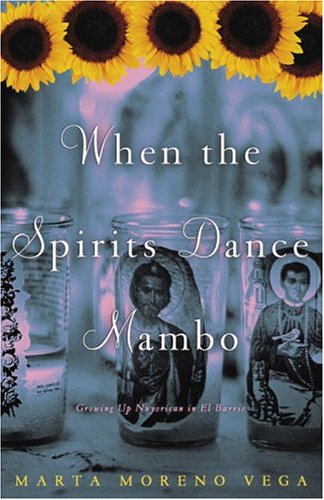
When rock and roll was transforming American culture in the 1950s and ’60s, East Harlem pulsed with the sounds of mambo and merengue. Instead of Elvis and the Beatles, Marta Moreno Vega grew up worshipping Celia Cruz, Mario Bauza, and Arsenio Rodriguez. Their music could be heard on every radio in El Barrio and from the main stage at the legendary Palladium, where every weekend working-class kids dressed in their sharpest suits and highest heels and became mambo kings and queens. Spanish Harlem was a vibrant and dynamic world, but it was also a place of constant change, where the traditions of Puerto Rican parents clashed with their children’s American ideals.
A precocious little girl with wildly curly hair, Marta was the baby of the family and the favorite of her elderly abuela, who lived in the apartment down the hall. Abuela Luisa was the spiritual center of the family, an espiritista who smoked cigars and honored the Afro-Caribbean deities who had always protected their family. But it was Marta’s brother, Chachito, who taught her the latest dance steps and called her from the pay phone at the Palladium at night so she could listen, huddled beneath the bedcovers, to the seductive rhythms of Tito Puente and his orchestra.
In this luminous and lively memoir, Marta Moreno Vega calls forth the spirit of Puerto Rican New York and the music, mysticism, and traditions of a remarkable and quintessentially American childhood.
“Viva Marta Moreno Vega! With honesty, humor, and love, she relives her coming-of-age in Spanish Harlem—the highs and the lows—eloquently documenting how deeply rooted West African cultural traditions are in her rich Puerto Rican heritage. Marta Vega’s memoir makes me want to mambo.” —Susan Taylor, editorial director of Essence and author of Lessons in Living
"synopsis" may belong to another edition of this title.
About the Author
Marta Moreno Vega is the founder and president of the Caribbean Cultural Center/African Diaspora Institute and cofounder of the Global Afro-Latino and Caribbean Initiative/Latin American Studies Program at Hunter College.
From the Inside Flap
When rock and roll was transforming American culture in the 1950s and '60s, East Harlem pulsed with the sounds of mambo and merengue. Instead of Elvis and the Beatles, Marta Moreno Vega grew up worshipping Celia Cruz, Mario Bauza, and Arsenio Rodriguez. Their music could be heard on every radio in El Barrio and from the main stage at the legendary Palladium, where every weekend working-class kids dressed in their sharpest suits and highest heels and became mambo kings and queens. Spanish Harlem was a vibrant and dynamic world, but it was also a place of constant change, where the traditions of Puerto Rican parents clashed with their children's American ideals.
A precocious little girl with wildly curly hair, Marta was the baby of the family and the favorite of her elderly abuela, who lived in the apartment down the hall. Abuela Luisa was the spiritual center of the family, an espiritista who smoked cigars and honored the Afro-Caribbean deities who had always protected their family. But it was Marta's brother, Chachito, who taught her the latest dance steps and called her from the pay phone at the Palladium at night so she could listen, huddled beneath the bedcovers, to the seductive rhythms of Tito Puente and his orchestra.
In this luminous and lively memoir, Marta Moreno Vega calls forth the spirit of Puerto Rican New York and the music, mysticism, and traditions of a remarkable and quintessentially American childhood.
"Viva Marta Moreno Vega! With honesty, humor, and love, she relives her coming-of-age in Spanish Harlem—the highs and the lows—eloquently documenting how deeply rooted West African cultural traditions are in her rich Puerto Rican heritage. Marta Vega's memoir makes me want to mambo." —Susan Taylor, editorial director of Essence and author of Lessons in Living
Reviews
Adult/High School–"Cotito" was the favorite of her grandmother, a high priestess of the Yoruba religion, whom she helped tend her altar. She accompanied Abuela to the botanica in East Harlem and witnessed the occasional possession by spirits. As she grew older, Vega found that these traditions could suffocate as well as nurture. Her parents' acceptance of machismo led to a double standard in the treatment of brother Chachito and his sisters. Mami, a trained nurse, was not to work outside the home because such women "get ideas" and cheat on their husbands. When she disobeyed, Papi's anger and violence were said to be the result of his love. Cotito silently decided that she didn't want such a love, just as she refused to lie to cover for her brother's philandering. Racism was found in the outside world (school, police) and at home: the children were expected to marry lighter-skinned Latinos, and Chachito jokingly called Cotito a "real African." Smart and perceptive, she became a strong young woman, and worked steadily toward her goal of becoming a teacher. At the mostly white arts high school, she and an African-American friend demanded that music from their cultures be included in music appreciation class. While rejecting the negative, she embraced the many positive aspects of her heritage and the love of her family. Cotito is as frank about her own shortcomings as she is about those of others. A vibrant, honest coming-of-age memoir that celebrates culture and community.–Sandy Freund, Richard Byrd Library, Fairfax County, VA
Copyright © Reed Business Information, a division of Reed Elsevier Inc. All rights reserved.
In this vivid work, which shares its title with a 2002 documentary Vega produced, two tales flawlessly merge: one recalls an Afro–Puerto Rican girl's upbringing in 1950s Spanish Harlem; the other explains the background for the author's eventual status as a priestess of the Santeria/Lucumi religion. What could have been a familiar coming-of-age story is made fresh with Vega's painterly detail and use of background music (Celia Cruz, Machito and Tito Puente's sounds are present throughout). The sorrows of early school ("the classroom was a joyless cell") give way to double-dutch jumping, puberty, Vega's first crush and her emerging interest in preserving her family's traditions. "Music," her grandmother Abuela, an espiritista (a sort of spiritual psychic), tells her, "is the food of the soul, and the right music calls the spirits." At Abuela's apartment, Vega learns of the orishas (gods and goddesses) and observes Abuela's bóveda (altar); together, they visit the botánica for healing oils. Lovelorn at 14, Vega confides in Abuela, who summons a spirit named Juango to command her body. "Trying to understand Juango was difficult enough, but talking about sex with a spirit possessing my grandmother's body was startling." And thus the author's future path begins. The spiritual and musical journey Vega takes readers on is informative and inspiring, even for the uninitiated.
Copyright © Reed Business Information, a division of Reed Elsevier Inc. All rights reserved.
As fluidly as a Latin dance band shifts from a swaying ballad into a hip-twitching mambo, so Vega's passionate memoir of growing up in 1950s Spanish Harlem expresses both the burdens and joys of her Puerto Rican heritage. Although despising the machismo that keeps her mother prim and servile, forces girls to contain their sexuality, and ultimately condemns her sister to a loveless marriage, Vega is energized by the tropical rhythms heating up Harlem's legendary dance halls and comforted by her grandmother's mystical connection to Afro-Caribbean spirits. Coming-of-age stories chronicling the struggles of first-generation Latinas are not in short supply, and some clunky phrasings ("Memories are the musical notes that form the composition of our souls") suggest that Vega's training in writing has been secondary to her work as a scholar and priestess of Santeria. Still, readers who enjoyed Sandra Cisneros' The House on Mango Street (1984) and Esmerelda Santiago's When I Was Puerto Rican (1993) will find the experiences limned here affecting; her recollections will also be of interest to researchers in gender and Latin American and Caribbean studies. Jennifer Mattson
Copyright © American Library Association. All rights reserved
Excerpt. © Reprinted by permission. All rights reserved.
one
In Abuela's World
Yo traigo mis flores acabaditas de cortar de varios colores mis flores para tu altar: principes de pura sangre para Chango . . .
I bring my fresh-cut flowers of many colors for your altar: deep, blood red roses for Chango . . .—celina y reutilio, "a santa barbara"
As the music plays, breathe in slowly. Feel the air flow through your body. Close your eyes and hold your breath. When the air feels like it's going to explode inside your chest, hold it longer. Now let it out. Listen. Listen to your heart and to the ta-ta-ta, ta-ta of the clave. Let the clapping rhythm of those two mahogany sticks travel through your body, throbbing in every part of you. Know that if you do not move to the beat, you will burst. That's mambo.
I grew up surrounded by the pulsating rhythms of Tito Puente and Machito and the teasing, sensual songs of Graciela. The deep, robust voice of Celia Cruz brought Africa to our home. In our cramped living room on 102nd Street, my brother taught me to mambo. There, too, my father took my mother in his dark, powerful arms and they swayed to the tune of a jibaro ballad. In the bed we shared, my older sister cried herself to sleep while the radio crooned a brokenhearted lament. And my grandmother, cleaning her altar to the spirits of our ancestors, played songs to the gods and goddesses. Imitating the motions of the sea, she let her body be carried by an imaginary wave, then, taking my hand, encouraged me to follow in her steps. In Abuela's world, our hearts beat to the drum song of the thunder god, Chango, "Cabo e Cabo e Cabosileo . . . Cabo e Cabo e
Cabosileo . . ."
A skinny girl with caramel skin—wide-eyed, wide-eared—I watched and heard and savored it all. As my body recalls my childhood, I journey back to meet family members who live now only in the spirit world but remind me always of who I am and of where I come from. Memories are the musical notes that form the composition of our souls. Feelings churned by memory connect us to the past, help us treasure the present, and can even reveal to us our future. My memories take me on a spiritual, musical voyage to El Barrio.
Mami, can I help Abuela?" I begged.
The herbal and floral aromas coming through our front door signaled that it was Saturday, the day that Abuela, like my mother, spiritually cleansed her apartment. I knew there would be neighbors gathered at my grandmother's door seeking relief from their daily woes. I knew, too, that she would be cooking my favorite dishes.
Most of the women in our building labored in sweatshops or as domestics for the wealthy. Their husbands toiled as janitors, factory workers, and doormen, on the docks or as merchant seamen who rarely saw their families. Others worked as messengers, sold furniture door to door, or hustled as numbers runners. My own father worked in an auto body shop and my mother stayed at home with the three of us—Alberto, called Chachito; Socorro, nicknamed Chachita; and me, Cotito. In the evening, like many other families in the building, Mami, my brother, my sister, and I did piecework—gluing small rhinestones to custom jewelry to earn extra money for household necessities, the glue staining our hands and creating a stench. Considering it women's work, Papi refused to glue rhinestones, as did most of the other men we knew.
The families in my building had left behind the countries of their births for the promise of a better life in Nueva York. For the residents of 330 East 102nd Street in East Harlem, the scents drifting from my Abuela's apartment created a climate all our own, a balm that healed heartache, homesickness, and the pain of the week's thankless hard work.
I sat at our kitchen table watching as Mami poured Spic and Span into the plastic pail filled with hot water. My mother was tall, fair, and strong. Even cleaning, she looked beautiful. She added yerba buena and abre camino leaves, Florida water and tuberose flowers. Ignoring my plea to go to Abuela's, Mami prepared the water to mop the apartment from the back bedroom to the front door. Then my sister or I would take the dirty water out to the sidewalk curb and spill it into the street, throwing out the negative energy it had gathered from our apartment.
"Please let me go," I begged Mami. "Abuela needs me. She gets tired walking back and forth trying to make her altar look pretty." Mami's back was turned, and she couldn't see my sister shooting an angry look at me. I stuck my tongue out at Chachita.
"Mami, she's just trying to get out of helping us," Chachita said, resentment growing in her voice. "Six isn't so young." Chachita was eight years older than I was. "I helped you clean when I was her age. Why can't she?" Mami squeezed and shredded the flowers into tiny pieces. Their sweet fragrance filled the kitchen. My sister tore an old bedsheet into rags to clean the furniture and the miniature glass animals that decorated the top of our wooden television cabinet. Outside on the street below, my father and brother washed our car.
"Bien, go and help Abuela, Cotito," my mother allowed. "As soon as you finish come back to clean with your sister and me." Knowing that I would spend the afternoon in Abuela's apartment, Mami said this for Chachita's benefit. Socorro did not think it fair that I escaped my chores and received endless pampering from Abuela, who always referred to me as la nena, the baby of the family.
I gave Chachita a look of triumph and opened the front door before Mami could change her mind. Letting it slam behind me, I raced down the corridor to Abuela's apartment—as I did every week—my shoes tapping against the porcelain floor tiles.
I could smell the powerful, enticing fragrances of my grandmother's devotion—Florida water, rompe saraguey and abre camino plants, Pompeii cologne—wafting from her door down the hall.
The strong fragrance of las siete potencias—the incense of the seven powers—signaled that she had finished spiritually mopping her apartment and was now making certain that any carga, or heaviness, would be overpowered, driven away by the strong smell. It was her desire that the energy leave not only her apartment but our whole building. I wondered if the smoke was lifting unwanted spirits from around me just as it removed them from Abuela's small apartment.
Today, three neighbors stood around Abuela's open doorway, but she was not to be seen. Their arms full of groceries from the local bodega and laundry they had gathered from the clothing lines in the basement yard, they stood calling compliments and questions inside.
"Dona Luisa, is that jasmine incense you're burning today?" Gloria from apartment 4 asked shyly.
"Si, jazmin con myrrah," Abuela's husky voice called back from inside. She did not make an appearance at the door. Guarding her privacy and her secrets, she never gave away the ingredients of her ritual mixtures. "Caridad's botanica has all the ingredients," she added, trying to dispel the notion that she was holding back information. Abuela knew that neighbors hoped that her spiritual vision would help them solve their problems. She sometimes volunteered information transmitted by the spirits, but she did not like people imposing themselves upon her goodwill.
Jesus from apartment 6 stood quietly and patted my head as I approached. A tall, pensive man the color of a coffee bean, he wore thick glasses and walked with a cane. Abuela was his dear friend, and he put up with her need for privacy. Mami and Papi often took Jesus to the supermarket, or my brother and sister would run to the neighborhood bodega for him. Jesus had no family but us.
Sweet, robust Lula adjusted her overstuffed grocery bags and peered into the doorway, hoping to snatch a moment with my elusive grandmother.
Gloria, a pious middle-aged woman, carried sadness on her shoulders like a shawl. Abandoned by her husband, she worked long hours in a sewing factory to support herself and three children. She was constantly in search of a way, a remedio, to get her husband back. The friendly trio formed a semicircle around Abuela's door, talking as if in a comfortable living room, unconcerned that their host had not joined them.
"Dona Luisa, your granddaughter is here," Lula called into Abuela's apartment. Approaching the door, I could hear Abuela's slippers—she called them mis chanclas—brush against the floor as she shuffled out to greet me.
Dressed all in white as always, a bright white kerchief tied around her head, my tiny, ebony-skinned Abuela grinned down at me. "I thought you had forgotten your old Abuela," she teased. "I was ready to give away los dulces de coco—the coconut candies I made for you."
Abuela waited a moment to see my reaction. I melted into her arms, hugging her tightly. "I'm here to help you, Abuela. Please don't give away los dulces." She kissed my cheek with warm, cigar-tainted lips, looked up at Lula, and said, "When you have children, your heart expands with love. But when you have grandchildren, your heart is an open door."
Laughing, Lula agreed: "That's how I feel about my grandchildren, Luisa. They have a revolving door to my heart." Taking a deep breath, Lula shook her head and said, "The smell of the incense is so heavenly it transports me away. Is this what the mixture is supposed to do? Does it have a special meaning?"
"I was wondering the same thing," added Gloria shyly.
Abuela teased them in return. "No," she said, "it is just to get rid of the strong smell of the bleach the janitor soaks the hallways with."
Laughing in a deep baritone, Jesus commented, "Luisa, you old fox, just tell us your secret."
"Of course the incense has a spiritual meaning," said Abuela,...
"About this title" may belong to another edition of this title.
Search results for When the Spirits Dance Mambo: Growing Up Nuyorican...

Stock Image
When the Spirits Dance Mambo
Seller: World of Books (was SecondSale), Montgomery, IL, U.S.A.
Seller rating 5 out of 5 stars

Paperback. Condition: Good. When rock and roll was transforming American culture in the 1950s and '60s, East Harlem pulsed with the sounds of mambo and merengue. Instead of Elvis and the Beatles, Marta Moreno Vega grew up worshiping Celia Cruz, Mario Bauza, and Arsenio Rodriguez. Their music could be heard on every radio in El Barrio and from the main stage at the legendary Palladium, where every weekend working-class kids dressed in their sharpest suits and highest heels and became mambo kings and queens. Spanish Harlem was a vibrant and dynamic world, but it was also a place of constant change, where the traditions of Puerto Rican parents clashed with their children's American ideals. A precocious little girl with wildly curly hair, Marta was the baby of the family and the favorite of her elderly abuela, who lived in the apartment down the hall. Abuela Luisa was the spiritual center of the family, an espiritista who smoked cigars and honored the Afro-Caribbean deities who had always protected their family. But it was Marta's brother, Chachito, who taught her the latest dance steps and called her from the pay phone at the Palladium at night so she could listen, huddled beneath the bedcovers, to the seductive rhythms of Tito Puente and his orchestra. In this luminous and lively memoir, Marta Moreno Vega calls forth the spirit of Puerto Rican New York and the music, mysticism, and traditions of a remarkable and quintessentially American childhood. Seller Inventory # 00110898626
Stock Image
When the Spirits Dance Mambo
Seller: World of Books Inc, Montgomery, IL, U.S.A.
Seller rating 4 out of 5 stars

Paperback. Condition: Good. When rock and roll was transforming American culture in the 1950s and '60s, East Harlem pulsed with the sounds of mambo and merengue. Instead of Elvis and the Beatles, Marta Moreno Vega grew up worshiping Celia Cruz, Mario Bauza, and Arsenio Rodriguez. Their music could be heard on every radio in El Barrio and from the main stage at the legendary Palladium, where every weekend working-class kids dressed in their sharpest suits and highest heels and became mambo kings and queens. Spanish Harlem was a vibrant and dynamic world, but it was also a place of constant change, where the traditions of Puerto Rican parents clashed with their children's American ideals. A precocious little girl with wildly curly hair, Marta was the baby of the family and the favorite of her elderly abuela, who lived in the apartment down the hall. Abuela Luisa was the spiritual center of the family, an espiritista who smoked cigars and honored the Afro-Caribbean deities who had always protected their family. But it was Marta's brother, Chachito, who taught her the latest dance steps and called her from the pay phone at the Palladium at night so she could listen, huddled beneath the bedcovers, to the seductive rhythms of Tito Puente and his orchestra. In this luminous and lively memoir, Marta Moreno Vega calls forth the spirit of Puerto Rican New York and the music, mysticism, and traditions of a remarkable and quintessentially American childhood. Seller Inventory # CIN1400049245G
Stock Image
When the Spirits Dance Mambo: Growing Up Nuyorican in El Barrio
Seller: GoldBooks, Denver, CO, U.S.A.
Seller rating 5 out of 5 stars
Paperback. Condition: new. New Copy. Customer Service Guaranteed. Seller Inventory # 58Z81_27_1400049245