Items related to The Eagle's Throne: A Novel
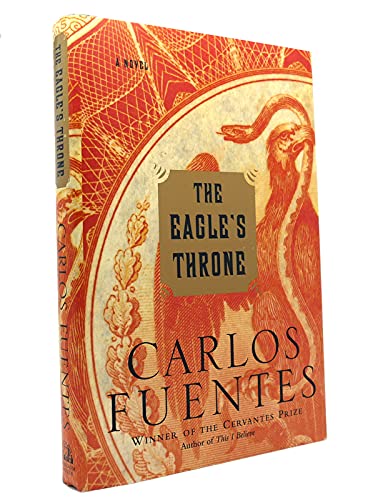

Here is a true literary event–the long-awaited new novel by Carlos Fuentes, one of the world’s great writers. By turns a tragedy and a farce, an acidic black comedy and an indictment of modern politics, The Eagle’s Throne is a seriously entertaining and perceptive story of international intrigue, sexual deception, naked ambition, and treacherous betrayal.
In the near future, at a meeting of the United Nations Security Council, Mexico’s idealistic president has dared to vote against the U.S. occupation of Colombia and Washington’s refusal to pay OPEC prices for oil. Retaliation is swift. Concocting a “glitch” in a Florida satellite, America’s president cuts Mexico’s communications systems–no phones, faxes, or e-mails–and plunges the country into an administrative nightmare of colossal proportions.
Now, despite the motto that “a Mexican politician never puts anything in writing,” people have no choice but to communicate through letters, which Fuentes crafts with a keen understanding of man’s motives and desires. As the blizzard of activity grows more and more complex, political adversaries come out to prey. The ineffectual president, his scheming cabinet secretary, a thuggish and ruthless police chief, and an unscrupulous, sensual kingmaker are just a few of the fascinating characters maneuvering and jockeying for position to achieve the power they all so desperately crave.
In the near future, at a meeting of the United Nations Security Council, Mexico’s idealistic president has dared to vote against the U.S. occupation of Colombia and Washington’s refusal to pay OPEC prices for oil. Retaliation is swift. Concocting a “glitch” in a Florida satellite, America’s president cuts Mexico’s communications systems–no phones, faxes, or e-mails–and plunges the country into an administrative nightmare of colossal proportions.
Now, despite the motto that “a Mexican politician never puts anything in writing,” people have no choice but to communicate through letters, which Fuentes crafts with a keen understanding of man’s motives and desires. As the blizzard of activity grows more and more complex, political adversaries come out to prey. The ineffectual president, his scheming cabinet secretary, a thuggish and ruthless police chief, and an unscrupulous, sensual kingmaker are just a few of the fascinating characters maneuvering and jockeying for position to achieve the power they all so desperately crave.
"synopsis" may belong to another edition of this title.
About the Author:
Carlos Fuentes is the author of more than twenty books, including This I Believe, The Death of Artemio Cruz, and The Old Gringo. He served as Mexico’s ambassador to France from 1975 to 1977. He has received many awards and honors, including the Rómulo Gallegos Prize, the National Prize in Literature (Mexico’s highest literary award), the Cervantes Prize, and the inaugural Latin Civilization Award. He has also been the recipient of France’s Legion of Honor medal, Italy’s Grinzane Cavour Award, Spain’s Prince of Asturias Award, and Brazil’s Order of the Southern Cross. His work has appeared in The Nation, Vanity Fair, The New York Times, The New York Times Book Review, the Los Angeles Times Book Review, and The Washington Post Book World. He currently divides his time between Mexico City and London.
From The Washington Post:
Every six years, a Mexican president's term comes to an end, and Mexicans turn their eyes, uneasily and even fearfully, toward the ritual of a new president's selection and ascension to the "Eagle's Throne." Officially, this has always been decided by national election, even during the 70 years when the Party of the Institutionalized Revolution held power and the only "election" that mattered was the furtive process by which the outgoing president chose his successor. Even now, as President Vicente Fox concludes his term and candidates from three different parties have a legitimate chance to win the election in July, many Mexicans still believe that the real process is happening out of sight -- "in the shadows," as Carlos Fuentes writes, "where real power is wielded."
Mexicans watch their election campaigns as if scrutinizing a murky body of water, trying to decipher what every ripple, bubble or splash indicates about what is happening beneath the surface. Rumors say the polls are manipulated by the pro-business media barons. Whom does Carlos Slim, the nation's most powerful magnate, want to win? Whom do the corrupt union bosses and the narcos favor? And isn't it true that the Machiavellian ex-president Carlos Salinas, back from his exile in Ireland, is really pulling the strings?
Such speculative machinations are the subject of Fuentes's The Eagle's Throne, published in 2002 in Mexico and now appearing for the first time in an energetic English translation by Kristina Cordero. Years ago, I sat in on a wonderful college course taught by Fuentes, and I distinctly recall him saying that he didn't like science fiction because "the future doesn't exist." The Eagle's Throne is set in 2020, but it's a futuristic novel that subverts the genre's pretensions by refusing to imagine a world much changed. In this 2020, a 93-year-old Fidel Castro still rules Cuba, the Rolling Stones are still touring, and undocumented migrants still pour across the violent U.S. border.
Alas, in this case, the world in turn has subverted the author's pretensions by changing a great deal in the short time between the novel's completion and its publication. People in Fuentes's 2020 still remember the Y2K "millennium bug" rather than 9/11, which is unmentioned in the book. It's the war on drugs, rather than any specter of terrorism, that drives the U.S. war machine. And while it's easy to believe that in 2020 Mexicans will remember George W. Bush -- just think of how that border "wall" is destined to loom in their national consciousness -- it's difficult to imagine he'll still be the subject of so many commonplace insults: "the despicable Bush Jr.," "Junior, a totally clueless man, a ventriloquist's dummy." Fuentes, writing before the 2003 Iraq invasion, misreads the nature of Bush's so-called imperial presidency, which is depicted here as driven solely by opinion polls, Congress and news media opinion: "The executive branch only gets its way in so far as !
it sides with all these forces."
In Fuentes's 2020, the United States has invaded and occupied Colombia. The Mexican president has called for an end to the occupation and refused to lower oil prices. In retaliation, the United States, which controls all of Mexico's communications systems, has cut off the country's Internet, telephones, faxes -- everything. ("Y2K" is invoked to provide some explanation of how this might happen.) And so the novel's characters are forced to communicate by letter, in violation of their politicians' creed never to leave anything in writing.
If this dire political crisis soon seems mostly forgotten by the book's characters, it is because this is essentially a satiric novel whose real target is the way politics and presidential succession work in Mexico now. The somewhat cumbersome futuristic framework merely provides Fuentes with a rationale for launching an epistolary novel in the exuberantly cynical manner of Les Liaisons Dangereuses.
The central correspondent, María del Rosario Galván, though nearing 50, is a beautiful, wily and ambitious consort of powerful men. She considers "politics to be the public expression of private passions. . . . But passions are very arbitrary forms of conduct, and politics is a discipline." At first, the object of María's scheming is Nicolás Valdivia, 15 years her junior, a darkly handsome and ambitious Mexican graduate of Paris's Ecole Nationale d'Administration. "Start opening those doors, my child, one by one," she instructs him. "Beyond the last threshold is my bedroom. The last key unlocks my body. Nicolás Valdivia: I will be yours when you are the President of Mexico."
She knows how to help him get there. In this Mexico, "he who doesn't deceive, doesn't achieve." Politics is the art of the lie: "The successful cultivation of lies is a fulltime job. Which is precisely what the political life allows for."
Maria's real ambitions, shared by most of the book's characters, are aimed at the presidential election of 2024. Maria, it turns out, is actually scheming on behalf of her longtime lover, the veteran politician Bernal Herrera. She and Herrera have many rivals, most of them far more reprehensible than they. Herrera claims that he wants to "create a country with laws that we are prepared to enforce and obey." But this is no country for naive idealists. The book offers a gallery of political characters who range from unequivocally venal to ruthless connoisseurs of necessary evils. "Certain areas of Mexican reality are so dark that only people with dirty hands can effectively control them," says the presidential adviser aptly known as Seneca. "Only those who were corrupt were free," he adds. "We created a culture of illegality."
As depicted by Fuentes, Mexican politics is in many ways the expression of a Mexican essentialism: "The president must prove that there's only one voice in Mexico -- his own. That was the meaning of the Aztec emperor's name, Tlatoani, god of the Great Voice." But that doesn't mean politics to the north is any cleaner: "Gringos know how to multiply Mexican vice by the thousand and hide it by the million."
Perhaps the novel's most formidable figure is a ghostly former president known as the Old Man Under the Arches, obviously inspired by Carlos Salinas. Installed in a café by the Veracruz central plaza, he offers oracle-like political wisdom and warnings to his scheming visitors. The most instructive involve a former presidential candidate believed to have been murdered, Tomás Moctezuma Moro. "He was going to put an end to corruption," Salinas remembers. "He said it was the lowest form of stealing from the poor. . . . 'Slow down, Tomás,' I told him." Corruption "lubricates" the Mexican nation; such a man was bound to cause alarm. The Old Man's confession regarding Moctezuma Moro's fate -- which echoes what the Mexican vox populi has long whispered about Salinas-Colosio -- is perhaps the novel's most powerful moment.
Fuentes -- who wrote an introduction to Salinas's memoirs -- belongs to a generation of eminent Latin American writers who like to take strong political positions and to be close to power and to the powerful. In Fuentes's case, this involvement seems to have provided a great deal of inside knowledge about how political power is actually wielded in Latin America. In The Eagle's Throne, he portrays and dissects the tragicomedy of Mexican political culture with an air of extraordinary authority and remorseless humor. As someone who, here in Mexico City, has become a daily observer of this very muddy Mexican election campaign, I can attest that the novel certainly seems prescient: "We resign ourselves to throwing meat to the lions every six years," says Congresswoman Tardegarda. "But the system doesn't change."
Other sources of this book's considerable pleasures are Fuentes's characteristic dazzling, razor-sharp, intellectual flights. In his vast and multi-faceted oeuvre, this may be a minor work, but it provides a feast of political insight, aphorisms and maxims, in the spirit of Machiavelli and Sun Tzu's The Art of War:
"Before becoming president, a man has to suffer and learn. If not, he'll suffer and learn during his presidency, at the country's expense."
"Politics is the art of swallowing frogs without flinching."
"Something indispensable in politics: the ability to manage groups of insecure men."
For anyone aspiring to be a Mexican politician, this should be an indispensable manual. For those seeking to apply such knowledge -- if only as a vicarious pleasure -- to their own circumstances, well, it can only make you wiser.
Reviewed by Francisco Goldman
Copyright 2006, The Washington Post. All Rights Reserved.
"About this title" may belong to another edition of this title.
- PublisherRandom House
- Publication date2006
- ISBN 10 1400062470
- ISBN 13 9781400062478
- BindingHardcover
- Number of pages352
- Rating
Buy New
Learn more about this copy
US$ 14.95
Shipping:
US$ 5.45
Within U.S.A.
Top Search Results from the AbeBooks Marketplace
Stock Image
The Eagle's Throne: A Novel [Hardcover] Fuentes, Carlos and Cordero, Kristina
Published by
Random House
(2006)
ISBN 10: 1400062470
ISBN 13: 9781400062478
New
Hardcover
Quantity: 1
Seller:
Rating

Book Description Hardcover. Condition: New. In shrink wrap. Seller Inventory # 10-13721
Buy New
US$ 14.95
Convert currency
Stock Image
The Eagle's Throne: A Novel
Published by
Random House
(2006)
ISBN 10: 1400062470
ISBN 13: 9781400062478
New
Hardcover
Quantity: 1
Seller:
Rating
Book Description Hardcover. Condition: new. Brand New Copy. Seller Inventory # BBB_new1400062470
Buy New
US$ 20.06
Convert currency
Stock Image
The Eagle's Throne: A Novel
Published by
Random House
(2006)
ISBN 10: 1400062470
ISBN 13: 9781400062478
New
Hardcover
Quantity: 1
Seller:
Rating
Book Description Hardcover. Condition: new. New. Fast Shipping and good customer service. Seller Inventory # Holz_New_1400062470
Buy New
US$ 21.68
Convert currency
Stock Image
The Eagle's Throne: A Novel
Published by
Random House
(2006)
ISBN 10: 1400062470
ISBN 13: 9781400062478
New
Hardcover
Quantity: 1
Seller:
Rating
Book Description Hardcover. Condition: new. Buy for Great customer experience. Seller Inventory # GoldenDragon1400062470
Buy New
US$ 24.18
Convert currency
Stock Image
The Eagle's Throne: A Novel
Published by
Random House
(2006)
ISBN 10: 1400062470
ISBN 13: 9781400062478
New
Hardcover
Quantity: 1
Seller:
Rating
Book Description Hardcover. Condition: new. New. Seller Inventory # Wizard1400062470
Buy New
US$ 26.11
Convert currency
Stock Image
The Eagle's Throne: A Novel
Published by
Random House
(2006)
ISBN 10: 1400062470
ISBN 13: 9781400062478
New
Hardcover
Quantity: 1
Seller:
Rating
Book Description Condition: New. Buy with confidence! Book is in new, never-used condition 0.7. Seller Inventory # bk1400062470xvz189zvxnew
Buy New
US$ 31.80
Convert currency
Stock Image
The Eagle's Throne: A Novel
Published by
Random House
(2006)
ISBN 10: 1400062470
ISBN 13: 9781400062478
New
Hardcover
Quantity: 1
Seller:
Rating
Book Description Hardcover. Condition: new. New Copy. Customer Service Guaranteed. Seller Inventory # think1400062470
Buy New
US$ 27.58
Convert currency
Stock Image
The Eagle's Throne: A Novel
Published by
Random House
(2006)
ISBN 10: 1400062470
ISBN 13: 9781400062478
New
Hardcover
Quantity: 1
Seller:
Rating
Book Description Hardcover. Condition: New. Seller Inventory # Abebooks445436
Buy New
US$ 59.00
Convert currency
Stock Image
THE EAGLE'S THRONE: A NOVEL
Published by
Random House
(2006)
ISBN 10: 1400062470
ISBN 13: 9781400062478
New
Hardcover
Quantity: 1
Seller:
Rating
Book Description Condition: New. New. In shrink wrap. Looks like an interesting title! 0.7. Seller Inventory # Q-1400062470
Buy New
US$ 96.81
Convert currency