
Items related to America's Constitution: A Biography
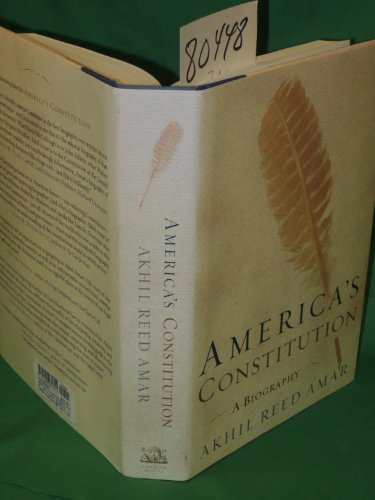
Synopsis
In America’s Constitution, one of this era’s most accomplished constitutional law scholars, Akhil Reed Amar, gives the first comprehensive account of one of the world’s great political texts. Incisive, entertaining, and occasionally controversial, this “biography” of America’s framing document explains not only what the Constitution says but also why the Constitution says it.
We all know this much: the Constitution is neither immutable nor perfect. Amar shows us how the story of this one relatively compact document reflects the story of America more generally. (For example, much of the Constitution, including the glorious-sounding “We the People,” was lifted from existing American legal texts, including early state constitutions.) In short, the Constitution was as much a product of its environment as it was a product of its individual creators’ inspired genius.
Despite the Constitution’s flaws, its role in guiding our republic has been nothing short of amazing. Skillfully placing the document in the context of late-eighteenth-century American politics, America’s Constitution explains, for instance, whether there is anything in the Constitution that is unamendable; the reason America adopted an electoral college; why a president must be at least thirty-five years old; and why–for now, at least–only those citizens who were born under the American flag can become president.
From his unique perspective, Amar also gives us unconventional wisdom about the Constitution and its significance throughout the nation’s history. For one thing, we see that the Constitution has been far more democratic than is conventionally understood. Even though the document was drafted by white landholders, a remarkably large number of citizens (by the standards of 1787) were allowed to vote up or down on it, and the document’s later amendments eventually extended the vote to virtually all Americans.
We also learn that the Founders’ Constitution was far more slavocratic than many would acknowledge: the “three fifths” clause gave the South extra political clout for every slave it owned or acquired. As a result, slaveholding Virginians held the presidency all but four of the Republic’s first thirty-six years, and proslavery forces eventually came to dominate much of the federal government prior to Lincoln’s election.
Ambitious, even-handed, eminently accessible, and often surprising, America’s Constitution is an indispensable work, bound to become a standard reference for any student of history and all citizens of the United States.
"synopsis" may belong to another edition of this title.
About the Author
Akhil Reed Amar graduated from Yale College and Yale Law School, and has been a member of the Yale Law School faculty since 1985. He is the author of The Bill of Rights: Creation and Reconstruction and has written widely on constitutional issues for The New York Times, The Washington Post, and Los Angeles Times. He lives in Woodbridge, Connecticut, with his wife and three children.
Reviews
By granting federal judges lifetime tenure, our Constitution did not merely seek to guarantee the independence of the judiciary but also its stability. Thus the recent twin vacancies on the Supreme Court portend dramatic changes in the personality of an institution not built for hairpin turns. But the uniqueness of the moment has largely been lost to common perception because the political rhetoric surrounding it is so familiar. When President Bush first introduced John G. Roberts Jr., who ultimately became his choice to replace the late William Rehnquist as the 17th chief justice, Bush said he was confident that Roberts "will strictly apply the Constitution" and would "not legislate from the bench." The president chose his phrases carefully: "Strict construction" of the actual words of the Constitution has been political code for some time now. Conservatives have been calling for unrelenting adherence to the sacred founding text since the 1960s in the wake of decisions like Griswold v. Connecticut, which struck down a state ban on contraceptive sales; Justice William O. Douglas, speaking for the court, determined that there was a constitutional right to marital privacy divined because the "specific guarantees of the Bill of Rights have penumbras formed by emanations from those guarantees." (Ironically, during his confirmation hearings, Roberts agreed with the result in Griswold and with the fact that there is a constitutional right of marital privacy.)
But leaving aside the shapes found in the shadows, what exactly does the Constitution say? It's a fair bet that many on both sides of the "strict construction" debate don't really know; after all, a recent poll by the American Bar Association indicated that nearly half of all Americans couldn't even identify the three branches of government.
Thus Akhil Reed Amar's America's Constitution: A Biography is auspiciously timed. The book's aim -- in the words of Amar, a professor at Yale Law School -- is "introducing the reader both to the legal text (and its consequences) and to the political deeds that gave rise to the text." This volume is nothing less than a word-by-word examination of the controlling phrases in the Constitution, beginning with the preamble and continuing through the 27th and most recent amendment. The result is a book that is elegantly written, thorough but concise, and consistently enlightening. As the subject suggests, however, it is far from light reading.
In college, I was taught that the Constitution was essentially a reactionary document, a view that had become standard in the wake of the historian Charles A. Beard's epochal 1913 study, An Economic Interpretation of the Constitution of the United States. Beard had contended that the Declaration of Independence contained a broadly idealistic vision of American democracy premised on John Locke's notion that "all men are created equal." The Constitution, on the other hand, was meant to serve the interests of the wealthy; it subverted democratic ideals, especially with its odious compromise providing that each slave be counted as three-fifths of a person for purposes of determining the population upon which congressional districts would be based.
Not so, Amar argues. Beginning with its ringing first words -- "We the People of the United States" -- the Constitution, in his view, embodies a profoundly democratic vision of the nation it summoned into being. He points out that the ratification process for the new Constitution "allowed a uniquely broad class of citizens to vote" for the delegates to the state conventions that approved the document -- often reducing (or, in the case of New York, entirely abandoning) property qualifications for free adult males wanting to vote. While an electorate that excluded more than half the voting-age population is nothing to celebrate by contemporary lights, Amar notes that at the time "all this was breathtakingly novel. In 1787, democratic self-government existed almost nowhere on earth." He buttresses this point repeatedly as he analyzes the Constitution's provisions, emphasizing, for example, Madison's celebration that the Constitution established "no qualification of wealth, of birth, of religious faith, or of civil profession" for election to any federal office, including the presidency.
Indeed, Amar posits that the idea of a fundamental equality between citizens was pivotal if the Constitution was to accomplish the strategic aims of the federalists, who wanted to create a durable union with a united defense. They were inspired, in large measure, by a fear that the former colonies were headed the way of Europe, a continent of pocket sovereignties beset by perpetual rivalries and wars. By emphasizing the conviction that power was derived from the people rather than from the states, the Framers found an intellectual foundation for a perpetual union from which no individual state could then withdraw.
That vision, however, collided with the reality that the sovereign states had to be persuaded to join. To accomplish that, the Framers adopted the three-fifths rule, which guaranteed that the slaveholding states, which would be outnumbered in the new Senate, could offset that advantage by wielding political authority in the House greater than their actual number of voters. Indeed, in one of his most fascinating asides, Amar argues that the electoral college -- often derided as one more anti-democratic mechanism intended to prevent the people from directly choosing their president -- was in fact an element of this compromise with the South. Direct election of the president, he argues, was impossible in 1787; after all, before the rise of political parties, presidential candidates were virtually unknown outside their home states. The point of the electoral college, which apportioned votes among the states based on their total number of representatives in the House and Senate, was to extend the legislative power that the South had achieved with the three-fifths rule to the executive branch as well.
As one expects from the best history, America's Constitution illumines many contemporary debates. One of the book's principal lessons is an unsurprising one: Even careful attention to the actual words of the Constitution can lead to interpretative disputes. For example, as was often evident during the Roberts hearings, many on both sides of the aisle in Congress have been greatly chagrined by a series of Rehnquist court decisions espousing a view that observers have labelled "the New Federalism." These opinions have struck down congressional enactments on the grounds that they do not fall within the powers granted Congress under the "commerce clause" and require that the issues addressed be left to the states. (Article I empowers Congress "To regulate Commerce with foreign Nations, and among the several States. . . . ") One reason these decisions came as such a surprise is that "Commerce" has traditionally been read by the Supreme Court as referring to commercial activity, leaving Congress free to act whenever there is any national economic effect to the conduct it has sought to regulate. But in 2000, in United States v. Morrison, the Rehnquist court struck down a portion of the 1994 Violence Against Women Act that had created a federal right to sue for gender-inspired violence, with the chief justice stating that the commerce clause still requires "a distinction between what is truly national and what is truly local." In these pages, Amar contributes a novel interpretation that might clarify the present debate and even bolster the New Federalism. He notes that " 'commerce' also had in 1787, and retains even now, a broader meaning referring to all forms of intercourse in the affairs of life." So read, Congress's power to act would hinge not on the question of whether an activity had a potential economic effect but whether "a given problem genuinely spilled across state or national lines."
On the other hand, Amar also emphasizes that contemporary judicial power, in which even the supposedly conservative Rehnquist court freely declared acts of Congress constitutionally out-of-bounds, may itself be a departure from the original text, notwithstanding the mantra-like invocations of "strict construction." The Constitution speaks repeatedly of a "supreme Court" -- with, as Amar points out, a small "s." As envisioned by the framers, the judicial branch was clearly subordinate to the other two. Judges were selected through the combined power of the president and Senate, and the courts' authority to hear appeals was to be exercised "with such Exceptions, and under such Regulations as the Congress shall make." The size of the Supreme Court and the very existence and location of inferior federal courts were purely matters of congressional will. Thus the words of the Constitution give little reason to anticipate that the Supreme Court, for example, would decide a presidential election, as it did in 2000, rather than leaving the matter to Congress. Amar's gloss on the text helps explain a growing cleavage on the right in which congressional conservatives like House Majority Leader Tom DeLay (R-Tex.) have recently criticized even the Rehnquist court for having far overreached its constitutional role.
I have only one cavil with this book, and that does not deal with its merits but with the way it is being marketed. Amar's publisher calls this a "general-audience book." If that means that Amar writes with ease and precision and largely avoids the desiccated abstractions of constitutional analysis -- no lay person would want to try to understand the differences between "strict scrutiny" and "medium scrutiny," for example -- it is surely true. But the subtitle "A Biography" suggests that, like recent popular volumes about John Adams, George Washington and Alexander Hamilton, this is another exciting story of America's founding. Amar is a chaired professor at one of America's best law schools, and his book is, at heart, a scholarly work of intellectual history, accompanied by 128 pages of endnotes. It is about ideas and words, not personalities. Even James Wilson, whom Amar promotes as a framer whose significance and wisdom have been overlooked, appears here only as a voice without a body or biography.
I expect to be taking Amar's volume off my shelf for years to come as an indispensable reference whenever I want to know more about the actual words that underpin contemporary constitutional debates. But there is no dramatic arc to this book, no story to its history: It simply goes from the front of the Constitution to the back. It is, however, an uncommonly engaging work of scholarship and deserves to be valued as such.
Reviewed by Scott Turow
Copyright 2005, The Washington Post. All Rights Reserved.
Starred Review. You can read the U.S. Constitution, including its 27 amendments, in about a half-hour, but it takes decades of study to understand how this blueprint for our nation's government came into existence. Amar, a 20-year veteran of the Yale Law School faculty, has that understanding, steeped in the political history of the 1780s, when dissatisfaction with the Articles of Confederation led to a constitutional convention in Philadelphia, which produced a document of wonderful compression and balance creating an indissoluble union.Amar examines in turn each article of the Constitution, explaining how the framers drew on English models, existing state constitutions and other sources in structuring the three branches of the federal government and defining the relationship of the that government to the states.Amar takes on each of the amendments, from the original Bill of Rights to changes in the rules for presidential succession. The book squarely confronts America's involvement with slavery, which the original Constitution facilitated in ways the author carefully explains.Scholarly, reflective and brimming with ideas, this book is miles removed from an arid, academic exercise in textual analysis. Amar evokes the passions and tumult that marked the Constitution's birth and its subsequent revisions. Only rarely do you find a book that embodies scholarship at its most solid and invigorating; this is such a book.
Copyright © Reed Business Information, a division of Reed Elsevier Inc. All rights reserved.
Amar, a Yale Law School professor, approaches the Constitution with a perspective that is both accessible and unconventional. He gets into the formative process of our most revered doctrine of governance by placing it in the context of law, history, and political science. Yet he broadens his focus beyond the Philadelphia constitutional convention to include popular conversation and competing values. Amar views America's foundation as a corporate merger, reflecting 13 colonies with different legal charters and interests. He raises central questions: Was the constitutional process democratic? Was it pro-slavery? He explores the context of the subsequent amendments, initially the Bill of Rights, then those associated with the Reconstruction era through the civil rights era. Amar dares to incorporate contemporary concerns around the amendments that have often prodded us toward achieving our otherwise unrealized ideals. There is a fluidity to Amar's analysis that contrasts with those strict constructionists and those with vested interests in the original intent of our Constitution, as if such ground were sacred. Vernon Ford
Copyright © American Library Association. All rights reserved
Excerpt. © Reprinted by permission. All rights reserved.
Chapter 1
In the Beginning
The Pennsylvania Packet, and Daily Advertiser (September 19, 1787).
When, after a summer of closed meetings in Philadelphia, America’s leading statesmen went public with their proposed Constitution on September 17, 1787, newspapers rushed to print the proposal in its entirety. In several printings, the dramatic words of the Preamble appeared in particularly large type.
It started with a bang. Ordinary citizens would govern themselves across a continent and over the centuries, under rules that the populace would ratify and could revise. By uniting previously independent states into a vast and indivisible nation, New World republicans would keep Old World monarchs at a distance and thus make democracy work on a scale never before dreamed possible.
“We . . . do”
With simple words placed in the document’s most prominent location, the Preamble laid the foundation for all that followed. “We the People of the United States, . . . do ordain and establish this Constitution . . .”
These words did more than promise popular self-government. They also embodied and enacted it. Like the phrases “I do” in an exchange of wedding vows and “I accept” in a contract, the Preamble’s words actually performed the very thing they described. Thus the Founders’ “Constitution” was not merely a text but a deed—a constituting. We the People do ordain. In the late 1780s, this was the most democratic deed the world had ever seen.
Behind this act of ordainment and establishment stood countless ordinary American voters who gave their consent to the Constitution via specially elected ratifying conventions held in the thirteen states beginning in late 1787. Until these ratifications took place, the Constitution’s words were a mere proposal—the text of a contract yet to be accepted, the script of a wedding still to be performed.
The proposal itself had emerged from a special conclave held in Philadelphia during the summer of 1787. Twelve state governments—all except Rhode Island’s—had tapped several dozen leading public servants and private citizens to meet in Philadelphia and ponder possible revisions of the Articles of Confederation, the interstate compact that Americans had formed during the Revolutionary War. After deliberating behind closed doors for months, the Philadelphia conferees unveiled their joint proposal in mid-September in a document signed by thirty-nine of the continent’s most eminent men, including George Washington, Benjamin Franklin, James Wilson, Roger Sherman, James Madison, Alexander Hamilton, Gouverneur Morris, John Rutledge, and Nathaniel Gorham. When these notables put their names on the page, they put their reputations on the line.
An enormous task of political persuasion lay ahead. Several of the leaders who had come to Philadelphia had quit the conclave in disgust, and others who had stayed to the end had refused to endorse the final script. Such men—John Lansing, Robert Yates, Luther Martin, John Francis Mercer, Edmund Randolph, George Mason, and Elbridge Gerry—could be expected to oppose ratification and to urge their political allies to do the same. No one could be certain how the American people would ultimately respond to the competing appeals. Prior to 1787, only two states, Massachusetts and New Hampshire, had ever brought proposed state constitutions before the people to be voted up or down in some special way. The combined track record from this pair of states was sobering: two successful popular ratifications out of six total attempts.
In the end, the federal Constitution proposed by Washington and company would barely squeak through. By its own terms, the document would go into effect only if ratified by specially elected conventions in at least nine states, and even then only states that said yes would be bound. In late 1787 and early 1788, supporters of the Constitution won relatively easy ratifications in Delaware, Pennsylvania, New Jersey, Georgia, and Connecticut. Massachusetts joined their ranks in February 1788, saying “we do” only after weeks of debate and by a close vote, 187 to 168. Then came lopsided yes votes in Maryland and South Carolina, bringing the total to eight ratifications, one shy of the mark. Even so, in mid-June 1788, a full nine months after the publication of the Philadelphia proposal, the Constitution was still struggling to be born, and its fate remained uncertain. Organized opposition ran strong in all the places that had yet to say yes, which included three of America’s largest and most influential states. At last, on June 21, tiny New Hampshire became the decisive ninth state by the margin of 57 to 47. A few days later, before news from the North had arrived, Virginia voted her approval, 89 to 79.
All eyes then turned to New York, where Anti-Federalists initially held a commanding lead inside the convention. Without the acquiescence of this key state, could the new Constitution really work as planned? On the other hand, was New York truly willing to say no and go it alone now that her neighbors had agreed to form a new, more perfect union among themselves? In late July, the state ultimately said yes by a vote of 30 to 27. A switch of only a couple of votes would have reversed the outcome. Meanwhile, the last two states, North Carolina and Rhode Island, refused to ratify in 1788. They would ultimately join the new union in late 1789 and mid-1790, respectively—well after George Washington took office as president of the new (eleven!) United States.
Although the ratification votes in the several states did not occur by direct statewide referenda, the various ratifying conventions did aim to represent “the People” in a particularly emphatic way—more directly than ordinary legislatures. Taking their cue from the Preamble’s bold “We the People” language, several states waived standard voting restrictions and allowed a uniquely broad class of citizens to vote for ratification-convention delegates. For instance, New York temporarily set aside its usual property qualifications and, for the first time in its history, invited all free adult male citizens to vote.1 Also, states generally allowed an especially broad group of Americans to serve as ratifying-convention delegates. Among the many states that ordinarily required upper-house lawmakers to meet higher property qualifications than lower-house members, none held convention delegates to the higher standard, and most exempted delegates even from the lower. All told, eight states elected convention delegates under special rules that were more populist and less property-focused than normal, and two others followed standing rules that let virtually all taxpaying adult male citizens vote. No state employed spe-cial election rules that were more property-based or less populist than normal.
In the extraordinarily extended and inclusive ratification process envisioned by the Preamble, Americans regularly found themselves discussing the Preamble itself. At Philadelphia, the earliest draft of the Preamble had come from the quill of Pennsylvania’s James Wilson,3 and it was Wilson who took the lead in explaining the Preamble’s principles in a series of early and influential ratification speeches. Pennsylvania Anti-Federalists complained that the Philadelphia notables had overreached in proposing an entirely new Constitution rather than a mere modification of the existing Articles of Confederation. In response, Wilson—America’s leading lawyer and one of only six men to have signed both the Declaration of Independence and the Constitution—stressed the significance of popular ratification. “This Constitution, proposed by [the Philadelphia draftsmen], claims no more than a production of the same nature would claim, flowing from a private pen. It is laid before the citizens of the United States, unfettered by restraint. . . . By their fiat, it will become of value and authority; without it, it will never receive the character of authenticity and power.”4 James Madison agreed, as he made clear in a mid-January 1788 New York newspaper essay today known as The Federalist No. 40—one of a long series of columns that he wrote in partnership with Alexander Hamilton and John Jay under the shared pen name “Publius.” According to Madison/Publius, the Philadelphia draftsmen had merely “proposed a Constitution which is to be of no more consequence than the paper on which it is written, unless it be stamped with the approbation of those to whom it is addressed. [The proposal] was to be submitted to the people themselves, [and] the disapprobation of this supreme authority would destroy it forever; its approbation blot out antecedent errors and irregu-larities.” Leading Federalists across the continent reiterated the point in similar language.
With the word fiat, Wilson gently called to mind the opening lines of Genesis. In the beginning, God said, fiat lux, and—behold!—there was light. So, too, when the American people (Publius’s “supreme authority”) said, “We do ordain and establish,” that very statement would do the deed. “Let there be a Constitution”—and there would be one. As the ulti-mate sovereign of all had once made man in his own image, so now the temporal sovereign of America, the people themselves, would make a constitution in their own image.
All this was breathtakingly novel. In 1787, democratic self-government existed almost nowhere on earth. Kings, emperors, czars, princes, sultans, moguls, feudal lords, and tribal chiefs held sway across the globe. Even England featured a limited monarchy and an entrenched aristocracy alon...
"About this title" may belong to another edition of this title.
Search results for America's Constitution: A Biography

Stock Image
America's Constitution: A Biography
Seller: World of Books (was SecondSale), Montgomery, IL, U.S.A.
Seller rating 5 out of 5 stars

Hardback. Condition: Good. Seller Inventory # 00104460040
Stock Image
America's Constitution: A Biography
Seller: World of Books (was SecondSale), Montgomery, IL, U.S.A.
Seller rating 5 out of 5 stars
Hardback. Condition: Very Good. Seller Inventory # 00110652976
Stock Image
America's Constitution: A Biography
Seller: World of Books (was SecondSale), Montgomery, IL, U.S.A.
Seller rating 5 out of 5 stars
Hardback. Condition: Fair. Seller Inventory # 00102068200
Stock Image
America's Constitution: A Biography
Seller: New Legacy Books, Annandale, NJ, U.S.A.
Seller rating 5 out of 5 stars
hardcover. Condition: Acceptable. The dust jacket shows normal wear. The pages show normal wear. Fast shipping and order satisfaction guaranteed. A portion of your purchase benefits Non-Profit Organizations, First Aid and Fire Stations! Seller Inventory # mon-uacc-1400062624
Stock Image
America's Constitution: A Biography
Seller: ThriftBooks-Reno, Reno, NV, U.S.A.
Seller rating 5 out of 5 stars
Hardcover. Condition: Fair. No Jacket. Former library book; Readable copy. Pages may have considerable notes/highlighting. ~ ThriftBooks: Read More, Spend Less. Seller Inventory # G1400062624I5N10
Stock Image
America's Constitution: A Biography
Seller: ThriftBooks-Reno, Reno, NV, U.S.A.
Seller rating 5 out of 5 stars
Hardcover. Condition: Fair. No Jacket. Missing dust jacket; Readable copy. Pages may have considerable notes/highlighting. ~ ThriftBooks: Read More, Spend Less. Seller Inventory # G1400062624I5N01
Stock Image
America's Constitution : A Biography
Published by
Random House Publishing Group, 2005
ISBN 10: 1400062624
ISBN 13: 9781400062621
Used
Hardcover
Seller: Better World Books, Mishawaka, IN, U.S.A.
Seller rating 5 out of 5 stars
Condition: Very Good. Pages intact with possible writing/highlighting. Binding strong with minor wear. Dust jackets/supplements may not be included. Stock photo provided. Product includes identifying sticker. Better World Books: Buy Books. Do Good. Seller Inventory # 3935216-6
Stock Image
America's Constitution: A Biography
Seller: ThriftBooks-Dallas, Dallas, TX, U.S.A.
Seller rating 5 out of 5 stars
Hardcover. Condition: Fair. No Jacket. Readable copy. Pages may have considerable notes/highlighting. ~ ThriftBooks: Read More, Spend Less. Seller Inventory # G1400062624I5N00
Stock Image
America's Constitution : A Biography
Published by
Random House Publishing Group, 2005
ISBN 10: 1400062624
ISBN 13: 9781400062621
Used
Hardcover
Seller: Better World Books: West, Reno, NV, U.S.A.
Seller rating 5 out of 5 stars
Condition: Very Good. Former library copy. Pages intact with possible writing/highlighting. Binding strong with minor wear. Dust jackets/supplements may not be included. Includes library markings. Stock photo provided. Product includes identifying sticker. Better World Books: Buy Books. Do Good. Seller Inventory # GRP82767951
Stock Image
America's Constitution: A Biography
Seller: ThriftBooks-Atlanta, AUSTELL, GA, U.S.A.
Seller rating 5 out of 5 stars
Hardcover. Condition: Good. No Jacket. Missing dust jacket; Pages can have notes/highlighting. Spine may show signs of wear. ~ ThriftBooks: Read More, Spend Less. Seller Inventory # G1400062624I3N01