Items related to Renaissance Genius: Galileo Galilei & His Legacy...
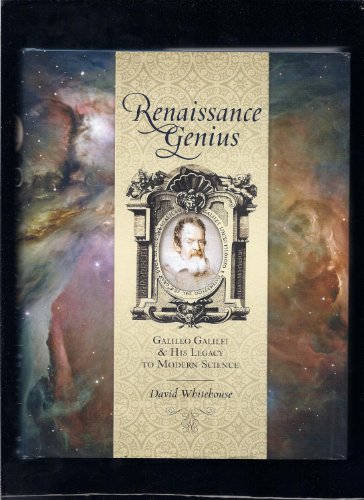

Four hundred years ago, Galileo Galilei first used the telescope to gaze at the heavens. In honor of that anniversary, as well as the international year of astronomy, this lavishly illustrated volume celebrates Galileo’s life and work.
Written by internationally renowned BBC science correspondent Dr. David Whitehouse the world’s most cited science journalist Renaissance Genius paints a fascinating portrait of the astronomer. Beautifully written, gorgeously packaged, and eminently knowledgeable, it offers a smart alternative to dry, academic studies of the subject.
Dr. Whitehouse invites the reader to journey into the world of the Italian Renaissance at a crucial time of change when science clashed with a church still mired in a medieval mindset. He helps us fully appreciate Galileo’s revolutionary discoveries and his role in opening up the cosmos to all mankind.
"synopsis" may belong to another edition of this title.
About the Author:
Dr. David Whitehouse was a consultant to many space agencies and involved in several space missions. As a result of his media work, he was invited by the BBC to become its science correspondent in 1988; from 1998 2006 he was the network’s first science editor working for BBC News Online. David has won many awards, including a Glaxo for newspaper science writing, a record five Netmedia awards, and the very first Arthur” award (named after Arthur C. Clarke) for space journalism. He has written thousands of newspaper and magazine articles and two acclaimed books, and is a Fellow of the Royal Astronomical Society and past president of the Society for Popular Astronomy. The asteroid 4036 was renamed asteroid Whitehouse in recognition of his services to science and the media.
From Booklist:
Timed for the four-hundredth anniversary of Galileo’s great astronomical discoveries with the telescope, this illustrated biography is an efficient and perceptive introduction to his personality and historic scientific achievements. Himself a scientist and author of popular works such as The Sun (2005), Whitehouse writes with empathy for Galileo’s impetus to connect with the reading public of his day, which he achieved with the sensational announcements in his 1610 book The Starry Messenger. Interestingly, Whitehouse sees the discovery of Jupiter’s moons as a by-product of Galileo’s midlife crisis. Successful but not famous, Galileo knew that the telescope could make his name, and he pounced on the opportunity. While the arc of Whitehouse’s narrative curves along Galileo’s relationships with the powerful of Renaissance Florence and Rome, culminating in his ordeal before the Inquisition, its inclusion of Galileo’s family life, by tapping into Dava Sobel’s Galileo’s Daughter (1999), renders a humanized portrait. Supported by a book design whose elements are colorful, cosmic, and subtle, Whitehouse’s volume should prove highly attractive to students and recreational readers of scientific history. --Gilbert Taylor
"About this title" may belong to another edition of this title.
- PublisherUnion Square & Co.
- Publication date2009
- ISBN 10 1402769776
- ISBN 13 9781402769771
- BindingHardcover
- Edition number1
- Number of pages256
- Rating
Buy New
Learn more about this copy
US$ 12.00
Shipping:
US$ 6.50
Within U.S.A.
Top Search Results from the AbeBooks Marketplace
Stock Image
Renaissance Genius: Galileo Galilei & His Legacy to Modern Science
Seller:
Rating

Book Description Hardcover. Condition: New. Dust Jacket Condition: New. A lavishly illustrated exploration of the life and science of Galileo, taking us on a journey into the world of the Italian Renaissance at a crucial time of change. Solid binding. Please note the image in this listing is a stock photo and may not match the covers of the actual item. Book. Seller Inventory # 123475674
Buy New
US$ 12.00
Convert currency
Stock Image
Renaissance Genius: Galileo Galilei & His Legacy to Modern Science
Seller:
Rating
Book Description Hardcover. Condition: New. In shrink wrap. Seller Inventory # 90-15108
Buy New
US$ 14.95
Convert currency
Stock Image
Renaissance Genius: Galileo Galilei His Legacy to Modern Science
Published by
Union Square & Co.
(2009)
ISBN 10: 1402769776
ISBN 13: 9781402769771
New
Hardcover
Quantity: 1
Seller:
Rating
Book Description Hardcover. Condition: new. New. Fast Shipping and good customer service. Seller Inventory # Holz_New_1402769776
Buy New
US$ 21.35
Convert currency
Stock Image
Renaissance Genius: Galileo Galilei His Legacy to Modern Science
Published by
Union Square & Co.
(2009)
ISBN 10: 1402769776
ISBN 13: 9781402769771
New
Hardcover
Quantity: 1
Seller:
Rating
Book Description Hardcover. Condition: new. New Copy. Customer Service Guaranteed. Seller Inventory # think1402769776
Buy New
US$ 27.58
Convert currency
Stock Image
RENAISSANCE GENIUS: GALILEO GALI
Published by
Union Square & Co.
(2009)
ISBN 10: 1402769776
ISBN 13: 9781402769771
New
Hardcover
Quantity: 1
Seller:
Rating

Book Description Condition: New. New. In shrink wrap. Looks like an interesting title! 2.16. Seller Inventory # Q-1402769776
Buy New
US$ 61.11
Convert currency
Stock Image
Renaissance Genius: Galileo Galilei & His Legacy to Modern Science Whitehouse, David
Published by
Union Square & Co.
(2009)
ISBN 10: 1402769776
ISBN 13: 9781402769771
New
Hardcover
Quantity: 1
Seller:
Rating
Book Description Condition: New. Seller Inventory # QCAE--0164
Buy New
US$ 52.00
Convert currency