
Items related to The First World War
Synopsis
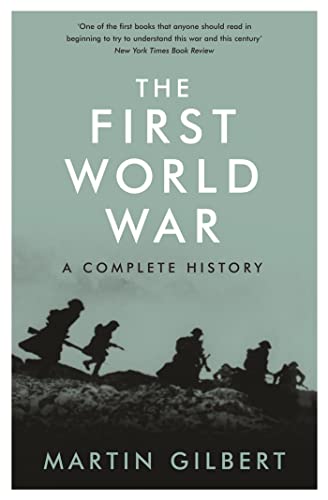
It was to be the war to end all wars, and it began at 11.15 on the morning of June 28, 1914, in an outpost of the Austro-Hungarian Empire called Sarajevo. It would end officially almost five years later. Unoffically, it has never ended: The horrors we live with today were born in the First World War. It left millions - civilians and soldiers - maimed or dead. And it left us with new technologies of death: tanks, planes, and submarines; reliable rapid-fire machine guns, poison gas and chemical warfare. It introduced us to unrestricted war on civilians and mistreatment of prisoners. Most of all, it changed our world. In its wake, empires toppled, monarchies fell, whole populations lost their national indentities as political systems and geographic boundaries relaligned. Instabilities were institutionalised, enmities enshrined. Manners, mores, codes of behaviour, literature, education and class distinctions - all underwent a vast sea change. In all these ways, the twentieth century can be said to have been born on the morning of June 28, 1914.
"synopsis" may belong to another edition of this title.
About the Author
Born in London in 1936 and now resident in north London, Sir Martin Gilbert was educated at Highgate School and Magdalene College, Oxford. An outstanding historian of the 20th century, he became the official biographer of Sir Winston Churchill in 1968 and has written to great acclaim on the Holocaust and the events of the Second World War.
From Kirkus Reviews
There may be no event in this century that has been more written about than the First World War. There may be little new to uncover about it. But this splendid book shows that its lessons cannot be too often learned. This is by no means a complete history. Whole areas of the conflict are scanted or mentioned only in passing, in particular the war on the Eastern Front. Distinguished British historian Gilbert (The Second World War, 1989, etc.) gives a great deal of attention to the British, less to the French, and a good deal less to everyone else. Nor is he particularly interested in strategy. But the power and passion that he brings to the story, the vividness with which he recreates the scale of the conflict, the enormity of its suffering, feats of individual bravery and cowardice, of devotion and desertion, will be hard to emulate. What lingers in the mind is the sheer scale of the suffering. In the first five weeks of conflict at Verdun, German soldiers were killed at the rate of one every 45 seconds, and French death rates were even higher. In the five months during which the battles of Verdun and the Somme were waged in 1916, nearly a million men died, an average of 6,600 every day, more than 277 every minute, nearly 5 every second. This was not exceptional: As Gilbert points out, the 20,000 British soldiers killed on the first day of the Somme are often recalled with horror, yet on average, a similar number of soldiers died during every four-day period of the entire war. His searing descriptions of the carnage poignantly remind us of the terrible consequences that followed from the casualness with which European statesmen allowed their nations to drift into war. An incomparable record of how ordinary and extraordinary men and women endured the unendurable. -- Copyright ©1994, Kirkus Associates, LP. All rights reserved.
"About this title" may belong to another edition of this title.
Search results for The First World War

Seller Image
The First World War
Seller: MusicMagpie, Stockport, United Kingdom
Seller rating 5 out of 5 stars

Condition: Very Good. 1791465687. 10/8/2026 1:21:27 PM. Seller Inventory # U9781409102793
Buy Used
US$ 7.82
US$ 7.33 shipping
Ships from United Kingdom to U.S.A.
Ships from United Kingdom to U.S.A.
Quantity: 1 available
Seller Image
The First World War
Seller: WeBuyBooks, Rossendale, LANCS, United Kingdom
Seller rating 5 out of 5 stars
paperback. Condition: Very Good. Most items will be dispatched the same or the next working day. A copy that has been read, but is in excellent condition. Pages are intact and not marred by notes or highlighting. The spine remains undamaged. Seller Inventory # rev1171410990
Buy Used
US$ 3.52
US$ 12.53 shipping
Ships from United Kingdom to U.S.A.
Ships from United Kingdom to U.S.A.
Quantity: 1 available
Seller Image
The First World War
Seller: WeBuyBooks, Rossendale, LANCS, United Kingdom
Seller rating 5 out of 5 stars
paperback. Condition: Good. Most items will be dispatched the same or the next working day. A copy that has been read but remains in clean condition. All of the pages are intact and the cover is intact and the spine may show signs of wear. The book may have minor markings which are not specifically mentioned. Seller Inventory # rev3534274629
Buy Used
US$ 3.52
US$ 12.53 shipping
Ships from United Kingdom to U.S.A.
Ships from United Kingdom to U.S.A.
Quantity: 2 available
Stock Image
The First World War
Seller: Sell Books, Elland, YORKS, United Kingdom
Seller rating 5 out of 5 stars
paperback. Condition: Good. Our good condition books are generally good for reading but not for gifting or collecting. They could have imperfections such as creasing, fanning, inscriptions, margin notes, yellowing, staining on edge or cover or pages, bumps, scuffs, etc etc (sometimes multiple of these). It's a wide category that encompasses anything that isn't almost-new down to anything that is slightly better than poor. We would NOT recommend gifting Good books - these should be considered reading copies. Our books are dispatched from a Yorkshire former cotton mill. We list via barcode/ISBN so please note that the images are stock images and may not be the exact copy you receive, furthermore the details about edition and year might not be accurate as many publishers reuse the same ISBN for multiple editions and as we simply scan a barcode or enter an ISBN we do not check the validity of the edition data when listing. If you're looking for an exact edition please don't order (at least not without checking with us first, although we don't always have time to check). We aim to dispatch prompty, the service used will depend on order value and book size. We can ship to most countries, see our shipping policies. Payment is via Abe only. Seller Inventory # SBAB-mon0000137596
Buy Used
US$ 2.67
US$ 15.23 shipping
Ships from United Kingdom to U.S.A.
Ships from United Kingdom to U.S.A.
Quantity: 1 available
Stock Image
The First World War
Seller: Anybook.com, Lincoln, United Kingdom
Seller rating 5 out of 5 stars
Condition: Good. This is an ex-library book and may have the usual library/used-book markings inside.This book has soft covers. In good all round condition. Please note the Image in this listing is a stock photo and may not match the covers of the actual item,1000grams, ISBN:9781409102793. Seller Inventory # 3974579
Buy Used
US$ 10.13
US$ 17.40 shipping
Ships from United Kingdom to U.S.A.
Ships from United Kingdom to U.S.A.
Quantity: 1 available
Stock Image
The First World War
Seller: Chiron Media, Wallingford, United Kingdom
Seller rating 5 out of 5 stars
Paperback. Condition: New. Brand new book, sourced directly from publisher. Dispatch time is 5-6 days from our warehouse. Book will be sent in robust, secure packaging to ensure it reaches you securely. Seller Inventory # 6666-HCE-9781409102793
Buy New
US$ 21.50
US$ 8.66 shipping
Ships from United Kingdom to U.S.A.
Ships from United Kingdom to U.S.A.
Quantity: 10 available
Stock Image
The First World War
Seller: PBShop.store US, Wood Dale, IL, U.S.A.
Seller rating 5 out of 5 stars
PAP. Condition: New. New Book. Shipped from UK. Established seller since 2000. Seller Inventory # GB-9781409102793
Stock Image
The First World War
Seller: PBShop.store UK, Fairford, GLOS, United Kingdom
Seller rating 5 out of 5 stars
PAP. Condition: New. New Book. Shipped from UK. Established seller since 2000. Seller Inventory # GB-9781409102793
Buy New
US$ 24.66
US$ 9.02 shipping
Ships from United Kingdom to U.S.A.
Ships from United Kingdom to U.S.A.
Quantity: 2 available
Seller Image
The First World War
Seller: Rarewaves USA, HEBRON, KY, U.S.A.
Seller rating 5 out of 5 stars
Paperback. Condition: New. 'One of the first books that anyone should read in beginning to try to understand this war and this century' New York Times Book ReviewIt was to be the war to end all wars, and it began at 11.15 on the morning of June 28, 1914, in an outpost of the Austro-Hungarian Empire called Sarajevo. It would end officially almost five years later. Unofficially, it has never ended: The horrors we live with today were born in the First World War.It left millions - civilians and soldiers - maimed or dead. And it left us with new technologies of death: tanks, planes, and submarines; reliable rapid-fire machine guns, poison gas and chemical warfare. It introduced us to unrestricted war on civilians and mistreatment of prisoners. Most of all, it changed our world. In its wake, empires toppled, monarchies fell, whole populations lost their national identities as political systems and geographic boundaries realigned. Instabilities were institutionalised, enmities enshrined. Manners, mores, codes of behaviour, literature, education and class distinctions - all underwent a vast sea change. In all these ways, the twentieth century can be said to have been born on the morning of June 28, 1914. Seller Inventory # LU-9781409102793
Stock Image
The First World War
Seller: Chiron Media, Wallingford, United Kingdom
Seller rating 5 out of 5 stars
paperback. Condition: New. Brand new book, sourced directly from publisher. Dispatch time is 24-48 hours from our warehouse. Book will be sent in robust, secure packaging to ensure it reaches you securely. Seller Inventory # 6666-GRD-9781409102793
Buy New
US$ 20.63
US$ 13.33 shipping
Ships from United Kingdom to U.S.A.
Ships from United Kingdom to U.S.A.
Quantity: 2 available