
Items related to The Essential Guide to Workplace Investigations: How...
The Essential Guide to Workplace Investigations: How to Handle Employee Complaints & Problems - Softcover
Synopsis
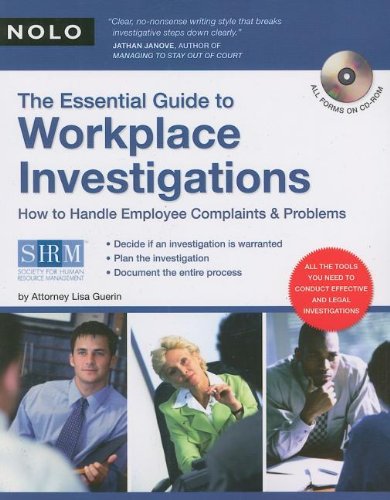
New from Nolo, in cooperation with the Society for Human Resource Management (SHRM), The Essential Guide to Workplace Investigations is a step-by-step guide to investigating and resolving common workplace issues.This Nolo-SHRM collaboration integrates Nolo s legendary legal know-how with SHRM s human resources expertise and unique understanding of everyday managerial challenges. The result is The Essential Guide to Workplace Investigations, an indispensable resource for managers, human resources professionals and business owners.This legal and practical reference is packed with tips and strategies that will help sort out workplace problems quickly and legally. Author and attorney Lisa Guerin explains how to conduct an investigation that will stand up in court, providing helpful instructions for addressing the four common kinds of workplace complaints: harassment, discrimination, workplace violence and employee theft. This book comes complete with forms, sample policies, checklists and other key resources you won t find elsewhere.
"synopsis" may belong to another edition of this title.
About the Author
Attorney Lisa Guerin has practiced employment law in government, public interest and private practice for 15 years. She has authored several of Nolo s most popular HR law titles, including The Manager s Legal Handbook and Dealing With Problem Employees.
Excerpt. © Reprinted by permission. All rights reserved.
Introduction
Chances are good that you picked up this book because you've become aware of a potentially serious problem at your company and you're not quite sure how to handle it. Maybe you've heard a complaint or report of misconduct that sounds something like this:
"Every time I go into John's office, he's looking at porn on the Internet -- it's really starting to offend me and some of the other women in the office."
"We've finished our internal audit, and the numbers just don't add up. I think we may have a thief on our payroll."
"I've been passed over for promotion three times, and each time the job has gone to a younger person who doesn't have my experience or training. I feel like I'm being discriminated against."
"Mark has been really angry lately -- he keeps talking about his gun collection, and yesterday he told me that 'management is about to get what's coming to them.' I'm afraid of what he might do."
Now you're facing some tough decisions: Whom should you believe? What really happened and why? How serious is this problem? What should you do about it? And, can you handle this without creating legal problems for the company?
A complete, impartial, and timely investigation will help you answer these questions and figure out what to do. In fact, a proper investigation is one of the most important tools for maintaining a safe and productive workplace -- and keeping your company out of legal trouble.
This book gives you the tools and information you need to conduct a successful investigation. Part I (Chapters 1 through 4) describes in detail the ten steps to a successful investigation of any kind of workplace problem. Part II (Chapters 5 through 8) takes a closer look at four common workplace problems -- discrimination, harassment, theft, and violence -- and explains how to handle the special investigation challenges posed by each.
This chapter will help you get started. It introduces the benefits and basic components of a proper workplace investigation, including the actions you will have to take -- and decisions you will have to make -- along the way. (Each of these steps is covered in detail in Chapters 2 through 4.) It also covers some common investigation mistakes that can lead to legal trouble -- and tips that will help you avoid them.
Investigations Require Judgment Calls
Although most investigations will require you to at least consider each of these ten steps, every situation is a little bit different. Workplace problems rarely land on your desk in a tidy package with an obvious solution. Instead, you'll often be faced with conflicting stories, documents that are open to different interpretations, and no clear answers about what happened and what you should do about it. You'll have to decide which problems merit a closer look, whom to interview, and what documents to review -- and when your investigation is complete, you'll have to decide what you think really happened.
All of these decisions are judgment calls, and no book can tell you how to handle every possible scenario you might face. However, if you follow the guidelines in the chapters that follow, keep an open mind, and use your best judgment, you should be able to handle most of the issues that come up.
"About this title" may belong to another edition of this title.
Search results for The Essential Guide to Workplace Investigations: How...

Stock Image
The Essential Guide to Workplace Investigations: How to Handle Em
Seller: Hawking Books, Edgewood, TX, U.S.A.
Seller rating 5 out of 5 stars

Condition: Very Good. Very Good Condition. No CD/DVD(s) Included. Five star seller - Buy with confidence! Seller Inventory # X1413306918X2
Stock Image
The Essential Guide to Workplace Investigations : How to Handle Employee Complaints and Problems
Seller: Better World Books, Mishawaka, IN, U.S.A.
Seller rating 5 out of 5 stars
Condition: Very Good. 1 Pap/Cdr. Former library copy. Pages intact with possible writing/highlighting. Binding strong with minor wear. Dust jackets/supplements may not be included. Includes library markings. Stock photo provided. Product includes identifying sticker. Better World Books: Buy Books. Do Good. Seller Inventory # 10291144-6
Stock Image
The Essential Guide to Workplace Investigations : How to Handle Employee Complaints and Problems
Seller: Better World Books, Mishawaka, IN, U.S.A.
Seller rating 5 out of 5 stars
Condition: Very Good. 1 Pap/Cdr. Pages intact with possible writing/highlighting. Binding strong with minor wear. Dust jackets/supplements may not be included. Stock photo provided. Product includes identifying sticker. Better World Books: Buy Books. Do Good. Seller Inventory # 5700913-6
Stock Image
The Essential Guide to Workplace Investigations : How to Handle Employee Complaints and Problems
Seller: Better World Books, Mishawaka, IN, U.S.A.
Seller rating 5 out of 5 stars
Condition: Good. 1 Pap/Cdr. Pages intact with minimal writing/highlighting. The binding may be loose and creased. Dust jackets/supplements are not included. Stock photo provided. Product includes identifying sticker. Better World Books: Buy Books. Do Good. Seller Inventory # 6397635-6
Seller Image
The Essential Guide to Workplace Investigations: How to Handle Employee Complaints & Problems
Seller: Goodwill Books, Hillsboro, OR, U.S.A.
Seller rating 5 out of 5 stars
Condition: very_good. Minimal signs of wear. Seller Inventory # GICWV.1413306918.VG
Stock Image
The Essential Guide to Workplace Investigations: How to Handle Employee Complaints & Problems
Seller: ThriftBooks-Dallas, Dallas, TX, U.S.A.
Seller rating 5 out of 5 stars
Paperback. Condition: Good. No Jacket. Pages can have notes/highlighting. Spine may show signs of wear. ~ ThriftBooks: Read More, Spend Less. Seller Inventory # G1413306918I3N00
Stock Image
The Essential Guide to Workplace Investigations: How to Handle Employee Complaints & Problems
Seller: ThriftBooks-Dallas, Dallas, TX, U.S.A.
Seller rating 5 out of 5 stars
Paperback. Condition: Very Good. No Jacket. May have limited writing in cover pages. Pages are unmarked. ~ ThriftBooks: Read More, Spend Less. Seller Inventory # G1413306918I4N00
Stock Image
The Essential Guide to Workplace Investigations: How to Handle Employee Complaints & Problems
Seller: HPB-Red, Dallas, TX, U.S.A.
Seller rating 5 out of 5 stars
Paperback. Condition: Good. Connecting readers with great books since 1972! Used textbooks may not include companion materials such as access codes, etc. May have some wear or writing/highlighting. We ship orders daily and Customer Service is our top priority! Seller Inventory # S_441790167
Stock Image
The Essential Guide to Workplace Investigations: How to Handle Employee Complaints & Problems
Seller: TheSalvationArmy, Atlanta, GA, U.S.A.
Seller rating 1 out of 5 stars

Paperback. Condition: Good. Your Purchase Changes Lives! Every purchase from The Salvation Army AbeBooks store helps fund our Adult Rehabilitation Centers, providing housing, meals, clothing, and life-changing support to individuals in need. All items are donated and sold as second-hand merchandise. Customer Service: Monday-Friday, 8 AM-3:30 PM ET. Please contact us through AbeBook's messaging. Thank you for shopping with purpose! Seller Inventory # ATL-BK-ug-1413306918
Stock Image
The Essential Guide to Workplace Investigations: How to Handle Employee Complaints & Problems
Seller: SHIMEDIA, Brooklyn, NY, U.S.A.
Seller rating 4 out of 5 stars

Condition: New. Satisfaction Guaranteed or your money back. Seller Inventory # 1413306918