Synopsis
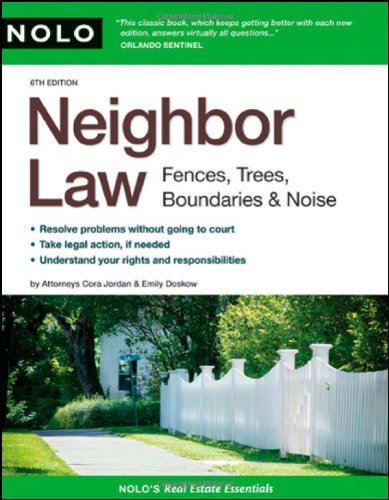
Learn your rights and responsibilities with Neighbor Law, Nolo's clear-cut, comprehensive guide to the laws concerning common neighbor disputes. This handy guide helps readers protect their rights while maintaining good relations with their neighbors. Neighbor Law covers: fences trees boundaries blocked views noise water issues issues with neighboring businesses dangers to children ("attractive nuisances") and more The book explains how to find the law in each circumstance and resolve disputes outside court -- but if you must go to small claims court, this popular book gives you the information you need.The 6th edition is completely revised and now provides new information on how to handle disputes such as drug dealing and blighted property.
"synopsis" may belong to another edition of this title.
About the Author
Cora Jordan, Attorney Cora Jordan earned her law degree at the University of Mississippi. A trained mediator, she is also the co-author of Plan Your Estate. Emily Doskow, Attorney Emily Doskow is an attorney-mediator in private practice in Berkeley and a Nolo editor, author of Nolo's Essential Guide to Divorce, and co-author of numerous other Nolo titles, including How to Change Your Name in California.
Excerpt. © Reprinted by permission. All rights reserved.
Introduction
He is happiest, be he king or peasant, who finds peace in his home. --Goethe
It is 7 a.m. on a Saturday morning. After a long and hard week, you are enjoying one of the great pleasures in life--not setting the alarm clock. Then the noise starts. Your next-door neighbor fires up the chain saw. Or the neighbor across the street gets an early start with her power mower. Or the teenager upstairs turns on the boom box. And the dog down the street barks at any and all of it.
Whatever the intrusion, your plans for peace are shot. You cover your head with the pillow for a while and then give up. Not wanting to cause trouble, you begin the weekend irritable, tired, maybe even physically ill.
In case you think you are just being too sensitive, think again. Noise is a very serious matter, and the time may come when you realize that you should have acted long ago to curb the situation. In California, if you sell your house, you must fill out a disclosure form for the new buyer, pointing out any problems. There is a blank to mark "yes" or "no" to the question: Neighborhood Noise Problems.¹ Then what do you do?
Laws Against Noise
You are protected from a noisy neighbor by local, and sometimes state, law. Additionally, rules in rental agreements and planned communities further restrict allowable noise. Noise regulations are enforced by the police, landlords, neighborhood associations, and the courts. And when you are affected by your neighbor's excessive noise, you can sue the neighbor for creating a private nuisance. You can ask a court for money damages and to have the noise stopped.
Local Noise Laws
The most effective weapon you have to maintain your peace and quiet is your local ordinance. Almost every community has a noise ordinance prohibiting excessive, unnecessary, and unreasonable noise. And most laws designate certain times as quiet times, such as nights and some hours on weekends. Some types of noise may be allowed at some times but not at others.
Certain necessary noises occur all of the time and we simply have to put up with them--for instance, noise from a heavy industry or from traffic on the freeway. But when we can control the noise, the ordinances apply. Running a power mower may be perfectly acceptable at 10 a.m. on Saturday, but not at 7 a.m., and turning up the volume on the TV or stereo may be okay at 5 p.m. but not at 2 a.m. when neighbors are trying to sleep.
A Look at the Law
If you are a reasonable person and your neighbor is driving you wiggy with noise, the neighbor is probably violating a noise law.
Many towns also have decibel level noise limits, and your town probably has electronic equipment for measuring the noise when a neighbor complains. A few cities have special noise units to enforce the laws and to free the police for other calls.
A typical noise ordinance, this one from Oxford, Mississippi, begins like this: "Creation of any unreasonably loud, disturbing and unnecessary noises in the city is hereby prohibited."² Some cities use the language "loud, raucous or nerve-wracking noise."
Some sounds that bother us the most are placed in special categories that are either not allowed or have special rules. These noises are assumed to disturb people. For instance, most cities prohibit either in their noise laws or vehicle laws the honking of auto horns unless there is danger. This means that the daily early-morning tooting across the street for the carpool is a violation.
Dogs are usually singled out; sometimes they are allowed to bark for very short periods, say under ten minutes. The dog that barks only at intruders or a passing fire engine is probably within legal limits. But the neighbors down the block who allow their dog to howl all night are violating the ordinance. If you are having problems with a dog, or are a dog owner, see Every Dog's Legal Guide, by Mary Randolph (Nolo).
Motorcycles may be mentioned by name in an ordinance. Unnecessary running of the engine, for example, may be presumed to disturb a neighbor.³
In addition to actual lists of troublesome noises, certain types of noise are sometimes included in the special categories. Examples are sounds of annoying pitch, such as a screech, and persistent or repetitive sounds, like the hum of a motor or the pounding of a hammer.
"About this title" may belong to another edition of this title.
Search results for Neighbor Law: Fences, Trees, Boundaries & Noise

Stock Image
Neighbor Law: Fences, Trees, Boundaries & Noise
Seller: World of Books (was SecondSale), Montgomery, IL, U.S.A.
Seller rating 5 out of 5 stars

Condition: Good. Item in good condition. Textbooks may not include supplemental items i.e. CDs, access codes etc. Seller Inventory # 00091303680
Stock Image
Neighbor Law : Fences, Trees, Boundaries and Noise
Seller: Better World Books, Mishawaka, IN, U.S.A.
Seller rating 5 out of 5 stars
Condition: Very Good. 6th. Former library book; may include library markings. Used book that is in excellent condition. May show signs of wear or have minor defects. Seller Inventory # 2068072-75
Stock Image
Neighbor Law : Fences, Trees, Boundaries and Noise
Seller: Better World Books, Mishawaka, IN, U.S.A.
Seller rating 5 out of 5 stars
Condition: Very Good. 6th. Used book that is in excellent condition. May show signs of wear or have minor defects. Seller Inventory # 5223155-6
Stock Image
Neighbor Law : Fences, Trees, Boundaries and Noise
Seller: Better World Books, Mishawaka, IN, U.S.A.
Seller rating 5 out of 5 stars
Condition: Good. 6th. Used book that is in clean, average condition without any missing pages. Seller Inventory # 5020036-75
Stock Image
Neighbor Law: Fences, Trees, Boundaries & Noise
Seller: ThriftBooks-Atlanta, AUSTELL, GA, U.S.A.
Seller rating 5 out of 5 stars
Paperback. Condition: Very Good. No Jacket. May have limited writing in cover pages. Pages are unmarked. ~ ThriftBooks: Read More, Spend Less. Seller Inventory # G1413307515I4N00
Stock Image
Neighbor Law: Fences, Trees, Boundaries & Noise
Seller: BooksRun, Philadelphia, PA, U.S.A.
Seller rating 5 out of 5 stars
Paperback. Condition: Good. 6. It's a preowned item in good condition and includes all the pages. It may have some general signs of wear and tear, such as markings, highlighting, slight damage to the cover, minimal wear to the binding, etc., but they will not affect the overall reading experience. Seller Inventory # 1413307515-11-1
Stock Image
Neighbor Law: Fences, Trees, Boundaries & Noise
Seller: HPB-Red, Dallas, TX, U.S.A.
Seller rating 5 out of 5 stars
paperback. Condition: Good. Connecting readers with great books since 1972! Used textbooks may not include companion materials such as access codes, etc. May have some wear or writing/highlighting. We ship orders daily and Customer Service is our top priority! Seller Inventory # S_428408049
Stock Image
Neighbor Law: Fences, Trees, Boundaries & Noise
Seller: HPB Inc., Dallas, TX, U.S.A.
Seller rating 5 out of 5 stars
Paperback. Condition: Very Good. Connecting readers with great books since 1972! Used books may not include companion materials, and may have some shelf wear or limited writing. We ship orders daily and Customer Service is our top priority! Seller Inventory # S_447270973
Stock Image
Neighbor Law: Fences, Trees, Boundaries Noise
Seller: GoldBooks, Denver, CO, U.S.A.
Seller rating 5 out of 5 stars
Condition: new. Seller Inventory # 86F99_77_1413307515