
Items related to Tensor Calculus for Physics: A Concise Guide
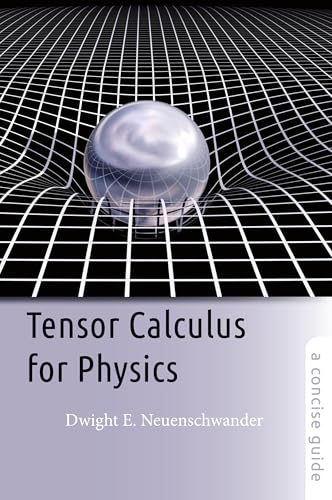
Synopsis
Using a clear, step-by-step approach, this book explains one of the more difficult—yet crucial—topics in physics.
Understanding tensors is essential for any physics student dealing with phenomena where causes and effects have different directions. A horizontal electric field producing vertical polarization in dielectrics; an unbalanced car wheel wobbling in the vertical plane while spinning about a horizontal axis; an electrostatic field on Earth observed to be a magnetic field by orbiting astronauts—these are some situations where physicists employ tensors. But the true beauty of tensors lies in this fact: When coordinates are transformed from one system to another, tensors change according to the same rules as the coordinates. Tensors, therefore, allow for the convenience of coordinates while also transcending them. This makes tensors the gold standard for expressing physical relationships in physics and geometry.
Undergraduate physics majors are typically introduced to tensors in special-case applications. For example, in a classical mechanics course, they meet the "inertia tensor," and in electricity and magnetism, they encounter the "polarization tensor." However, this piecemeal approach can set students up for misconceptions when they have to learn about tensors in more advanced physics and mathematics studies (e.g., while enrolled in a graduate-level general relativity course or when studying non-Euclidean geometries in a higher mathematics class).
Dwight E. Neuenschwander's Tensor Calculus for Physics is a bottom-up approach that emphasizes motivations before providing definitions. Using a clear, step-by-step approach, the book strives to embed the logic of tensors in contexts that demonstrate why that logic is worth pursuing. It is an ideal companion for courses such as mathematical methods of physics, classical mechanics, electricity and magnetism, and relativity.
"synopsis" may belong to another edition of this title.
About the Author
Dwight E. Neuenschwander is an emeritus professor of physics at Southern Nazarene University. He is the author of Emmy Noether's Wonderful Theorem and How to Involve Undergraduates in Research: A Field Guide for Faculty.
"About this title" may belong to another edition of this title.
Search results for Tensor Calculus for Physics: A Concise Guide

Stock Image
Tensor Calculus for Physics: A Concise Guide
Published by
Johns Hopkins University Press, 2014
ISBN 10: 1421415658
ISBN 13: 9781421415659
Used
Paperback
Seller: World of Books (was SecondSale), Montgomery, IL, U.S.A.
Seller rating 5 out of 5 stars

Paperback. Condition: Good. It is an ideal companion for courses such as mathematical methods of physics, classical mechanics, electricity and magnetism, and relativity. Seller Inventory # CIN1421415658G
Stock Image
Tensor Calculus for Physics: A Concise Guide
Published by
Johns Hopkins University Press, 2014
ISBN 10: 1421415658
ISBN 13: 9781421415659
Used
Paperback
Seller: World of Books Inc, Montgomery, IL, U.S.A.
Seller rating 4 out of 5 stars

Paperback. Condition: Good. It is an ideal companion for courses such as mathematical methods of physics, classical mechanics, electricity and magnetism, and relativity. Seller Inventory # CIN1421415658G
Stock Image
Tensor Calculus for Physics: A Concise Guide
Published by
Johns Hopkins University Press, 2014
ISBN 10: 1421415658
ISBN 13: 9781421415659
Used
Softcover
Seller: medimops, Berlin, Germany
Seller rating 5 out of 5 stars
Condition: good. Befriedigend/Good: Durchschnittlich erhaltenes Buch bzw. Schutzumschlag mit Gebrauchsspuren, aber vollständigen Seiten. / Describes the average WORN book or dust jacket that has all the pages present. Seller Inventory # M01421415658-G
Buy Used
US$ 55.08
US$ 11.20 shipping
Ships from Germany to U.S.A.
Ships from Germany to U.S.A.
Quantity: 1 available