
Items related to Behavioral Interventions in Cognitive Behavior Therapy:...
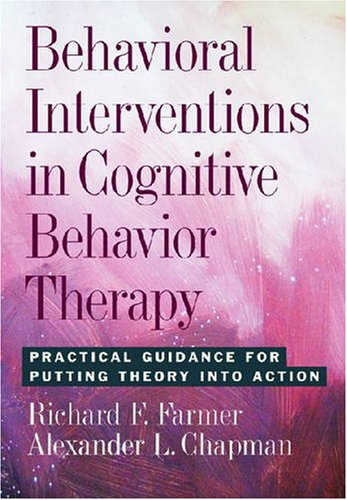
Behavioral Interventions in Cognitive Behavior Therapy: Practical Guidance for Putting Theory into Action - Hardcover
Synopsis
Cognitive behavior therapy (CBT) dominates lists of evidence-based treatments and is increasingly used by front-line clinicians. Behavioral methods, such as self-monitoring, behavioral activation, behavioral experiments, exposure therapy, and skills training, are core features of CBT. In fact, some studies suggest that these are among the primary active ingredients in CBT.
In this detailed, step-by-step guide, Farmer and Chapman show readers how to put behavioral theory and science into action. They discuss case formulation and treatment planning, core behavioral intervention strategies, and innovative approaches, such as acceptance, mindfulness, and a behavioral approach to cognition. Flexible and useful across different client populations, the behavioral interventions described here leave room for therapists to be respectful of their clients' unique needs and individuality. Using case examples, the authors demonstrate how to generate case formulations, apply interventions, respond to common problems, navigate termination, and help clients to generalize treatment gains beyond therapy. The behavioral framework they describe is practical and accessible to clinicians and students with varying degrees of behavioral training.
"synopsis" may belong to another edition of this title.
About the Author
Richard F. Farmer, PhD, is currently a researcher at Oregon Research Institute in Eugene. After completing a clinical internship at Duke University Medical Center in Durham, North Carolina, and earning a doctorate degree in clinical psychology from the University of North Carolina at Greensboro, he served as an associate professor of psychology at Idaho State University in Pocatello and as a senior lecturer in psychology at the University of Canterbury in Christchurch, New Zealand. Dr. Farmer's main areas of interest include behavior therapy, behavioral and personality assessment, depression, personality disorders, impulsivity, eating disorders, and experiential avoidance.
Alexander L. Chapman, PhD, is currently an assistant professor in psychology at Simon Fraser University in Burnaby, British Columbia, Canada. Dr. Chapman received his doctorate degree in clinical psychology from Idaho State University in Pocatello in 2003, after completing his clinical internship at Duke University Medical Center in Durham, North Carolina. He then completed a postdoctoral fellowship with Marsha Linehan at the University of Washington in Seattle. His research focuses on borderline personality disorder, dialectical behavior therapy, emotion regulation, self-harm, and impulsivity, and he has published numerous articles and book chapters on these topics. Dr. Chapman is also cofounder of the Dialectical Behaviour Therapy Centre of Vancouver in British Columbia, Canada.
"About this title" may belong to another edition of this title.
Search results for Behavioral Interventions in Cognitive Behavior Therapy:...

Stock Image
Behavioral Interventions in Cognitive Behavior Therapy: Practical Guidance for Putting Theory into Action
Published by
American Psychological Association, 2007
ISBN 10: 1433802414
ISBN 13: 9781433802416
Used
Hardcover
Seller: World of Books (was SecondSale), Montgomery, IL, U.S.A.
Seller rating 5 out of 5 stars

Hardback. Condition: Good. Cognitive behavior therapy (CBT) dominates lists of evidence-based treatments and is increasingly used by front-line clinicians. Behavioral methods, such as self-monitoring, behavioral activation, behavioral experiments, exposure therapy, and skills training, are core features of CBT. In fact, some studies suggest that these are among the primary active ingredients in CBT.In this detailed, step-by-step guide, Farmer and Chapman show readers how to put behavioral theory and science into action. They discuss case formulation and treatment planning, core behavioral intervention strategies, and innovative approaches, such as acceptance, mindfulness, and a behavioral approach to cognition. Flexible and useful across different client populations, the behavioral interventions described here leave room for therapists to be respectful of their clients' unique needs and individuality. Using case examples, the authors demonstrate how to generate case formulations, apply interventions, respond to common problems, navigate termination, and help clients to generalize treatment gains beyond therapy. The behavioral framework they describe is practical and accessible to clinicians and students with varying degrees of behavioral training.This is a practical guide to the most popular form of therapy used (shown to be effective with depression and many other disorders). It combines discussion of theory with detailed descriptions of therapeutic procedures and applications. It includes an extensive use of case studies. It provides a practical analysis of research results. It contains material useful across client populations and conditions. It is appropriate for grad students through seasoned clinicians. Seller Inventory # 00109545307
Stock Image
Behavioral Interventions in Cognitive Behavior Therapy : Practical Guidance for Putting Theory into Action
Published by
American Psychological Association, 2007
ISBN 10: 1433802414
ISBN 13: 9781433802416
Used
Hardcover
First Edition
Seller: Better World Books, Mishawaka, IN, U.S.A.
Seller rating 5 out of 5 stars
Condition: Good. 1st Edition. Former library copy. Pages intact with minimal writing/highlighting. The binding may be loose and creased. Dust jackets/supplements are not included. Includes library markings. Stock photo provided. Product includes identifying sticker. Better World Books: Buy Books. Do Good. Seller Inventory # 17605367-6
Stock Image
Behavioral Interventions in Cognitive Behavior Therapy: Practical Guidance for Putting Theory into Action
Published by
American Psychological Association, 2007
ISBN 10: 1433802414
ISBN 13: 9781433802416
Used
Hardcover
Seller: World of Books Inc, Montgomery, IL, U.S.A.
Seller rating 4 out of 5 stars

Hardback. Condition: Good. Cognitive behavior therapy (CBT) dominates lists of evidence-based treatments and is increasingly used by front-line clinicians. Behavioral methods, such as self-monitoring, behavioral activation, behavioral experiments, exposure therapy, and skills training, are core features of CBT. In fact, some studies suggest that these are among the primary active ingredients in CBT.In this detailed, step-by-step guide, Farmer and Chapman show readers how to put behavioral theory and science into action. They discuss case formulation and treatment planning, core behavioral intervention strategies, and innovative approaches, such as acceptance, mindfulness, and a behavioral approach to cognition. Flexible and useful across different client populations, the behavioral interventions described here leave room for therapists to be respectful of their clients' unique needs and individuality. Using case examples, the authors demonstrate how to generate case formulations, apply interventions, respond to common problems, navigate termination, and help clients to generalize treatment gains beyond therapy. The behavioral framework they describe is practical and accessible to clinicians and students with varying degrees of behavioral training.This is a practical guide to the most popular form of therapy used (shown to be effective with depression and many other disorders). It combines discussion of theory with detailed descriptions of therapeutic procedures and applications. It includes an extensive use of case studies. It provides a practical analysis of research results. It contains material useful across client populations and conditions. It is appropriate for grad students through seasoned clinicians. Seller Inventory # CIN1433802414G
Stock Image
Behavioral Interventions in Cognitive Behavior Therapy: Practical Guidance for Putting Theory into Action
Published by
Amer Psychological Assn, 2007
ISBN 10: 1433802414
ISBN 13: 9781433802416
Used
Hardcover
Seller: WorldofBooks, Goring-By-Sea, WS, United Kingdom
Seller rating 5 out of 5 stars
Hardback. Condition: Fair. A readable copy of the book which may include some defects such as highlighting and notes. Cover and pages may be creased and show discolouration. Seller Inventory # GOR015115029
Buy Used
US$ 13.01
US$ 7.40 shipping
Ships from United Kingdom to U.S.A.
Ships from United Kingdom to U.S.A.
Quantity: 1 available
Stock Image
Behavioral Interventions in Cognitive Behavior Therapy: Practical Guidance for Putting Theory Into Action
Published by
American Psychological Assoc, 2010
ISBN 10: 1433802414
ISBN 13: 9781433802416
Used
Hardcover
Seller: Anybook.com, Lincoln, United Kingdom
Seller rating 5 out of 5 stars
Condition: Good. This is an ex-library book and may have the usual library/used-book markings inside.This book has hardback covers. Book contains pencil markings. In good all round condition. Dust jacket in good condition. Please note the Image in this listing is a stock photo and may not match the covers of the actual item,950grams, ISBN:9781433802416. Seller Inventory # 2948787
Buy Used
US$ 24.35
US$ 17.23 shipping
Ships from United Kingdom to U.S.A.
Ships from United Kingdom to U.S.A.
Quantity: 1 available
Stock Image
Behavioral Interventions in Cognitive Behavior Therapy: Practical Guidance for Putting Theory into Action
Seller: Revaluation Books, Exeter, United Kingdom
Seller rating 5 out of 5 stars
Hardcover. Condition: Brand New. 1st edition. 341 pages. 10.25x7.25x1.25 inches. In Stock. Seller Inventory # 1433802414
Buy New
US$ 97.40
US$ 16.51 shipping
Ships from United Kingdom to U.S.A.
Ships from United Kingdom to U.S.A.
Quantity: 1 available