
Items related to Faith, Reason and Common Sense: An Exploration of the...
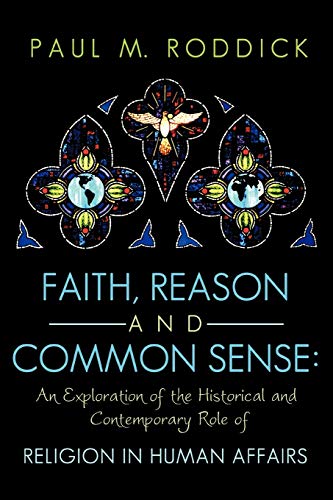
Faith, Reason and Common Sense: An Exploration of the Historical and Contemporary Role of Religion in Human Affairs - Softcover
Synopsis
Have you ever wondered where religion is concerned, what you really believe? In FAITH, REASON & COMMON SENSE the interdependence of religion and culture is examined with care and insight. Readers with strong religious convictions may be surprised to discover that the history of religion - every religion - is both a chronicle of heresy and a reconfiguration of belief. In his examination of the relationship between Faith and Reason, the author rejects the familiar premise that a life guided by one must exclude the other. Although he stresses the importance of examining `the faith of our fathers' he is respectful of those who, in a world dominated by science, find guidance and reassurance in their religion. Far ranging and insightful, drawing on a wealth of sources and opinions, there is something for everyone in this challenging and though-provoking study.
"synopsis" may belong to another edition of this title.
Excerpt. © Reprinted by permission. All rights reserved.
Faith, Reason and Common Sense
An Exploration of the Historical and Contemporary Role of Religion in Human AffairsBy Paul M. RoddickAuthorHouse
Copyright © 2010 Paul M. RoddickAll right reserved.
ISBN: 978-1-4490-7332-9
Contents
Introduction...................................................viiPreface........................................................xiiiChapter 1. Mind and Meaning....................................1Chapter 2. In the Beginning....................................14Chapter 3. The Blight of Heresy................................28Chapter 4. Multicultural Canada................................59Chapter 5. Charity in Canada...................................93Chapter 6. The Aesthetics of Religion..........................122Chapter 7. Perception, Passion and Reality.....................141Chapter 8. Controlling the Faithful............................164Chapter 9. Good and Evil.......................................203Chapter 10. Seeking Salvation..................................219Chapter 11. Faith in Life and Religion.........................232Chapter 12. A House of Many Mansions...........................256Chapter 13. Creation versus Evolution..........................283Chapter 14. Conclusion.........................................298Acknowledgements...............................................311Bibliography...................................................313
Chapter One
Mind and Meaning
Cogito, ergo sum. I think; therefore I am. Rene Descartes
The unexamined life is not worth living. Socrates
The entire problem of the mind is of enormous interest. And yet it demands a superhuman courage to dwell on. The mind considering itself - I shudder; it is too vast, a space without dimensions, filled with cosmic events that are silent and immaterial. For one's sanity it is preferable to track God in the external world. E.L. Doctorow (City of God)
i
Whence comes religion? If by religion we mean theology, there can be only one answer - by revelation, from God. But do we listen to the voice of God directly calling to us to raise our eyes to the heavens and to hear His one clear message, that we humans - the pride of His creation - can hear (as we might say in our barbarous way) straight from the horse's mouth?
Oh no. We receive our revelations by way of the Bible and the Qur'an, the Torah and the Talmud, from rabbis, mullahs, priests, Papal Encyclicals and catechisms, and for the scholarly inclined, the Dead Sea scrolls
Like the Wizard of Oz, God stays behind the curtain. Whatever the source of revelation, it is man who delivers the message. Man speaks for God. God never speaks for Himself.
Perhaps, if we are so bold as to harbour such heretical thoughts, to understand God we should begin our reflections on religion by looking inwards, to understand ourselves.
The eloquent accounts of the nature of the gods, and of their prescriptive and proscriptive declarations of good and evil, have always been articulated by man, in language created by man. It is no accident that as man and his language evolved, his gods have also undergone an evolution.
Without language our ability to communicate with one another would be comparable to communication between animals. Without language I could not write this book, and without language you could not read it. Language is a medium created by man to explain the world (and himself) to others. Without language there would be neither gods nor God.
ii
The necessary foundation for all activities of the human mind, including those activities that produce revelations, is information. From birth to death the human mind absorbs, stores, processes, retains and discards immense amounts of information. But, however important information is to understanding, it never speaks for itself. We, with our human minds, must assess information, interpret it, apply it, and speak for it.
Military intelligence is a small section of information. But all information is a lot like military intelligence. What is apparently true is not necessarily true; and what appears to be false is not necessarily false. Martin Luther understood this when he wrote: "Faith does not require information, knowledge and certainty, but a free surrender and a joyful bet on His unfelt, untried and unknown goodness." Luther could have been reporting on the rules of evidence that U.S. president G.W. Bush and his advisors used in establishing the supposed presence of weapons of mass destruction in Iraq.
The human mind's capacity to store and process information has changed little in fifty thousand years. Yet, the amount of information it must deal with has grown exponentially, especially in the last millennium, and more particularly, in the last century. What began as a gentle snowfall has become a blizzard, an avalanche. We are overwhelmed.
In the ancient world the storehouse of information grew very slowly, and with discouraging setbacks. Until the invention of alphabets and written language, circa 1000 BCE, (i.e. before the current era) information was transferred from one generation to the next orally or in pictographs. Prior to the invention of the printing press (in the fifteenth century) information was recorded by scribes and preserved in scrolls or codices. The most famous and voluminous library of ancient times was at Alexandria in Egypt. Unfortunately, over a period of five hundred years it was destroyed in whole or in part a number of times, by earthquakes, tidal waves, fire and conquest.
Today, what is known about anything and everything is almost immediately accessible in the language of your choice. Like food, information is now packaged to suit every palette, although like food, not all is of the same quality. For example, there are tens of thousands of published essays, articles, sermons, theses and books, learned and less learned, explaining and interpreting the Bible - a single volume (of an uncertain age) that can be held in one hand.
We are justly proud of the way in which we have accumulated information in recent centuries and the techniques we have developed for storing and accessing it. The first library to which I had access consisted of three shelves of books (including Black Beauty, Alice in Wonderland, Anne of Green Gables and a Webster's Dictionary) at the back of a one-room school in Northern Alberta. How different it is today. In the small city of Kingston, Ontario where I now live, there are several well-stocked public libraries I can access with a single library card. If they do not have the title I want they will usually track it down and acquire it for me - sometimes from Queen's University. Queen's has been accumulating books since it first opened its doors in 1842 (with two professors and sixteen students). It now administers six libraries containing more than two million titles.
Then there is the Internet, a magical kingdom I can access in seconds with my mouse "wand", and never leave my chair. It can provide me, for example, with scholarly essays on the evolution of the Semitic alphabet, Pope Pius XI's 1930 Papal Encyclical, Humanae Vitae or a full-colour reproduction of Michelangelo's Creation of Man.
Still, we must admit that in most circumstances an increase in the volume of information does not lead to truth. Werner Heisenberg, 1932 Nobel Prize winner and discoverer of quantum mathematics, is remembered also for his "uncertainty principle" which postulates that all observations are inherently subjective, and that nothing can ever absolutely be determined. The Bible makes the same point, (but more elegantly) when it speaks to us "as through a glass darkly." The uncertainty principle is one we must keep in mind as we approach the subject of religion. Nurtured in a society that equates science with truth, it is easy to wrap ourselves in the smug self-satisfaction of certainty. We need to recognize that however much we are moved to challenge the certainty of others, we must beware of embracing our own beliefs with too much conviction.
In the first half of the twentieth century we were faced with the forcefully and confidently asserted certainties of fascism, national socialism and communism - totalitarian political systems that disparaged the slowly evolving uncertainties of democracy. And although the Communists and Nazis were routed, the struggle to find and agree on principles and processes to permit homo sapiens to prosper and live together in harmony remains a work in progress.
All species go through a brain growth-spurt known as synaptogenesis. In humans this period lasts from the sixth month of gestation until several years after birth. That is why early childhood education is so important, and perhaps why perceptions and beliefs acquired during this period are not easily discarded.
The human brain is genetically equipped with capacities and resources we draw upon throughout life. Like all God's creatures, we are hard wired with instincts, genetic attributes which produce reflexive responses to particular stimuli. Instincts apart, the human mind at birth is a tabula rasa, a clean slate, or in contemporary terms a diskette fresh from the box - and like a diskette, the mind is formatted to receive information. Nature has provided the hard drive and software designed to download information into the mind. But it is nurture that develops the keyboard skills which permit us to accumulate, store and analyze the information, to become (as we say) aware of the world around us. Anything that can be absorbed in the mind, classified, tagged, and made available for retrieval at some future date, is knowledge.
Think of knowledge as the stones from which one may build a cathedral, and the mind as the architect and builder. Your computer is loaded with knowledge, and so are the shelves of your library. But without you to sort it out and apply it, it changes nothing. It is our minds that change the world.
Your mind is a lot more than a computer. The computer remembers everything, but it knows nothing. In this context knowing implies the effective application of knowledge; it requires, you could say, wisdom.
iii
A major - perhaps the major - precursor of both knowledge (and what I call wisdom) is curiosity, an attribute of humans that, in its nature and extent, distinguishes them from all other creatures. Animal curiosity is almost always associated with a particular purpose and an immediate need, but human curiosity knows no such limits. Each one of us from birth to death, is curious. We reach out, instinctively, to touch, to evaluate, to understand our environment. We pose questions and we seek answers. Sometimes our curiosity is driven by basic needs like hunger or thirst, but just as often we are driven by needs that have no immediate or practical purpose, to investigate the depths of the ocean, explore the canals of Venice, climb Mount Everest or send a probe to Mars.
With brains hard-wired to be curious, the accumulation of knowledge begins in infancy. A child's brain soaks up knowledge as a dry sponge soaks up water. "What is this?" "How does it work?" And a little later, " Where do babies come from?"
Our instinctive curiosity stimulates another important attribute of the mind, imagination. When we cannot find the answers to our questions, we invent them. The fruits of human imagination have created a treasure house of literature, art and music, and not least of all, the myth-histories of religion.
C. Scott Littleton, General Editor of Mythology, The Illustrated Anthology of World Myths & Story Telling, writes about the meaning of myth.
Myths can be understood as magic mirrors in which the reflections of not just our own hopes and fears, but also those from the earliest time can be viewed. Some of the stories are unimaginably old and were recounted long before the birth of writing and the dawn of recorded history. Collectively the tales form the basis of much of the world's literature, philosophy and religion, and act as a powerful document of the human imagination.
In the prologue to the first volume of his massive anthropological study HISTORICAL ATLAS OF WORLD MYTHOLOGY, Joseph Campbell writes: "We live, today, in a terminal moraine of myths and mythic symbols, fragments large and small of traditions that formerly inspired and gave rise to civilizations ... The first function of mythology is to waken and maintain in the individual a sense of wonder and participation in the mystery of this finally inscrutable universe ..."
But as York University Professor David Martel Johnson reminds us in his book How History Made the Mind, humans were not always myth makers. In their primitive origins, "people thought in very concrete terms, not in symbols ... They hunted prey, mastered survival and buried their dead, just as the Neanderthals did." Our evolution from animal to man was perhaps millions of years in the making and (as far as we know) there is no other species like us.
iv
Stuart Hampshire, in his book Innocence and Experience, contrasts the rational mind with the imaginative mind.
The raw material of intellect is argument, and argument proceeds by general rules, generally acknowledged. The leaps and swerves of a person's imagination does not follow any standardized routes, and the thought that follows a standardized path would not be called imagination ... A strongly imaginative response draws upon an immense accumulation of interacting memories and associations, layer upon layer, combining and recombining.
The age of imagination, of myths, of epics and oral history, of symbolic art and artifacts, began only when language had evolved to a level where the imaginative creations of one generation could be passed on to the next. In this manner human cultures evolved and became increasingly complex, adding layer upon layer, like a snowball rolling down hill.
Each of us, in a sense, replicates the experience of mankind. As we develop from new-born baby to pre-school child and into the adult world, we begin as the human species began - preoccupied with the fundamentals of survival. But soon, in early childhood, we become fascinated with myths, fairy stories, fables, and the treasure house of the glorious fabrications that attempt to explain our world.
The biblical story of our origins in the Garden of Eden is yet another fairy tale, one we learn in childhood and are loath to abandon. The challenge for humans, children and adults is to separate the world of imagination from the real world. In our early years our minds are not developed enough to distinguish what is demonstrably true (because it may be verified by the senses) from what is false or in doubt (because it is not verifiable by the senses). Most of us who were raised in Western culture believed in Santa Claus until we were six or seven, and some of us believed in the tooth fairy. As we grew older we were encouraged to question our perception of the real world and the world of imagination as a seamless whole. Nature arranged it this way. The principal function of the mind in childhood is to absorb knowledge, not to evaluate it. Childhood is that happy time when we don't care (and don't need to care) whether we are being captivated by truth or fiction.
Without language, intellectual intercourse amongst humans would be as rudimentary as it is amongst the great apes. Rene Descartes may postulate: "I think, therefore I am". But if he cannot express what he thinks and communicate it to others his wisdom ends where it began, in his mind. With language, ideas move on to other minds, challenge them, stimulate them, pile stone on stone until what began as a hovel grows into a cathedral.
(Continues...)
Excerpted from Faith, Reason and Common Senseby Paul M. Roddick Copyright © 2010 by Paul M. Roddick. Excerpted by permission.
All rights reserved. No part of this excerpt may be reproduced or reprinted without permission in writing from the publisher.
Excerpts are provided by Dial-A-Book Inc. solely for the personal use of visitors to this web site.
"About this title" may belong to another edition of this title.
Search results for Faith, Reason and Common Sense: An Exploration of the...

Seller Image
Faith Reason and Common Sense : An Exploration of the Historical and Contemporary Role of Religion in Human Affairs
Seller: GreatBookPrices, Columbia, MD, U.S.A.
Seller rating 5 out of 5 stars

Condition: New. Seller Inventory # 9229853-n
Seller Image
Faith, Reason and Common Sense: An Exploration of the Historical and Contemporary Role of Religion in Human Affairs (Paperback or Softback)
Published by
Authorhouse 5/12/2010, 2010
ISBN 10: 1449073328
ISBN 13: 9781449073329
New
Paperback or Softback
Seller: BargainBookStores, Grand Rapids, MI, U.S.A.
Seller rating 5 out of 5 stars
Paperback or Softback. Condition: New. Faith, Reason and Common Sense: An Exploration of the Historical and Contemporary Role of Religion in Human Affairs. Book. Seller Inventory # BBS-9781449073329
Stock Image
Faith, Reason and Common Sense: An Exploration of the Historical and Contemporary Role of Religion in Human Affairs
Seller: California Books, Miami, FL, U.S.A.
Seller rating 5 out of 5 stars
Condition: New. Seller Inventory # I-9781449073329
Seller Image
Faith Reason and Common Sense : An Exploration of the Historical and Contemporary Role of Religion in Human Affairs
Seller: GreatBookPrices, Columbia, MD, U.S.A.
Seller rating 5 out of 5 stars
Condition: As New. Unread book in perfect condition. Seller Inventory # 9229853
Stock Image
Faith, Reason and Common Sense: An Exploration of the Historical and Contemporary Role of Religion in Human Affairs
Print on DemandSeller: Chiron Media, Wallingford, United Kingdom
Seller rating 5 out of 5 stars
PF. Condition: New. This item is printed on demand. Brand new book, sourced directly from publisher. Dispatch time is 6-7 days from our warehouse. Book will be sent in robust, secure packaging to ensure it reaches you securely. Seller Inventory # 6666-IUK-9781449073329
Buy New
US$ 19.94
US$ 6.65 shipping
Ships from United Kingdom to U.S.A.
Ships from United Kingdom to U.S.A.
Quantity: 20 available
Stock Image
Faith, Reason and Common Sense
Print on DemandSeller: PBShop.store US, Wood Dale, IL, U.S.A.
Seller rating 5 out of 5 stars
PAP. Condition: New. New Book. Shipped from UK. THIS BOOK IS PRINTED ON DEMAND. Established seller since 2000. Seller Inventory # L0-9781449073329
Stock Image
Faith, Reason and Common Sense
Print on DemandSeller: PBShop.store UK, Fairford, GLOS, United Kingdom
Seller rating 5 out of 5 stars
PAP. Condition: New. New Book. Delivered from our UK warehouse in 4 to 14 business days. THIS BOOK IS PRINTED ON DEMAND. Established seller since 2000. Seller Inventory # L0-9781449073329
Buy New
US$ 25.35
US$ 6.69 shipping
Ships from United Kingdom to U.S.A.
Ships from United Kingdom to U.S.A.
Quantity: Over 20 available
Stock Image
Faith, Reason and Common Sense
Print on DemandSeller: Majestic Books, Hounslow, United Kingdom
Seller rating 4 out of 5 stars

Condition: New. Print on Demand pp. 336 2:B&W 6 x 9 in or 229 x 152 mm Perfect Bound on Creme w/Gloss Lam. Seller Inventory # 95355580
Buy New
US$ 31.25
US$ 8.67 shipping
Ships from United Kingdom to U.S.A.
Ships from United Kingdom to U.S.A.
Quantity: 4 available
Stock Image
Faith, Reason and Common Sense
Print on DemandSeller: Books Puddle, Woodside, NY, U.S.A.
Seller rating 4 out of 5 stars
Condition: New. Print on Demand pp. 336. Seller Inventory # 2698090339
Stock Image
Faith, Reason and Common Sense: An Exploration of the Historical and Contemporary Role of Religion in Human Affairs
Seller: Ria Christie Collections, Uxbridge, United Kingdom
Seller rating 5 out of 5 stars
Condition: New. In English. Seller Inventory # ria9781449073329_new
Buy New
US$ 28.03
US$ 15.06 shipping
Ships from United Kingdom to U.S.A.
Ships from United Kingdom to U.S.A.
Quantity: Over 20 available