Items related to See It Feelingly: Classic Novels, Autistic Readers,...
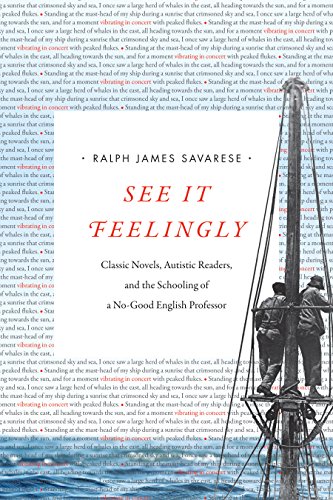
See It Feelingly: Classic Novels, Autistic Readers, and the Schooling of a No-Good English Professor (Thought in the Act) - Hardcover

“We each have Skype accounts and use them to discuss [Moby-Dick] face to face. Once a week, we spread the worded whale out in front of us; we dissect its head, eyes, and bones, careful not to hurt or kill it. The Professor and I are not whale hunters. We are not letting the whale die. We are shaping it, letting it swim through the Web with a new and polished look.”—Tito Mukhopadhyay
Since the 1940s researchers have been repeating claims about autistic people's limited ability to understand language, to partake in imaginative play, and to generate the complex theory of mind necessary to appreciate literature. In See It Feelingly Ralph James Savarese, an English professor whose son is one of the first nonspeaking autistics to graduate from college, challenges this view.
Discussing fictional works over a period of years with readers from across the autism spectrum, Savarese was stunned by the readers' ability to expand his understanding of texts he knew intimately. Their startling insights emerged not only from the way their different bodies and brains lined up with a story but also from their experiences of stigma and exclusion.
For Mukhopadhyay Moby-Dick is an allegory of revenge against autism, the frantic quest for a cure. The white whale represents the autist's baffling, because wordless, immersion in the sensory. Computer programmer and cyberpunk author Dora Raymaker skewers the empathetic failings of the bounty hunters in Philip K. Dick's Do Androids Dream of Electric Sheep? Autistics, some studies suggest, offer instruction in embracing the nonhuman. Encountering a short story about a lonely marine biologist in Antarctica, Temple Grandin remembers her past with an uncharacteristic emotional intensity, and she reminds the reader of the myriad ways in which people can relate to fiction. Why must there be a norm?
Mixing memoir with current research in autism and cognitive literary studies, Savarese celebrates how literature springs to life through the contrasting responses of unique individuals, while helping people both on and off the spectrum to engage more richly with the world.
Since the 1940s researchers have been repeating claims about autistic people's limited ability to understand language, to partake in imaginative play, and to generate the complex theory of mind necessary to appreciate literature. In See It Feelingly Ralph James Savarese, an English professor whose son is one of the first nonspeaking autistics to graduate from college, challenges this view.
Discussing fictional works over a period of years with readers from across the autism spectrum, Savarese was stunned by the readers' ability to expand his understanding of texts he knew intimately. Their startling insights emerged not only from the way their different bodies and brains lined up with a story but also from their experiences of stigma and exclusion.
For Mukhopadhyay Moby-Dick is an allegory of revenge against autism, the frantic quest for a cure. The white whale represents the autist's baffling, because wordless, immersion in the sensory. Computer programmer and cyberpunk author Dora Raymaker skewers the empathetic failings of the bounty hunters in Philip K. Dick's Do Androids Dream of Electric Sheep? Autistics, some studies suggest, offer instruction in embracing the nonhuman. Encountering a short story about a lonely marine biologist in Antarctica, Temple Grandin remembers her past with an uncharacteristic emotional intensity, and she reminds the reader of the myriad ways in which people can relate to fiction. Why must there be a norm?
Mixing memoir with current research in autism and cognitive literary studies, Savarese celebrates how literature springs to life through the contrasting responses of unique individuals, while helping people both on and off the spectrum to engage more richly with the world.
"synopsis" may belong to another edition of this title.
About the Author:
Ralph James Savarese is the author of Reasonable People: A Memoir of Autism and Adoption and coeditor of three collections, including one on the concept of neurodiversity. He has published widely in academic and creative writing journals. In 2012-13 he was a neurohumanities fellow at Duke University's Institute for Brain Sciences. He teaches at Grinnell College in Iowa.
Review:
"Impassioned and persuasive. . . . A fresh and absorbing examination of autism.", Kirkus Reviews Published On: 2018-07-15
"This idealistic argument for the social value of literature and for the diversity of autism as a condition is a rewarding endeavor. . . .", Publishers Weekly Published On: 2018-07-23
"This is a powerful book — one that really must be experienced. It is a book that unlocks doors to the many rooms of autism and is likely to surprise the thinking of anyone who steps into them. It carries within it the possibilities of new perspectives on literary work, a greater understanding of autistic neurology, and the chance to meet some remarkable individuals. Read it." -- Michael Northen, Wordgathering Published On: 2018-09-12
"Savarese has produced a masterpiece, simultaneously dense and accessible. His voice moves freely—alternating among lyrical, narrative, and instructive—never losing the flow, never dipping into pedantry, never soaring too far toward the abstract for the reader to follow. Not only is this collection of essays brimming with the most important information and ideas about autism, it is a collaboration of rare beauty." -- Maxfield Sparrow, Thinking Person's Guide to Autism Published On: 2018-11-28
"Savarese shows that literature—with its imagery, inclusivity, and rich detail—is a natural tent pole for a truly neurodiverse community, one populated by autists and neurotypicals alike. . . . The radical possibility this book ultimately offers is that the gap that has for so long existed between nonverbal autists and neurotypicals can be bridged through literature. Literature is, as Whitman said of himself, large, and contains multitudes." -- Ittai Orr, Synapsis Published On: 2019-02-08
"Readers will find this book to be a work of art as Ralph Savarese not only exhibits an understanding of the beauty of teaching but also of the language of the autistic mind. Savarese’s literary creation demystifies the limits of the autistic mind by following five autistic adults through their interpretation of and response to classic literature. . . . Highly recommended. Advanced undergraduates and above; professionals and general readers." -- D. Pellegrino, Choice Published On: 2019-04-01
"The sense of critical self-reflection is crucial to this enterprise, and is evident throughout the book. Thankfully, this never veers into self-indulgence; as such, [Savarese's] ethnographic work in this area is an exemplar to all those who study ‘others,’ as outsiders with situated knowledge." -- Alison Wilde, Disability & Society Published On: 2019-04-19
"To imagine an autistic rhetoric or an autistic literature is to struggle, audaciously, against a legacy of neurotypical people failing to imagine autism as anything other than lack. That struggle is joined . . . by Ralph [James] Savarese, whose See It Feelingly gives us five extraordinary examples of autistic readers’ responses to literature. It’s like Norman Holland’s classic work of reader-response criticism, 5 Readers Reading . . . except with autism." -- Michael Bérubé, Public Books Published On: 2019-09-23
"Powered by his enthusiasm for connecting with autistics and for representing the fullness of their humanity, See It Feelingly is that rare book in English studies that succeeds as creative nonfiction: a memoir of teaching non-traditional learners that makes a provocative claim for the primacy of the senses in reading literature." -- Dawn Coleman, Leviathan Published On: 2019-10-01
"This idealistic argument for the social value of literature and for the diversity of autism as a condition is a rewarding endeavor. . . .", Publishers Weekly Published On: 2018-07-23
"This is a powerful book — one that really must be experienced. It is a book that unlocks doors to the many rooms of autism and is likely to surprise the thinking of anyone who steps into them. It carries within it the possibilities of new perspectives on literary work, a greater understanding of autistic neurology, and the chance to meet some remarkable individuals. Read it." -- Michael Northen, Wordgathering Published On: 2018-09-12
"Savarese has produced a masterpiece, simultaneously dense and accessible. His voice moves freely—alternating among lyrical, narrative, and instructive—never losing the flow, never dipping into pedantry, never soaring too far toward the abstract for the reader to follow. Not only is this collection of essays brimming with the most important information and ideas about autism, it is a collaboration of rare beauty." -- Maxfield Sparrow, Thinking Person's Guide to Autism Published On: 2018-11-28
"Savarese shows that literature—with its imagery, inclusivity, and rich detail—is a natural tent pole for a truly neurodiverse community, one populated by autists and neurotypicals alike. . . . The radical possibility this book ultimately offers is that the gap that has for so long existed between nonverbal autists and neurotypicals can be bridged through literature. Literature is, as Whitman said of himself, large, and contains multitudes." -- Ittai Orr, Synapsis Published On: 2019-02-08
"Readers will find this book to be a work of art as Ralph Savarese not only exhibits an understanding of the beauty of teaching but also of the language of the autistic mind. Savarese’s literary creation demystifies the limits of the autistic mind by following five autistic adults through their interpretation of and response to classic literature. . . . Highly recommended. Advanced undergraduates and above; professionals and general readers." -- D. Pellegrino, Choice Published On: 2019-04-01
"The sense of critical self-reflection is crucial to this enterprise, and is evident throughout the book. Thankfully, this never veers into self-indulgence; as such, [Savarese's] ethnographic work in this area is an exemplar to all those who study ‘others,’ as outsiders with situated knowledge." -- Alison Wilde, Disability & Society Published On: 2019-04-19
"To imagine an autistic rhetoric or an autistic literature is to struggle, audaciously, against a legacy of neurotypical people failing to imagine autism as anything other than lack. That struggle is joined . . . by Ralph [James] Savarese, whose See It Feelingly gives us five extraordinary examples of autistic readers’ responses to literature. It’s like Norman Holland’s classic work of reader-response criticism, 5 Readers Reading . . . except with autism." -- Michael Bérubé, Public Books Published On: 2019-09-23
"Powered by his enthusiasm for connecting with autistics and for representing the fullness of their humanity, See It Feelingly is that rare book in English studies that succeeds as creative nonfiction: a memoir of teaching non-traditional learners that makes a provocative claim for the primacy of the senses in reading literature." -- Dawn Coleman, Leviathan Published On: 2019-10-01
"About this title" may belong to another edition of this title.
- PublisherDuke University Press Books
- Publication date2018
- ISBN 10 1478001305
- ISBN 13 9781478001300
- BindingHardcover
- Number of pages296
- Rating
Buy New
Learn more about this copy
US$ 14.00
Shipping:
US$ 5.00
Within U.S.A.
Top Search Results from the AbeBooks Marketplace
Stock Image
See It Feelingly: Classic Novels, Autistic Readers, and the Schooling of a No-Good English Professor (Thought in the Act)
Published by
Duke University Press Books
(2018)
ISBN 10: 1478001305
ISBN 13: 9781478001300
New
Hardcover
Quantity: 1
Seller:
Rating

Book Description Hardcover. Condition: New. Seller Inventory # 1191y
Buy New
US$ 14.00
Convert currency
Stock Image
See It Feelingly: Classic Novels, Autistic Readers, and the Schooling of a No-Good English Professor (Thought in the Act)
Published by
Duke University Press Books
(2018)
ISBN 10: 1478001305
ISBN 13: 9781478001300
New
Hardcover
Quantity: 4
Seller:
Rating

Book Description Hardcover. Condition: New. Ships in a BOX from Central Missouri! UPS shipping for most packages, (Priority Mail for AK/HI/APO/PO Boxes). Seller Inventory # 002273597N
Buy New
US$ 15.40
Convert currency
Stock Image
See It Feelingly: Classic Novels, Autistic Readers, and the Schooling of a No-Good English Professor (Thought in the Act)
Published by
Duke University Press Books
(2018)
ISBN 10: 1478001305
ISBN 13: 9781478001300
New
Hardcover
Quantity: 1
Seller:
Rating
Book Description Hardcover. Condition: new. Brand New Copy. Seller Inventory # BBB_new1478001305
Buy New
US$ 22.48
Convert currency
Stock Image
See It Feelingly: Classic Novels, Autistic Readers, and the Schooling of a No-Good English Professor (Thought in the Act)
Published by
Duke University Press Books
(2018)
ISBN 10: 1478001305
ISBN 13: 9781478001300
New
Hardcover
Quantity: 1
Seller:
Rating
Book Description Hardcover. Condition: new. Buy for Great customer experience. Seller Inventory # GoldenDragon1478001305
Buy New
US$ 24.80
Convert currency
Seller Image
See It Feelingly : Classic Novels, Autistic Readers, and the Schooling of a No-Good English Professor
Published by
Duke University Press Books
(2018)
ISBN 10: 1478001305
ISBN 13: 9781478001300
New
Hardcover
Quantity: 3
Seller:
Rating
Book Description Condition: New. Seller Inventory # 33183635-n
Buy New
US$ 26.51
Convert currency
Stock Image
See It Feelingly: Classic Novels, Autistic Readers, and the Schooling of a No-Good English Professor (Thought in the Act)
Published by
Duke University Press Books
(2018)
ISBN 10: 1478001305
ISBN 13: 9781478001300
New
Hardcover
Quantity: 1
Seller:
Rating
Book Description Hardcover. Condition: new. New. Seller Inventory # Wizard1478001305
Buy New
US$ 26.31
Convert currency
Stock Image
See It Feelingly: Classic Novels, Autistic Readers, and the Schooling of a No-Good English Professor (Thought in the Act)
Published by
Duke University Press Books
(2018)
ISBN 10: 1478001305
ISBN 13: 9781478001300
New
Hardcover
Quantity: 1
Seller:
Rating
Book Description Hardcover. Condition: new. New Copy. Customer Service Guaranteed. Seller Inventory # think1478001305
Buy New
US$ 28.16
Convert currency
Stock Image
See It Feelingly: Classic Novels, Autistic Readers, and the Schooling of a No-Good English Professor (Thought in the Act)
Published by
Duke University Press
(2018)
ISBN 10: 1478001305
ISBN 13: 9781478001300
New
Hardcover
Quantity: 1
Seller:
Rating
Book Description Condition: new. Seller Inventory # FrontCover1478001305
Buy New
US$ 29.76
Convert currency
Seller Image
See It Feelingly: Classic Novels, Autistic Readers, and the Schooling of a No-Good English Professor (Thought in the Act) by Savarese, Ralph James [Hardcover ]
Published by
Duke University Press Books
(2018)
ISBN 10: 1478001305
ISBN 13: 9781478001300
New
Hardcover
Quantity: 10
Seller:
Rating

Book Description Hardcover. Condition: new. Seller Inventory # 9781478001300
Buy New
US$ 35.02
Convert currency
Stock Image
See It Feelingly: Classic Novels, Autistic Readers, and the Schooling of a No-Good English Professor (Thought in the Act)
Published by
Duke University Press Books
(2018)
ISBN 10: 1478001305
ISBN 13: 9781478001300
New
Hardcover
Quantity: 1
Seller:
Rating
Book Description Hardcover. Condition: new. New. Fast Shipping and good customer service. Seller Inventory # Holz_New_1478001305
Buy New
US$ 37.00
Convert currency