
Items related to Emil Fackenheim's Quest: From Philosophy to Prophetic...
Synopsis
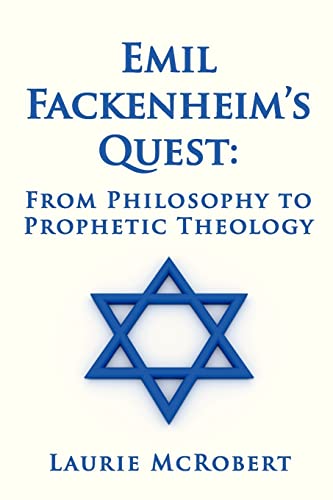
Emil Fackenheim’s Quest: From Philosophy to Prophetic Theology constitutes a comprehensive study of the Jewish thinker Emil L. Fackenheim who lived between 1916 and 2003. The study begins with extracts of letters and articles which he wrote as early as 1939 and ends with his writing of To Mend the World published in 1982. It starts with the new thinking movement in Judaism, considers the mediaeval responses to prophecy and philosophy and includes the prophetic experience as described by modern Jewish thinkers. This sets the stage for Fackenheim’s quest. His writings clearly track the important philosophical and theological questions that preoccupy him during this time. These questions reveal his subjective concerns which focus on what becomes a pivotal question for him: Has God revealed Himself once more in history? One of the ways that Fackenheim responds to what he believes to be a revelation from God is in a prophetic way with the 614th commandment to Jews “Thou shalt not give Hitler Posthumous victories”. The book’s themes deal primarily with the Holocaust. The Holocaust is the firewall that neither traditional philosophy nor Christianity can transcend unless they put aside their grandiose theories of a perennial philosophical Truth, and of the Christ conquering event of death and thus evil. The Christ event, Fackenheim argues can no longer be seen as an overcoming of death (evil) since Christ never had to encounter the radical evil of the Holocaust. What would Christ a Jew have done during the Holocaust—save his people from the gas chambers, or die with them? Fackenheim is concerned for the Jewish people’s homeland Israel. His epiphany during the six day War includes the fact that Israel as a state is fragile and that Jews, religious or secular, whether they believe or not in God must join forces to protect it.
"synopsis" may belong to another edition of this title.
About the Author
Laurie McRobert is an independent scholar who received her Ph.D. in Philosophy of Religion from McGill University where she lectured in the Department of Philosophy. Her first book Char Davies' Immersive Virtual Art and the Essence of Spatiality, explored spatiality from various disciplines concentrating primarily on immersive virtual art. He next book Appearances: Genetic Mythology and Cosmic Instincts took a step forward into a cosmic perspective of spatiality. The present book grapples with radical evil.
Reviews
A detailed study of German-born Jewish philosopher Emil Fackenheim’s thought. Philosopher McRobert (Appearances: Genetic Mythology and Cosmic Instincts, 2011, etc.) presents a thorough chronological analysis of Fackenheim’s writings. Fackenheim (1916-2003) was a Holocaust survivor, philosopher and rabbi. His work developed from his preoccupation with medieval philosophy and the works of philosophers Friedrich Schelling, Martin Buber and Franz Rosenzweig, toward a search for existential foundations in the works of Georg Hegel and Soren Kierkegaard. Fackenheim’s study of Immanuel Kant’s works, McRobert writes, provided him with the means to pose theological issues philosophically. The author concludes that Fackenheim eventually went beyond philosophy and, in his major work, To Mend the World (1982), moved toward prophetic theology. She sets out to show how the philosopher’s early work prepared the way for this change by asserting that evil was an absolute, and by providing “prophetic symbols” for his philosophy and theology. Fackenheim, McRobert explains, ended up seeing the Holocaust as an event of transcendent absolute evil that forever fragments meaning—one that must be kept alive in the witnesses’ minds in order not to give Hitler any posthumous victories. The philosopher also came to see Israel as a necessary “secular-religious truth” to resist evil. This book provides a serious examination of philosophical and theological issues and is meant for scholarly, not casual, readers; it’s best suited for graduate students in philosophy. Students of contemporary Jewish thought, particularly those interested in ethics and theology in the light of the Holocaust, will likely be drawn to this detailed study, and readers of Fackenheim’s work, in particular, may also find it a helpful guide. A comprehensive inquiry into the central tenets of Fackenheim’s philosophy.
"About this title" may belong to another edition of this title.
Search results for Emil Fackenheim's Quest: From Philosophy to Prophetic...

Seller Image
Emil Fackenheim's Quest : From Philosophy to Prophetic Theology
Published by
CreateSpace Independent Publishing Platform, 2013
ISBN 10: 1479110566
ISBN 13: 9781479110568
New
Softcover
Seller: GreatBookPrices, Columbia, MD, U.S.A.
Seller rating 5 out of 5 stars

Condition: New. Seller Inventory # 19330276-n
Stock Image
Emil Fackenheim's Quest: From Philosophy to Prophetic Theology
Published by
CreateSpace Independent Publishing Platform, 2013
ISBN 10: 1479110566
ISBN 13: 9781479110568
New
Softcover
Seller: California Books, Miami, FL, U.S.A.
Seller rating 5 out of 5 stars
Condition: New. Print on Demand. Seller Inventory # I-9781479110568
Stock Image
Emil Fackenheim's Quest (SIGNED)t: From Philosophy to Prophetic Theology. A Chronological in Depth Study of the Early to Middle Phase of His Work 1940-1982
Published by
CreateSpace Independent Publishing Platform, 2013
ISBN 10: 1479110566
ISBN 13: 9781479110568
Used
Softcover
Signed
Seller: Aldersgate Books Inc., Niagara Falls, NY, U.S.A.
Seller rating 4 out of 5 stars

Condition: FINE. 2013. SIGNED by the author to title page. Trade paperback. 440pp. Index. FINE. Seller Inventory # 2644073
Seller Image
Emil Fackenheim's Quest : From Philosophy to Prophetic Theology
Published by
CreateSpace Independent Publishing Platform, 2013
ISBN 10: 1479110566
ISBN 13: 9781479110568
Used
Softcover
Seller: GreatBookPrices, Columbia, MD, U.S.A.
Seller rating 5 out of 5 stars
Condition: As New. Unread book in perfect condition. Seller Inventory # 19330276
Seller Image
Emil Fackenheim's Quest: From Philosophy to Prophetic Theology
Published by
CreateSpace Independent Publishing Platform, 2013
ISBN 10: 1479110566
ISBN 13: 9781479110568
Used
Softcover
Signed
Seller: Rivendell Books Ltd., Barrie, ON, Canada
Seller rating 5 out of 5 stars
Softcover. Condition: Very Good. Signed by Laurie McRobert on title page. Excellent condition, one crease on bottom front cover. Signed by author. Seller Inventory # 6260
Buy Used
US$ 36.13
US$ 20.00 shipping
Ships from Canada to U.S.A.
Ships from Canada to U.S.A.
Quantity: 1 available
Seller Image
EMIL FACKENHEIM'S QUEST: FROM PHILOSOPHY TO PROPHETIC THEOLOGY
Published by
CreateSpace Independent Publishing Platform, 2013
ISBN 10: 1479110566
ISBN 13: 9781479110568
Used
Softcover
Seller: Librería Páramo, Urueña, VA, Spain
Seller rating 5 out of 5 stars
Condition: Muy Bueno. Createspace Independent Publishing Platform, 2013, 428pp, tapa blanda, muy buen estado//// Nota de la librería: Si no se especifica en la descripción anterior, los libros no tienen subrayados, anotaciones, firmas o defectos reseñables. ATENCIÓN: EL ENVÍO GRATUITO ES ORDINARIO SIN NÚMERO DE SEGUIMIENTO, y puede sufrir retrasos de varios días. Le dejarán un aviso en el buzón PARA LA RECOGIDA EN OFICINA. PRIORITARIO/CERTIFICADO CON ENTREGA A DOMICILIO POR SOLO 2,90 euros. AS2747. Seller Inventory # AS2747
Buy Used
US$ 23.08
US$ 44.81 shipping
Ships from Spain to U.S.A.
Ships from Spain to U.S.A.
Quantity: 1 available
Seller Image
Emil Fackenheim's Quest : From Philosophy to Prophetic Theology
Published by
CreateSpace Independent Publishing Platform, 2013
ISBN 10: 1479110566
ISBN 13: 9781479110568
Used
Softcover
Seller: GreatBookPricesUK, Woodford Green, United Kingdom
Seller rating 5 out of 5 stars
Condition: As New. Unread book in perfect condition. Seller Inventory # 19330276
Buy Used
US$ 53.85
US$ 19.85 shipping
Ships from United Kingdom to U.S.A.
Ships from United Kingdom to U.S.A.
Quantity: Over 20 available
Seller Image
Emil Fackenheim's Quest : From Philosophy to Prophetic Theology
Published by
CreateSpace Independent Publishing Platform, 2013
ISBN 10: 1479110566
ISBN 13: 9781479110568
New
Softcover
Seller: GreatBookPricesUK, Woodford Green, United Kingdom
Seller rating 5 out of 5 stars
Condition: New. Seller Inventory # 19330276-n
Buy New
US$ 56.76
US$ 19.85 shipping
Ships from United Kingdom to U.S.A.
Ships from United Kingdom to U.S.A.
Quantity: Over 20 available
Stock Image
Emil Fackenheim's Quest: From Philosophy to Prophetic Theology
Published by
Createspace Independent Publishing Platform, 2013
ISBN 10: 1479110566
ISBN 13: 9781479110568
New
Paperback / softback
Seller: THE SAINT BOOKSTORE, Southport, United Kingdom
Seller rating 5 out of 5 stars
Paperback / softback. Condition: New. This item is printed on demand. New copy - Usually dispatched within 5-9 working days. Seller Inventory # C9781479110568
Buy New
US$ 56.78
US$ 22.38 shipping
Ships from United Kingdom to U.S.A.
Ships from United Kingdom to U.S.A.
Quantity: Over 20 available
Stock Image
Emil Fackenheim's Quest (Paperback)
Published by
Createspace Independent Publishing Platform, 2013
ISBN 10: 1479110566
ISBN 13: 9781479110568
New
Paperback
Seller: CitiRetail, Stevenage, United Kingdom
Seller rating 5 out of 5 stars
Paperback. Condition: new. Paperback. Emil Fackenheim's Quest: From Philosophy to Prophetic Theology constitutes a comprehensive study of the Jewish thinker Emil L. Fackenheim who lived between 1916 and 2003. The study begins with extracts of letters and articles which he wrote as early as 1939 and ends with his writing of To Mend the World published in 1982. It starts with the new thinking movement in Judaism, considers the mediaeval responses to prophecy and philosophy and includes the prophetic experience as described by modern Jewish thinkers. This sets the stage for Fackenheim's quest. His writings clearly track the important philosophical and theological questions that preoccupy him during this time. These questions reveal his subjective concerns which focus on what becomes a pivotal question for him: Has God revealed Himself once more in history? One of the ways that Fackenheim responds to what he believes to be a revelation from God is in a prophetic way with the 614th commandment to Jews "Thou shalt not give Hitler Posthumous victories". The book's themes deal primarily with the Holocaust. The Holocaust is the firewall that neither traditional philosophy nor Christianity can transcend unless they put aside their grandiose theories of a perennial philosophical Truth, and of the Christ conquering event of death and thus evil. The Christ event, Fackenheim argues can no longer be seen as an overcoming of death (evil) since Christ never had to encounter the radical evil of the Holocaust. What would Christ a Jew have done during the Holocaust-save his people from the gas chambers, or die with them? Fackenheim is concerned for the Jewish people's homeland Israel. His epiphany during the six day War includes the fact that Israel as a state is fragile and that Jews, religious or secular, whether they believe or not in God must join forces to protect it. This item is printed on demand. Shipping may be from our UK warehouse or from our Australian or US warehouses, depending on stock availability. Seller Inventory # 9781479110568
Buy New
US$ 57.91
US$ 48.97 shipping
Ships from United Kingdom to U.S.A.
Ships from United Kingdom to U.S.A.
Quantity: 1 available