
Items related to Algorithms of Oppression: How Search Engines Reinforce...
Synopsis
A revealing look at how negative biases against women of color are embedded in search engine results and algorithms
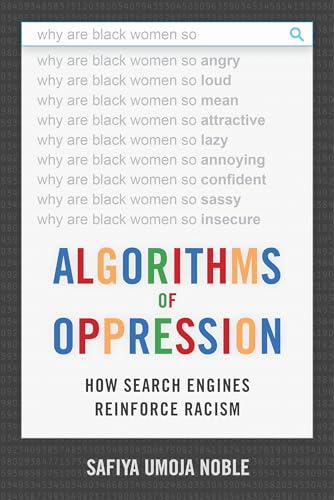
Run a Google search for “Black girls”―what will you find? “Big Booty” and other sexually explicit terms are likely to come up as top search terms. But, if you type in “white girls,” the results are radically different. The suggested porn sites and un-moderated discussions about “why Black women are so sassy” or “why Black women are so angry” presents a disturbing portrait of Black womanhood in modern society.
In Algorithms of Oppression, Safiya Umoja Noble challenges the idea that search engines like Google offer an equal playing field for all forms of ideas, identities, and activities. Data discrimination is a real social problem; Noble argues that the combination of private interests in promoting certain sites, along with the monopoly status of a relatively small number of Internet search engines, leads to a biased set of search algorithms that privilege whiteness and discriminate against people of color, specifically women of color.
Through an analysis of textual and media searches as well as extensive research on paid online advertising, Noble exposes a culture of racism and sexism in the way discoverability is created online. As search engines and their related companies grow in importance―operating as a source for email, a major vehicle for primary and secondary school learning, and beyond―understanding and reversing these disquieting trends and discriminatory practices is of utmost importance.
An original, surprising and, at times, disturbing account of bias on the internet, Algorithms of Oppression contributes to our understanding of how racism is created, maintained, and disseminated in the 21st century.
"synopsis" may belong to another edition of this title.
About the Author
Safiya Umoja Noble is the David O. Sears Presidential Endowed Chair of Social Sciences and Professor at the University of California, Los Angeles. She is the Director of the Center on Resilience & Digital Justice and Co-Director of the Minderoo Initiative on Tech & Power at UCLA. She currently serves as a Director of the UCLA DataX Initiative, leading work in critical data studies for the campus. Noble is the author of the best-selling book Algorithms of Oppression: How Search Engines Reinforce Racism. In 2021, she was recognized as a MacArthur Foundation Fellow for her ground-breaking work on algorithmic discrimination. In 2022, she was recognized as the inaugural NAACP-Archewell Digital Civil Rights Award recipient. She is also the recipient of the 2023 Miles Conrad Award, a lifetime achievement award for those working in the information community.
"About this title" may belong to another edition of this title.
Search results for Algorithms of Oppression: How Search Engines Reinforce...

Stock Image
Algorithms of Oppression: How Search Engines Reinforce Racism
Published by
New York University Press, 2018
ISBN 10: 1479837245
ISBN 13: 9781479837243
Used
Paperback
Seller: World of Books (was SecondSale), Montgomery, IL, U.S.A.
Seller rating 5 out of 5 stars

Paperback. Condition: Good. A revealing look at how negative biases against women of color are embedded in search engine results and algorithms Run a Google search for "Black girls"?what will you find? "Big Booty" and other sexually explicit terms are likely to come up as top search terms. But, if you type in "white girls," the results are radically different. The suggested porn sites and un-moderated discussions about "why Black women are so sassy" or "why Black women are so angry" presents a disturbing portrait of Black womanhood in modern society. In Algorithms of Oppression, Safiya Umoja Noble challenges the idea that search engines like Google offer an equal playing field for all forms of ideas, identities, and activities. Data discrimination is a real social problem; Noble argues that the combination of private interests in promoting certain sites, along with the monopoly status of a relatively small number of Internet search engines, leads to a biased set of search algorithms that privilege whiteness and discriminate against people of color, specifically women of color. Through an analysis of textual and media searches as well as extensive research on paid online advertising, Noble exposes a culture of racism and sexism in the way discoverability is created online. As search engines and their related companies grow in importance?operating as a source for email, a major vehicle for primary and secondary school learning, and beyond?understanding and reversing these disquieting trends and discriminatory practices is of utmost importance. An original, surprising and, at times, disturbing account of bias on the internet, Algorithms of Oppression contributes to our understanding of how racism is created, maintained, and disseminated in the 21st century. Seller Inventory # 00110627229
Stock Image
Algorithms of Oppression: How Search Engines Reinforce Racism
Published by
New York University Press, 2018
ISBN 10: 1479837245
ISBN 13: 9781479837243
Used
Paperback
Seller: World of Books (was SecondSale), Montgomery, IL, U.S.A.
Seller rating 5 out of 5 stars
Paperback. Condition: Very Good. A revealing look at how negative biases against women of color are embedded in search engine results and algorithms Run a Google search for "Black girls"?what will you find? "Big Booty" and other sexually explicit terms are likely to come up as top search terms. But, if you type in "white girls," the results are radically different. The suggested porn sites and un-moderated discussions about "why Black women are so sassy" or "why Black women are so angry" presents a disturbing portrait of Black womanhood in modern society. In Algorithms of Oppression, Safiya Umoja Noble challenges the idea that search engines like Google offer an equal playing field for all forms of ideas, identities, and activities. Data discrimination is a real social problem; Noble argues that the combination of private interests in promoting certain sites, along with the monopoly status of a relatively small number of Internet search engines, leads to a biased set of search algorithms that privilege whiteness and discriminate against people of color, specifically women of color. Through an analysis of textual and media searches as well as extensive research on paid online advertising, Noble exposes a culture of racism and sexism in the way discoverability is created online. As search engines and their related companies grow in importance?operating as a source for email, a major vehicle for primary and secondary school learning, and beyond?understanding and reversing these disquieting trends and discriminatory practices is of utmost importance. An original, surprising and, at times, disturbing account of bias on the internet, Algorithms of Oppression contributes to our understanding of how racism is created, maintained, and disseminated in the 21st century. Seller Inventory # CIN1479837245VG
Stock Image
Algorithms of Oppression : How Search Engines Reinforce Racism
Published by
New York University Press, 2018
ISBN 10: 1479837245
ISBN 13: 9781479837243
Used
Softcover
Seller: Better World Books, Mishawaka, IN, U.S.A.
Seller rating 5 out of 5 stars
Condition: Good. Former library copy. Pages intact with minimal writing/highlighting. The binding may be loose and creased. Dust jackets/supplements are not included. Includes library markings. Stock photo provided. Product includes identifying sticker. Better World Books: Buy Books. Do Good. Seller Inventory # 40873308-6
Stock Image
Algorithms of Oppression: How Search Engines Reinforce Racism
Published by
New York University Press February 2018, 2018
ISBN 10: 1479837245
ISBN 13: 9781479837243
Used
Paper Back
Seller: A Cappella Books, Inc., Atlanta, GA, U.S.A.
Seller rating 5 out of 5 stars
Paper Back. Condition: Very Good. Seller Inventory # 404744
Stock Image
Algorithms of Oppression : How Search Engines Reinforce Racism
Published by
New York University Press, 2018
ISBN 10: 1479837245
ISBN 13: 9781479837243
Used
Softcover
Seller: Better World Books: West, Reno, NV, U.S.A.
Seller rating 5 out of 5 stars
Condition: Very Good. Pages intact with possible writing/highlighting. Binding strong with minor wear. Dust jackets/supplements may not be included. Stock photo provided. Product includes identifying sticker. Better World Books: Buy Books. Do Good. Seller Inventory # 17897972-6
Stock Image
Algorithms of Oppression : How Search Engines Reinforce Racism
Published by
New York University Press, 2018
ISBN 10: 1479837245
ISBN 13: 9781479837243
Used
Softcover
Seller: Better World Books: West, Reno, NV, U.S.A.
Seller rating 5 out of 5 stars
Condition: Good. Pages intact with minimal writing/highlighting. The binding may be loose and creased. Dust jackets/supplements are not included. Stock photo provided. Product includes identifying sticker. Better World Books: Buy Books. Do Good. Seller Inventory # 17339210-6
Stock Image
Algorithms of Oppression: How Search Engines Reinforce Racism
Published by
New York University Press, 2018
ISBN 10: 1479837245
ISBN 13: 9781479837243
Used
Paperback
Seller: World of Books Inc, Montgomery, IL, U.S.A.
Seller rating 4 out of 5 stars

Paperback. Condition: Very Good. A revealing look at how negative biases against women of color are embedded in search engine results and algorithms Run a Google search for "Black girls"?what will you find? "Big Booty" and other sexually explicit terms are likely to come up as top search terms. But, if you type in "white girls," the results are radically different. The suggested porn sites and un-moderated discussions about "why Black women are so sassy" or "why Black women are so angry" presents a disturbing portrait of Black womanhood in modern society. In Algorithms of Oppression, Safiya Umoja Noble challenges the idea that search engines like Google offer an equal playing field for all forms of ideas, identities, and activities. Data discrimination is a real social problem; Noble argues that the combination of private interests in promoting certain sites, along with the monopoly status of a relatively small number of Internet search engines, leads to a biased set of search algorithms that privilege whiteness and discriminate against people of color, specifically women of color. Through an analysis of textual and media searches as well as extensive research on paid online advertising, Noble exposes a culture of racism and sexism in the way discoverability is created online. As search engines and their related companies grow in importance?operating as a source for email, a major vehicle for primary and secondary school learning, and beyond?understanding and reversing these disquieting trends and discriminatory practices is of utmost importance. An original, surprising and, at times, disturbing account of bias on the internet, Algorithms of Oppression contributes to our understanding of how racism is created, maintained, and disseminated in the 21st century. Seller Inventory # CIN1479837245VG
Stock Image
Algorithms of Oppression: How Search Engines Reinforce Racism
Published by
New York University Press, 2018
ISBN 10: 1479837245
ISBN 13: 9781479837243
Used
Paperback
Seller: World of Books Inc, Montgomery, IL, U.S.A.
Seller rating 4 out of 5 stars
Paperback. Condition: Good. A revealing look at how negative biases against women of color are embedded in search engine results and algorithms Run a Google search for "Black girls"?what will you find? "Big Booty" and other sexually explicit terms are likely to come up as top search terms. But, if you type in "white girls," the results are radically different. The suggested porn sites and un-moderated discussions about "why Black women are so sassy" or "why Black women are so angry" presents a disturbing portrait of Black womanhood in modern society. In Algorithms of Oppression, Safiya Umoja Noble challenges the idea that search engines like Google offer an equal playing field for all forms of ideas, identities, and activities. Data discrimination is a real social problem; Noble argues that the combination of private interests in promoting certain sites, along with the monopoly status of a relatively small number of Internet search engines, leads to a biased set of search algorithms that privilege whiteness and discriminate against people of color, specifically women of color. Through an analysis of textual and media searches as well as extensive research on paid online advertising, Noble exposes a culture of racism and sexism in the way discoverability is created online. As search engines and their related companies grow in importance?operating as a source for email, a major vehicle for primary and secondary school learning, and beyond?understanding and reversing these disquieting trends and discriminatory practices is of utmost importance. An original, surprising and, at times, disturbing account of bias on the internet, Algorithms of Oppression contributes to our understanding of how racism is created, maintained, and disseminated in the 21st century. Seller Inventory # CIN1479837245G
Stock Image
Algorithms of Oppression: How Search Engines Reinforce Racism
Seller: Hilltop Book Shop, Marshfield, WI, U.S.A.
Seller rating 5 out of 5 stars
paperback. Condition: Very Good. Paperback in very good condition. Light edge wear to covers. Clean pages free of writing, marks or tears. Binding is secure. No spine creases. Our feedback says it all! Feel confident when you order from Hilltop Book Shop. Seller Inventory # 2301130006
Seller Image
Algorithms of Oppression : How Search Engines Reinforce Racism
Seller: GreatBookPrices, Columbia, MD, U.S.A.
Seller rating 5 out of 5 stars
Condition: good. May show signs of wear, highlighting, writing, and previous use. This item may be a former library book with typical markings. No guarantee on products that contain supplements Your satisfaction is 100% guaranteed. Twenty-five year bookseller with shipments to over fifty million happy customers. Seller Inventory # 29711836-5