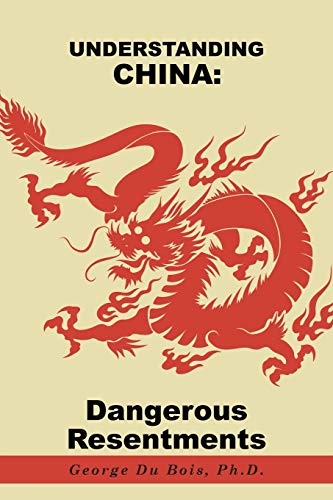
Understanding China: Dangerous Resentments - Softcover
Du Bois, George

 
9781490745053: Understanding China: Dangerous Resentments

Synopsis

The United States has been the world's dominant super power for the last 70 years. It sets the rules for international relations and seeks to maintain the status quo. That situation is changing. China is expected to equal the United States in power within two decades, and relations between the two have become increasingly confrontational. American policy makers need to understand Chinese attitudes formed during 4,000 years of their history-as leaders of civilization until 1800-and then as impotent objects of exploitation and derision for the next 100 years. The Chinese have strong resentments against the nations of the West, resentments that pose a danger of future conflict unless American policy makers understand and attempt to mitigate them. Any evaluation of China's future actions that omits its long history treats relations between the two countries as mere questions of economic tensions, military power, and super-power ambitions. While these factors are important, so also is cultural memory. This book presents a concise but complete overview of Chinese history up to 2014 and indicates crucial lessons that should be drawn in order to facilitate peaceful trade and cooperation.

"synopsis" may belong to another edition of this title.

Excerpt. © Reprinted by permission. All rights reserved.

Understanding China: Dangerous Resentments

By George Du Bois

Trafford Publishing

Copyright © 2014 George Du Bois, Ph.D.
All rights reserved.
ISBN: 978-1-4907-4505-3

Contents

1. China Awakens, 1,
2. Ancient China (ca. 2070 to 206 B.C.E.), 7,
3. Imperial China (206 B.C.E. to 960 C.E.), 39,
4. Imperial China (960 to 1796), 85,
5. The Stability of Confucian Civilization, 133,
6. The Late Qing Dynasty (1796 to 1912), 139,
7. The Early Republic (1912 to 1949), 189,
8. The People's Republic of China: The Mao Zedong Era (1949 to 1976), 215,
9. The Deng Xiaoping Era (1976 to mid-1990s), 237,
10. Deng Xiaoping's Successors (mid-1990s to 2014), 257,
11. China and the United States, 275,


CHAPTER 1

China Awakens


In the early 19th century when China was still admired by intellectuals in the West, Napoleon remarked, "China is a sleeping giant. Let it sleep, for when it awakens, it will astonish the world." That moment has finally arrived, and the nations of the West are not sure whether China is ultimately a friend or a foe.

Answering that question must take into account both China's past unhappy relations with the West (resentments) and some aspects of its brilliant 2,000-year-old Confucian culture (lingering heritage.) Without such considerations, any analysis of future relations looks essentially at the future as mere questions of economic tensions, military power and hegemonic ambitions.

Understanding China's resentments requires an examination of two factors that together (the "Western Impact") make that nation's relations with the West unique: 1) the distinctive mistreatment of China by Western nations beginning in the 19th century and 2) the consequent quasi-destruction of a remarkable civilization developed over 4,000 years. Both contribute to China's psychological sense of grievance.

The most egregious example of Western mistreatment is Britain's attack on China in 1842 to force it to permit unlimited importation of opium, reaching the astounding cumulative total of 800,000,000 pounds by 1899. In that period, China experienced a full share of the negative aspects of colonialism but none of the positive ones. The contrast with India is instructive. In India, the British took control of the country and exploited it. In China, no one took control, but the Western nations individually extorted concessions from the Chinese by treaty, and thanks to most favored nation clauses, whatever one nation extorted from the hapless Chinese redounded to the benefit of all.

Both India and China suffered exploitation, but only India gained some benefits. When the British departed from India, they left behind, for instance, a well-trained modern civil service and an extensive railway system. No Western nation trained Chinese civil servants, and none built a large railroad system. On balance it was probably more advantageous to be an outright colony than to retain a powerless national independence. The abuse that China experienced in the 19th century still rankles the proud Chinese.

Although many historians capably describe the Western mistreatment of China, they hardly mention the resentment some Chinese feel from the quasi-destruction of a culture that had stood at the forefront of world civilization for millennia. (The term "quasi" is used deliberately. Those aspects of the culture not destroyed by the Western Impact are the lingering heritage that statesmen today should also take into account in analyzing China–to which we turn three paragraphs below.)

Chinese civilization had usually been in the vanguard of world civilization for over 2,000 years–the richest, most populous of civilizations. Statesmen today need an understanding of the nature of that civilization, significantly dismantled by Western arms and the introduction of culture more appropriate to a modern society than to a traditional agricultural society like China. Western political creeds, education, science, mathematics and industrialism rendered China's own way of life obsolete. Here the contrast with Islamic civilization is instructive. The Islamic Golden Age of advances in philosophy, science, art, and architecture ended with the Mongol conquest of Baghdad hundreds of years before Islamic lands suffered Western exploitation. The West did not cause the decline of Islamic civilization. The West was, by contrast, a major cause of the rapid decline of Chinese civilization from power and splendor to impotence and derision.

Both Western exploitation and cultural destruction reverberate, consciously and unconsciously, in the Chinese psyche today and are likely to influence future decisions of Chinese leaders. China suffered a compound fracture. In this respect, it is unique in the present world. The West should be very careful not to aggravate those feelings of resentment. Welcoming China into a significant role in peace-keeping in the modern world is likely to prove more rewarding than viewing China as a potential threat. China's reaching great power status is now inevitable.

In addition, some aspects of China's brilliant civilization–the lingering heritage–may also play a role in the decisions of China's leaders. An evaluation of China's political stance, for example, should take into account China's long tradition of authoritarian government. Democracy has essentially never existed in China; yet China was long perhaps the most sophisticated of civilized nations. China's great contribution to political theory, the doctrine of the Mandate of Heaven, the first theory of justifiable revolution against tyranny, serves today as a warning to China's leaders that present rampant corruption threatens the regime. Thus, the lingering heritage serves as a backdrop to contemporary anti-corruption campaigns.

Lingering heritage affects the economy as well. An evaluation of the future nature of China's economy should recognize that after thousands of years of experience with government monopolies, particularly in the salt and iron industries, there is little likelihood that China will develop a totally market economy. An evaluation of China's future financial strength should also take into account the traditional reliance on family for one's security in old age. China has already taken modest steps to liberalize its one-child policy, allowing the creation of families of larger size. Such an event could lift a significant financial burden from the government in the future if the next generation of elderly can count on larger families, nuclear and extended, to support them.

An evaluation of China's traditional attitudes toward other countries should also help inform policy makers as to prospects of war between China and the United States. China has not aggressively annexed territory for the last 1,500 years without ostensibly legitimate reasons.

The themes of China's resentments and lingering heritage appear throughout this account, though to differing degrees in different parts of the book.

The first part of the book surveys the first 4,000 years of Chinese history (2070 B.C.E. to 1911 C.E.), elucidating China's extraordinary heritage. Knowledge of China's civilization, especially the last 2,000 years, is important today to statesmen and businessmen, for many features of and attitudes derived from that civilization endure and potentially influence the actions and attitudes of China's leaders and people today. Many aspects of culture are slow to change.

The second part of the book examines China's sad history during the 19th century C.E., when the leaders of China adamantly refused to jettison their culture and adopt a majority of Western ways. This section thus explores the historical reasons for Chinese resentments. Why, after all, should the Chinese change their civilization in order to imitate ruthless men whom they considered "sea devils?" The splendor and cultural brilliance of Chinese culture had radiated like a bonfire throughout East Asia and deeply influenced Korea and Japan. Here the contrast with Japan is instructive. China, the propagator of culture in East Asia, resisted all but minimal changes to its culture in the 19th century. Japan had been a frequent borrower of culture (from China) including the written script, the tea ceremony, Chinese architecture, and Zen Buddhism. Well aware of the advantages of cultural borrowings, the Japanese set out to adopt Western ways with a speed and enthusiasm unmatched in history while China stood still. As a result, China experienced stagnation and then chaos, whereas Japan developed a powerful economy.

China's civilization was such that most of its previous conquerors astonishingly had adopted Chinese culture in preference to their own. History was not to repeat itself. In its encounters with the West, China was confronted for the first time in the 19th century C.E. with a culture more dynamic than its own. Finally, even the conservatives realized–but too late–that substantial change was necessary.

The third part of the book ties the themes of lingering heritage and resentment together. It starts with an examination of the years from 1911 to 1976 when China experienced revolution, political chaos, civil war among warlords, civil war between Nationalists and Communists, invasion by Japan, and ill-advised policies under Mao Zedong. It then examines the three decades of extraordinary economic growth under Deng Xiaoping and his successors in a tacit alliance with the United States. It closes with an examination of the most recent few years when China and the United States have each taken actions creating a degree of mutual distrust and making war between these powerful nations a possibility. American policy makers need to understand that a muscular approach to China will not work. It can only initiate a spiral of confrontations and military spending that increase the prospects of an unnecessary war.

CHAPTER 2

Ancient China

(ca. 2070 to 206 B.C.E.)


The most striking facts about Chinese civilization are its long duration and its cultural brilliance. Though historians long doubted Chinese accounts about events prior to the 11th century B.C.E., archaeologists in the 20th century C.E. proved that much in these accounts must be considered historical. The dawn of Chinese civilization has receded some 1000 years to the 21st century B.C.E.


A. The Legendary Emperors

Many of the emperors of China's high antiquity may be recognized, not as actual rulers but as stages of development of the Chinese people. Such is the case with Fu Xi, reputed to have taught the "black-haired people" to live in houses, fish with nets, keep domestic animals, and live in family groups. His illustrious successor Shennong is supposed to have taught the Chinese the art of farming. Still a third legendary emperor, Huangdi, also known as the "Yellow Emperor," is alleged to have established a single government, invented bricks, and built roads; his wife's great achievement was teaching the Chinese how to raise silkworms.

In these legends a progressive increase in the level of civilization is discernible. Some of the succeeding legendary emperors, though, acted much more like actual rulers and may have been historical persons. Foremost among them were Yao, Shun and Yu, who gave the Chinese people eras of peace, prosperity and good government. Yao rejected his own son as his successor in favor of Shun, whom he chose because of his moral qualities–the first instance in Chinese history of virtue as a necessary characteristic of a legitimate ruler. Yao's choice was wise, for Shun's was a model of benevolent government. Yu, in particular, is beloved of the Chinese. He labored ceaselessly for 13 years to prevent the floods that periodically ravaged China and founded the Xia dynasty, the first of China's great ruling families, when the people urged that his son succeed him.

The importance of Yao, Shun and Yu depends not upon whether they were actual historical personalities but rather on the fact that their examples partially shaped the ideal of a ruler's conduct for some 2,500 years. In the 5th century B.C.E., Confucius, greatest of all Chinese philosophers, held up these three sovereigns as models for the Chinese to emulate. Living in a troubled era of constant warfare, he urged his countrymen to return to the peaceful ways of these rulers. Thus, characteristically, the Chinese looked to the past for a golden age, not to the future, as is the case with modern peoples.


B. Pre-History

Archaeology has shown that after ca. 2070 B.C.E. peoples of a reasonably advanced culture inhabited China. Hundreds of sites in the Yellow River ("Huang He") valley disclose the existence of people who produced exquisite black, red or gray pottery. They lived in villages, kept dogs, pigs, sheep and cattle, buried their dead face down, used knives and sickles, and grew millet and eventually rice.

The pottery people practiced intensive agriculture farming small plots by hand rather than extensive agriculture by animal-drawn plough. They were gardeners rather than farmers. In intensive agriculture a high degree of cooperation is required within the family. Unless all members attempt to maximize the yield of each square foot of ground, there might not be enough food for the family's own needs, let alone a surplus to exchange for salt, cooking oil, tools, cloth, etc. A family that worked together survived; a family that quarreled or pursued individualistic goals risked impoverishment or starvation.

The traditional Chinese family system with all power concentrated in the oldest male was a consequence of the intensive agriculture practiced by the pottery people. It only awaited Confucius and his followers to give it a moral and political rationalization to serve as the most important factor in the longevity of China's brilliant civilization. The history of China would have been quite different had extensive farming of large areas by plow been adopted. In farming by hand, the Chinese committed themselves to many of the features of their civilization for the next 4,000 years. The plow, the sine qua non of extensive farming was invented in the early Middle East but did not reach China until the late-middle part of the Zhou dynasty, about 1,500 years after the dawn of Chinese civilization. By then, it was too late for plow cultivation to supplant the firmly established pattern of farming by hand. Fields were already miniscule Rare was the peasant whose acres were all of a single piece, and their size made extensive farming impractical.

The prehistoric "pottery peoples" of China were not as sophisticated as the Chinese people of later ages, but they were far from primitive. Their only severe handicaps were ignorance of the use of metal and lack of a system of writing. Archaeologists hypothesize the derivation of China's first dynasty, the Xia dynasty (roughly 2070 to 1550 B.C.E.), from the black pottery people.

No Xia texts exist, but archaeologists have excavated settlements with post-and-beam type palaces on platforms of stamped earth surrounded by the modest dwellings of the common people. The Xia made a great advance in the arts of civilization by learning the techniques of bronze casting. Bronze originated in the ancient Middle East and gradually radiated in all directions, arriving late in China by virtue of the long distance involved and the impenetrability of the mountain ranges to the south and deserts to the west of China. Bronze entered China from Siberia in the north, and it is for this reason above all that Chinese civilization originated in the central plain of China in the great Yellow River ("Huang He") valley.

The Xia used bronze for weapons and bronze artifacts used in religious ceremonies, particularly ancestor worship, a practice initially limited to the royal family but which over the centuries all Chinese families adopted. The Confucianists would, a thousand and more years later, use this practice as one foundation upon which to build one of the most remarkably stable civilizations the world has ever seen. Ancestor worship also required the Chinese to look to the past for guidance.


C. The Shang Dynasty (ca. 1550 to ca. 1045 B.C.E.)

With the Shang dynasty begins a more certain history of the Chinese people, for the Shang unlike the Xia had a fully developed written script, another great advance in the arts of civilization. In the last years of the 19th century C.E., peasants in the modern province of Henan began uncovering "oracle bones" as they tilled their fields. By the turn of the century scholars realized that these ancient bones were inscribed with the earliest known form of the Chinese script. Later excavations uncovered the great metropolis of Anyang, ancient capital of the Shang in the extreme north of present-day Henan province, and yielded over 100,000 of these bones, the shoulder blades of oxen and the plastrons (i.e. the underside of the shell) of a species of long-extinct turtle. A prodigious effort by scholars has succeeded in deciphering a large number of the inscribed characters.

Used to foretell the future, the bones were inscribed with questions relating to the weather, sickness, crops, the prospect of military success, etc. The officials in charge, who formed a semi-priesthood, heated the "oracle" bones with a redhot poker until they cracked. They then interpreted the cracks to obtain answers to the questions and often inscribed the answers on the bones. The characters used indicate that the Chinese script is indigenous to China and not an offshoot of some other hieroglyphic script like that of Egypt.


(Continues...)
Excerpted from Understanding China: Dangerous Resentments by George Du Bois. Copyright © 2014 George Du Bois, Ph.D.. Excerpted by permission of Trafford Publishing.
All rights reserved. No part of this excerpt may be reproduced or reprinted without permission in writing from the publisher.
Excerpts are provided by Dial-A-Book Inc. solely for the personal use of visitors to this web site.

"About this title" may belong to another edition of this title.

Other Popular Editions of the Same Title

9781490745077: Understanding China: Dangerous Resentments

Featured Edition

ISBN 10:  1490745076 ISBN 13:  9781490745077
Publisher: Trafford Publishing, 2014
Hardcover