
Items related to Programming Language Cultures: Automating Automation
Synopsis
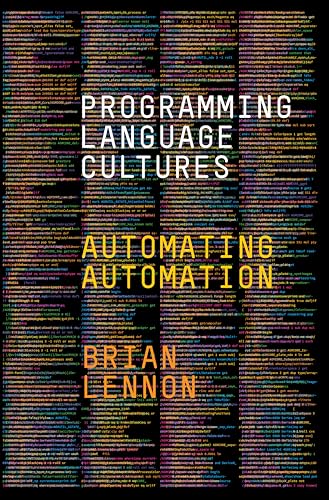
In this book, Brian Lennon demonstrates the power of a philological approach to the history of programming languages and their usage cultures. In chapters focused on specific programming languages such as SNOBOL and JavaScript, as well as on code comments, metasyntactic variables, the very early history of programming, and the concept of DevOps, Lennon emphasizes the histories of programming languages in their individual specificities over their abstract formal or structural characteristics, viewing them as carriers and sometimes shapers of specific cultural histories. The book's philological approach to programming languages presents a natural, sensible, and rigorous way for researchers trained in the humanities to perform research on computing in a way that draws on their own expertise. Combining programming knowledge with a humanistic analysis of the social and historical dimensions of computing, Lennon offers researchers in literary studies, STS, media and digital studies, and technical fields the first technically rigorous approach to studying programming languages from a humanities-based perspective.
"synopsis" may belong to another edition of this title.
About the Author
Brian Lennon is Professor of English and Comparative Literature at Pennsylvania State University. He is the author of Passwords: Philology, Security, Authentication (2018) and In Babel's Shadow: Multilingual Literatures, Monolingual States (2010).
"About this title" may belong to another edition of this title.
Search results for Programming Language Cultures: Automating Automation

Stock Image
Programming Language Cultures : Automating Automation
Published by
Stanford University Press, 2024
ISBN 10: 1503639878
ISBN 13: 9781503639874
Used
Softcover
Seller: GreatBookPrices, Columbia, MD, U.S.A.
Seller rating 5 out of 5 stars

Condition: As New. Unread book in perfect condition. Seller Inventory # 46361337
Stock Image
Programming Language Cultures : Automating Automation
Published by
Stanford University Press, 2024
ISBN 10: 1503639878
ISBN 13: 9781503639874
New
Softcover
Seller: GreatBookPrices, Columbia, MD, U.S.A.
Seller rating 5 out of 5 stars
Condition: New. Seller Inventory # 46361337-n
Seller Image
Programming Language Cultures: Automating Automation (Paperback or Softback)
Published by
Stanford University Press 8/27/2024, 2024
ISBN 10: 1503639878
ISBN 13: 9781503639874
New
Paperback or Softback
Seller: BargainBookStores, Grand Rapids, MI, U.S.A.
Seller rating 5 out of 5 stars
Paperback or Softback. Condition: New. Programming Language Cultures: Automating Automation. Book. Seller Inventory # BBS-9781503639874
Stock Image
Programming Language Cultures
Seller: PBShop.store UK, Fairford, GLOS, United Kingdom
Seller rating 5 out of 5 stars
PAP. Condition: New. New Book. Shipped from UK. Established seller since 2000. Seller Inventory # FW-9781503639874
Buy New
US$ 29.17
US$ 5.52 shipping
Ships from United Kingdom to U.S.A.
Ships from United Kingdom to U.S.A.
Quantity: 15 available
Stock Image
Programming Language Cultures: Automating Automation (eng)
Published by
Stanford University Press, 2024
ISBN 10: 1503639878
ISBN 13: 9781503639874
New
Softcover
Seller: Brook Bookstore On Demand, Napoli, NA, Italy
Seller rating 5 out of 5 stars
Condition: new. Seller Inventory # HPPAAWGXWB
Buy New
US$ 30.99
US$ 6.16 shipping
Ships from Italy to U.S.A.
Ships from Italy to U.S.A.
Quantity: Over 20 available
Stock Image
Programming Language Cultures: Automating Automation
Published by
Stanford University Press, 2024
ISBN 10: 1503639878
ISBN 13: 9781503639874
New
Softcover
Seller: Majestic Books, Hounslow, United Kingdom
Seller rating 4 out of 5 stars

Condition: New. Seller Inventory # 398204561
Buy New
US$ 32.21
US$ 8.62 shipping
Ships from United Kingdom to U.S.A.
Ships from United Kingdom to U.S.A.
Quantity: 3 available
Stock Image
Programming Language Cultures Automating Automation
Seller: Revaluation Books, Exeter, United Kingdom
Seller rating 5 out of 5 stars
Paperback. Condition: Brand New. 240 pages. 9.00x6.00x9.00 inches. In Stock. Seller Inventory # __1503639878
Buy New
US$ 27.72
US$ 13.26 shipping
Ships from United Kingdom to U.S.A.
Ships from United Kingdom to U.S.A.
Quantity: 2 available
Stock Image
Programming Language Cultures: Automating Automation
Published by
Stanford University Press, 2024
ISBN 10: 1503639878
ISBN 13: 9781503639874
New
Softcover
Seller: Kennys Bookshop and Art Galleries Ltd., Galway, GY, Ireland
Seller rating 5 out of 5 stars
Condition: New. Seller Inventory # V9781503639874
Buy New
US$ 33.21
US$ 10.64 shipping
Ships from Ireland to U.S.A.
Ships from Ireland to U.S.A.
Quantity: Over 20 available
Stock Image
Programming Language Cultures: Automating Automation
Published by
Stanford University Press, 2024
ISBN 10: 1503639878
ISBN 13: 9781503639874
New
Softcover
Seller: Ria Christie Collections, Uxbridge, United Kingdom
Seller rating 5 out of 5 stars
Condition: New. In English. Seller Inventory # ria9781503639874_new
Buy New
US$ 32.69
US$ 12.42 shipping
Ships from United Kingdom to U.S.A.
Ships from United Kingdom to U.S.A.
Quantity: Over 20 available
Stock Image
Programming Language Cultures: Automating Automation
Published by
Stanford University Press, 2024
ISBN 10: 1503639878
ISBN 13: 9781503639874
New
Paperback / softback
Seller: THE SAINT BOOKSTORE, Southport, United Kingdom
Seller rating 5 out of 5 stars
Paperback / softback. Condition: New. New copy - Usually dispatched within 4 working days. Seller Inventory # B9781503639874
Buy New
US$ 25.94
US$ 21.22 shipping
Ships from United Kingdom to U.S.A.
Ships from United Kingdom to U.S.A.
Quantity: Over 20 available