
Items related to We Can't Talk about That at Work!: How to Talk...
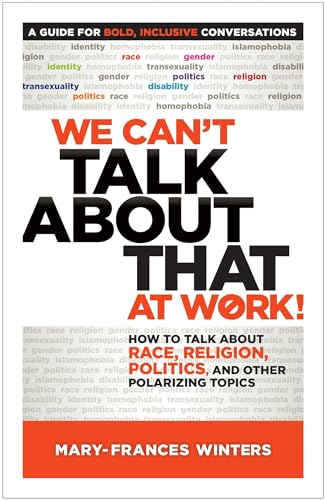
We Can't Talk about That at Work!: How to Talk about Race, Religion, Politics, and Other Polarizing Topics - Softcover
Synopsis
Instead of shutting down any mention of taboo topics, Mary-Frances Winters shows how to structure intentional conversations about them, so people can safely confront biases and stereotypes and create stronger, more inclusive organizations.
Politics, religion, race - we can't talk about topics like these at work, right? But in fact, these conversations are happening all the time, either in real life or virtually via social media. And if they aren't handled effectively, they can become more polarizing and divisive, impacting productivity, engagement, retention, teamwork, and even employees' sense of safety in the workplace. But you can turn that around and address difficult topics in a way that brings people together instead of driving them apart.
As a thought leader in the field of diversity and inclusion, Mary-Frances Winters has been helping clients create inclusive environments for over three decades. In this concise and powerful book, she shows you how to lay the groundwork for having bold, inclusive conversations.
Even with the best of intentions, you can't just start talking about taboo topics - that's wandering into a minefield. Winters offers exercises and tools to help you become aware of how your cultural background has shaped your perceptions and habits and to increase your understanding of how people from other cultures may differ from you, particularly when it comes to communicating and handling conflict.
Once you're ready (you can take the self-assessment included in the book to make sure), Winters gives detailed instructions on exactly how to structure these conversations. She emphasizes that this is a process, not a destination—you may not be able to resolve major issues nicely and neatly in just one conversation. And while the process is important, so is intent. She urges readers to “come from your heart, learn from your mistakes, and continue to contribute to making this a more inclusive world for all.”
"synopsis" may belong to another edition of this title.
About the Author
As founder and president of the Winters Group, Mary-Frances Winters has been helping clients create inclusive environments for over three decades. She was named a diversity pioneer by Profiles in Diversity Journal and is the recipient of the prestigious Athena Award, as well as the Winds of Change Award conferred by the Forum on Workplace Inclusion.
Excerpt. © Reprinted by permission. All rights reserved.
We Can't Talk About That At Work!
How To Talk About Race, Religion, Politics, and Other Polarizing Topics
By Mary-Frances WintersBerrett-Koehler Publishers, Inc.
Copyright © 2017 Mary-Frances Winters
All rights reserved.
ISBN: 978-1-5230-9426-4All rights reserved.
Contents
Preface, xi,
1 Why Do We Have to Talk about THAT at Work?, 1,
2 Get Yourself Ready for Bold, Inclusive Conversations, 19,
3 Expand Your Understanding of Others and Assess Organizational Readiness, 41,
4 Prepare: Why, Who, What, How, Where, and When?, 67,
5 Let the Conversations Begin: Search for Shared Meaning, 87,
6 Let the Conversations Continue: Interpret and Bridge Differences, 107,
7 Sharpen Inclusive Habits, 119,
Glossary, 139,
Notes, 145,
Acknowledgments, 153,
Index, 155,
About the Author, 161,
CHAPTER 1
Why Do We Have to Talk about THAT at Work?
High performing leaders are able to unite diverse team members by building common goals and even shared emotions by engaging in powerful and effective dialogue.
GEORGE KOHLRIESER, Clinical and Organizational Psychologist1
Why in the world would we want to encourage employees to talk about polarizing topics in the workplace? We come to work in order to make products and provide services for our customers, members, and/or clients — not to talk about social issues. Topics such as race, politics, and religion are inappropriate and should be discouraged.
Perhaps this is how you feel. For as long as I can remember, this has been the prevailing sentiment for many organizations and corporate environments. However, there are compelling reasons why a position of avoidance is no longer the best policy.
The most persuasive reason for building the skills necessary to talk about polarizing topics at work is that they are already being talked about or thought about, more than you may think. Social media is a huge factor in the increased visibility of and exposure to these issues. And even as these topics remain top of mind for most of us, in general, we lack the skills to have effective dialogue.
The goal of this book is to help you make the conversations that are already happening more productive, supportive, and inclusive, leaving people feeling whole and ultimately resulting in better teamwork, productivity, and engagement.
A POLARIZED SOCIETY LEADS TO A POLARIZED WORKPLACE
When race enters our public conversations about these important national issues, the dialogue is too often dehumanizing and racially charged. Language matters, and we need more tools to move our race conversations forward in more accurate, fair, and productive ways.
President Barack Obama
As the workforce becomes more diverse, there are more people from different racial/ethnic groups, religious affiliations, political affiliations, sexual orientations, and disability statuses who may be facing very different realities than ever before. We are living in times of heightened social conflict around race, religion, and politics. The last few years have been filled with instances of police brutality, the shooting and killing of police officers, immigration debates, religious intolerance against Muslims and Jews, heightened awareness of transgender rights and its backlash, terrorism, and extreme political divisions, making it impossible for many not to bring strong emotions about these issues into the workplace.
Social scientists contend that the more we feel threatened, the greater our tendency to be "tribal" and polarized. Tribalism is part of human nature. We've found that many people feel that their way of life is being threatened by terrorism, demographic changes, and new technology. When people are fearful, the gut level response is to blame "the other tribe(s)" for their plight. With so many complex issues facing society today, there is more polarization than ever before. Consider these realities:
* In a 2016 survey that explored the state of race relations in the United States, only 44 percent of white people were very concerned about the killings of black people at the hands of police, compared to 77 percent of black responders. However, when asked about the killings of police officers in Dallas, over 75 percent of both black and white people were very concerned.
* In a survey on race and workplace trauma conducted by The Winters Group, six in ten whites answered that they think their organization understands the unique experiences of blacks in the workplace. In direct contrast six in ten blacks answered that they did not think their organization understands their unique experiences.
* The vote for Britain to exit the European Union has largely been attributed to class issues and xenophobia. A headline in the Guardian in June 2016 read, "BREXIT is the only way the working class can change anything." The results of the election showed deep class divides. Many working-class Brits blame immigration for the loss in jobs. Between 1993 and 2014, the number of immigrants into the UK surged from 3.8 million to 8.3 million.
* A recent poll showed that 56 percent of Americans feel that Muslim values are at odds with US values. However, 68 percent said that they had never or seldom talked to a Muslim.
* In a Pew survey on gender equality, 56 percent of men said that obstacles inhibiting women's progress are largely gone. Only 34 percent of women shared that view.
* According to a global study conducted by Unilever based on interviews with 9,000 men and women across eight global markets, stereotypes and inappropriate behavior targeting women in the workplace still prevail. Sixty-seven percent of women in the study reported that they feel pressured to "get over" inappropriate behavior, and 55 percent of men and 64 percent of women believe that men do not challenge each other when they witness such behavior.
* Relative to political polarization in the United States, a Pew study showed that 93 percent of Republicans are more conservative than the median Democrat, while a nearly identical share of Democrats (94 percent) is more liberal than the median Republican. Twenty years ago, there was a much smaller divide, with 64 percent of Republicans to the right of the median Democrat, and 70 percent of Democrats to the left of the median Republican.
* The inauguration of Donald Trump as the 45th president of the United States drew strong protests around the world. Globally, over three million people participated in the Women's March to protest the election of President Trump, who they feel does not represent the values espoused by the United States, especially those policies geared toward gender equality, health care for women, religious freedom, and LGBTQ rights. Protesters said that they joined the marches because of Trump's divisive campaign and his disparagement of women, minorities, and immigrants.
* The North Carolina HB2 bill, known as the "bathroom bill," requires transgender people to use public bathrooms associated with their birth sex. As a result, a number of organizations cancelled high-profile events in the state, resulting in millions of dollars of lost revenue.
* Environmental justice and racism, both highly political subjects, intersected in mid-2016 when the US Army Corps of Engineers authorized the Dakota Access Pipeline project (DAPL), which threatened the safety and sanctity of the Standing Rock Sioux tribe's water and sacred cultural sites. The project sparked national protests and a grassroots movement that sought to reaffirm the humanity of indigenous people and their land. The DAPL has sparked polarization among business, political, and Native American communities.
* There has been ongoing dissention around the term "Redskin" and other mascots that denigrate Native American communities. As of 2010, over 115 professional organizations — representing civil rights advocates, educational institutions, athletes, and scientific experts — have published resolutions or policies that state that the use of Native American names and/or symbols by non-native sports teams is a harmful form of ethnic stereotyping that promotes misunderstanding and prejudice, which contributes to other problems faced by Native Americans. 14 However, as of the publication date of this book, the Washington, DC, football team has not changed its name.
* We see a great deal of polarization and discourse around immigration. A range of countermeasures have been put forth — from building a wall to the more liberal proposal of the Dream Act, a multi-phased process for undocumented residents to provide conditional residency leading to permanent status. Due in part to political dissention, the bill never passed.
* While conversations about disability and people with disabilities may not be deemed as polarizing, I have found that we shy away from the subject matter, even in discussions around diversity. Perhaps this is because we do not know how to effectively have these bold conversations. In 2014, the British charity Scope conducted a survey that found two-thirds of British people feel uncomfortable or awkward talking to somebody who is disabled.
Kate Vernon, director of strategy programs at Community Business and author of extensive research on diversity and inclusion in Asia, makes this observation:
It can be difficult to have open and honest conversations about race in Asia. We often talk about culture and the impact of different cultural profiles on communication and working styles — but we rarely address the biases and prejudices that exist about or between different ethnic groups, or openly acknowledge the power and privilege that certain groups enjoy. But there is no doubt that racism does exist in Asia. Whether it be India or Hong Kong, Japan or Singapore, there is an unspoken, often complex racial hierarchy that many will recognize but be wary to articulate. If we are to promote a culture of true inclusion, we need to find a way to broach this sensitive topic. Yet the Asian preference for promoting harmony, saving face, and showing respect can make having such bold conversations doubly hard.
These polarized views and often-avoided topics drive attitudes, perceptions, and behaviors. If I no longer believe there are barriers for women in the workplace, I would see no need for special programs designed to bolster women's chances for advancement. If I am not concerned about the shootings of unarmed black men, then I may not be empathetic to workers who are fearful and traumatized by such events.
POLARIZATION THWARTS INCLUSION; INCLUSION DRIVES ENGAGEMENT
Polarization thwarts attempts for inclusion. Polarization is the opposite of inclusion. Polarization fosters an "us-and-them" environment, whereas inclusion attempts to create a sense of belonging and unity. Most major organizations today have a goal to create an inclusive culture because they realize that inclusion drives engagement. As reported in a 2013 Gallup study, inclusion and engagement are highly correlated. The results showed that the most engaged employees rated the company high on diversity and inclusion. The least engaged employees rated the company very low on the questions related to diversity and inclusion. The Winters Group conducted a survey with a large financial institution that showed similar results. Inclusion was the highest correlated factor to engagement.
When employees feel that they are psychologically safe, they are also more engaged and innovative. According to a study by Catalyst that surveyed Australian workers, employees who experience psychological safety feel that they can freely speak up about problems and tough issues. One's perception of psychological safety is based on a belief about the organization's norms or culture, which I cover in Chapter 3. The same study identified four leadership characteristics that enable psychological safety across race, gender, and other demographic variables. They are accountability, courage, humility, and empowerment. I speak to courage and cultural humility in Chapter 2.
THE IMPACT OF SOCIAL MEDIA ON POLARIZATION
Social media outlets are exacerbating the increase in polarization. Instantaneous access to breaking news and opinions via tools such as Twitter, Facebook, Snapchat, and others has magnified opportunities to engage in contentious conversation and debate. People routinely use their smart phones to record all sorts of events that go viral for the whole world to see and comment on.
Before social media, we weren't as likely to be constantly confronted with polarizing topics such as race, religion, and politics unless we were news junkies. In the workplace, it is easy, even if against company policy, to have ongoing access to social media on our smart devices. Therefore, many people are constantly debating and sharing their opinions and beliefs on social media; and to the extent that they are virtually connected to coworkers, they are having these conversations at work, or in a workplace context. Social media makes it very easy to know the beliefs and opinions of coworkers.
The more that an individual's personal beliefs are repeated (i.e., go viral), the more they become accepted as fact. By the same token, the more an individual's or a group's beliefs are challenged, the more they are believed by that group. When beliefs are challenged, the human tendency is to become more obstinate and determined to defend the opinion. In other words, we dig our heels in deeper, as the saying goes. Any attention to the belief or opinion, positive or negative, acts as fuel for the fire.
Let's take Facebook, for example. The personal nature of this form of electronic communication can keep our emotions in high gear. We tell our Facebook friends what we like and what we don't like. When we disagree with a friend on Facebook we continue to post more rationale for our own position, and they, in turn, post more for their position, increasing the polarization. In the extreme, when a friend posts something we don't like, we can "un-friend" them. In other words, we can stay firmly rooted in our own beliefs, totally rejecting another's viewpoint. We take an "I don't want to hear it" attitude and in some cases, an "I don't like you anymore." We are often unable to separate the person from their position. I discuss the need to separate the person from the position in Chapter 3.
Many people today are addicted to social media. Social and behavioral scientists are busy studying the psychological ramifications of this fairly new phenomenon. I have talked with many people who say they have disconnected from social media and now feel less stressed. Some, who have not done so, bring these intense emotions and associated anxiety with them to work. And they do not stop communicating on polarizing issues just because they are at work.
THE IMPACT ON EMPLOYEES, IN THEIR OWN WORDS
The Winters Group has conducted a number of dialogue sessions for a variety of different clients over the past year, supporting them in effectively addressing the aftermath of recent traumatic events and the polarized views that seem to always be associated with them. My first request is "Describe how you are feeling in one word." The responses range from depressed, despondent, frustrated, angry, helpless, and hopeless to encouraged, energized, hopeful, and optimistic. However, a majority of the emotions are negative.
Psychologists believe that the recurrence of unfortunate events intensifies feelings of stress and trauma. The more we see images of police shootings, terrorist attacks, and other acts of violence, the more we are likely to experience effects likened to post traumatic stress syndrome. Individuals who are most impacted by these events — for instance, black men fearful that they will be wrongly targeted by police, Muslim women in hijabs afraid they will be subject to bullying or worse, transgendered employees afraid to use the bathroom that corresponds to their gender identities — are likely distracted at work. This impacts engagement and productivity.
The Winters Group has conducted several public, free virtual learning webinars to address some of these issues. One was called Race & Workplace Trauma during the Age of #BlackLivesMatter. More than 250 people were in attendance. Another, called Let the Healing Begin: Restoring Our Quest for Inclusion, was conducted immediately following the 2016 presidential election. Over 600 registered for this 90-minute session. We polled participants during both sessions to explore the extent to which these events impacted their productivity at work. More than 60 percent admitted that there was either a "great deal" or "somewhat" of an impact.
Here are some perspectives shared during these sessions:
"I came to work the day after the Philando Castile killing and I said to my boss that I was pretty upset, and I got nothing, not even an acknowledgment. This really shook me up and now I don't know if I can really trust her."
— African American male at large consulting company (I heard similar sentiments from several others from different companies.)
"I am Muslim, gay, and from the Middle East. That is three strikes against me. When I am waiting for the train at the metro station I don't stand near the edge because I am afraid someone might push me in. I bring that fear to work with me every day. It does impact my ability to concentrate and do my best work."
— male employee at a not-for-profit research organization
"I was at work and got a call from my child at school. He was terrified because the kids were telling him that he was going to be deported. I felt a need to leave and go and get him. My boss understood."
— Latina employee at a large service organization
"Our company sent out a statement after the Pulse Night Club shooting but said nothing about the killings of unarmed black men. Why does one group deserve acknowledgment and sympathy and our group [African Americans] does not?"
— African American employee at a large consulting firm (I heard similar statements from African Americans at several different companies.)
(Continues...)
Excerpted from We Can't Talk About That At Work! by Mary-Frances Winters. Copyright © 2017 Mary-Frances Winters. Excerpted by permission of Berrett-Koehler Publishers, Inc..
All rights reserved. No part of this excerpt may be reproduced or reprinted without permission in writing from the publisher.
Excerpts are provided by Dial-A-Book Inc. solely for the personal use of visitors to this web site.
"About this title" may belong to another edition of this title.
Search results for We Can't Talk about That at Work!: How to Talk...

Stock Image
We Cant Talk about That at Work! A Guide for Bold, Inclusive Conversations
Published by
Berrett-Koehler Publishers, 2017
ISBN 10: 1523094265
ISBN 13: 9781523094264
Used
Paperback
Seller: World of Books (was SecondSale), Montgomery, IL, U.S.A.
Seller rating 5 out of 5 stars

Paperback. Condition: Fair. Politics, religion, race - we can't talk about topics like these at work, right? But in fact, these conversations are happening all the time, and if they aren't handled effectively, they can become even more polarizing and divisive, impacting productivity, engagement, retention, teamwork, and even an employee's sense of safety in the workplace. But in this concise and powerful book, Mary-Frances Winters, a thought leader in the field of diversity and inclusion, shows you how to lay the groundwork for having bold, inclusive conversations - conversations that address those difficult topics in ways that bring people together instead of driving them apart. Through the exercises and tools Winters offers here, you can prepare for the process of having these conversations effectively and ethically. And although major issues are unlikely to be nicely and neatly settled in just one conversation, if you combine diligence, good intentions, careful introspection, and patience, success is within yo ur g rasp. Seller Inventory # 00099029541
Stock Image
We Cant Talk about That at Work! A Guide for Bold, Inclusive Conversations
Published by
Berrett-Koehler Publishers, 2017
ISBN 10: 1523094265
ISBN 13: 9781523094264
Used
Paperback
Seller: World of Books (was SecondSale), Montgomery, IL, U.S.A.
Seller rating 5 out of 5 stars
Paperback. Condition: Very Good. Politics, religion, race - we can't talk about topics like these at work, right? But in fact, these conversations are happening all the time, and if they aren't handled effectively, they can become even more polarizing and divisive, impacting productivity, engagement, retention, teamwork, and even an employee's sense of safety in the workplace. But in this concise and powerful book, Mary-Frances Winters, a thought leader in the field of diversity and inclusion, shows you how to lay the groundwork for having bold, inclusive conversations - conversations that address those difficult topics in ways that bring people together instead of driving them apart. Through the exercises and tools Winters offers here, you can prepare for the process of having these conversations effectively and ethically. And although major issues are unlikely to be nicely and neatly settled in just one conversation, if you combine diligence, good intentions, careful introspection, and patience, success is within yo ur g rasp. Seller Inventory # 00085173185
Stock Image
We Cant Talk about That at Work! A Guide for Bold, Inclusive Conversations
Published by
Berrett-Koehler Publishers, 2017
ISBN 10: 1523094265
ISBN 13: 9781523094264
Used
Paperback
Seller: World of Books (was SecondSale), Montgomery, IL, U.S.A.
Seller rating 5 out of 5 stars
Paperback. Condition: Good. Politics, religion, race - we can't talk about topics like these at work, right? But in fact, these conversations are happening all the time, and if they aren't handled effectively, they can become even more polarizing and divisive, impacting productivity, engagement, retention, teamwork, and even an employee's sense of safety in the workplace. But in this concise and powerful book, Mary-Frances Winters, a thought leader in the field of diversity and inclusion, shows you how to lay the groundwork for having bold, inclusive conversations - conversations that address those difficult topics in ways that bring people together instead of driving them apart. Through the exercises and tools Winters offers here, you can prepare for the process of having these conversations effectively and ethically. And although major issues are unlikely to be nicely and neatly settled in just one conversation, if you combine diligence, good intentions, careful introspection, and patience, success is within yo ur g rasp. Seller Inventory # 00086025807
Stock Image
We Can't Talk about That at Work!: How to Talk about Race, Religion, Politics, and Other Polarizing Topics
Published by
Berrett-Koehler Publishers, 2017
ISBN 10: 1523094265
ISBN 13: 9781523094264
Used
paperback
Seller: Gulf Coast Books, Cypress, TX, U.S.A.
Seller rating 5 out of 5 stars
paperback. Condition: Very Good. Seller Inventory # 1523094265-2-36285668
Stock Image
We Can't Talk about That at Work!: How to Talk about Race, Religion, Politics, and Other Polarizing Topics
Published by
Berrett-Koehler Publishers, 2017
ISBN 10: 1523094265
ISBN 13: 9781523094264
Used
paperback
Seller: Orion Tech, Kingwood, TX, U.S.A.
Seller rating 5 out of 5 stars
paperback. Condition: Very Good. Seller Inventory # 1523094265-2-36879490
Stock Image
We Can't Talk about That at Work!: How to Talk about Race, Religion, Politics, and Other Polarizing Topics
Published by
Berrett-Koehler Publishers, 2017
ISBN 10: 1523094265
ISBN 13: 9781523094264
Used
paperback
Seller: Your Online Bookstore, Houston, TX, U.S.A.
Seller rating 5 out of 5 stars
paperback. Condition: Fair. Seller Inventory # 1523094265-4-36687519
Stock Image
We Can't Talk about That at Work!: How to Talk about Race, Religion, Politics, and Other Polarizing Topics
Published by
Berrett-Koehler Publishers, 2017
ISBN 10: 1523094265
ISBN 13: 9781523094264
Used
paperback
Seller: Gulf Coast Books, Cypress, TX, U.S.A.
Seller rating 5 out of 5 stars
paperback. Condition: As New. Seller Inventory # 1523094265-1-37151072
Seller Image
We Can't Talk about That at Work!: How to Talk about Race, Religion, Politics, and Other Polarizing Topics
Published by
Berrett-Koehler Publishers, 2017
ISBN 10: 1523094265
ISBN 13: 9781523094264
Used
Softcover
Seller: Zoom Books East, Glendale Heights, IL, U.S.A.
Seller rating 5 out of 5 stars
Condition: good. Book is in good condition and may include underlining highlighting and minimal wear. The book can also include "From the library of" labels. May not contain miscellaneous items toys, dvds, etc. . We offer 100% money back guarantee and 24 7 customer service. Seller Inventory # ZEV.1523094265.G
Stock Image
We Can't Talk about That at Work!: How to Talk about Race, Religion, Politics, and Other Polarizing Topics
Published by
Berrett-Koehler Publishers (edition 1), 2017
ISBN 10: 1523094265
ISBN 13: 9781523094264
Used
Paperback
Seller: BooksRun, Philadelphia, PA, U.S.A.
Seller rating 5 out of 5 stars
Paperback. Condition: Very Good. 1. It's a well-cared-for item that has seen limited use. The item may show minor signs of wear. All the text is legible, with all pages included. It may have slight markings and/or highlighting. Seller Inventory # 1523094265-11-1
Seller Image
We Can't Talk about That at Work!: How to Talk about Race, Religion, Politics, and Other Polarizing Topics
Published by
Berrett-Koehler Publishers, 2017
ISBN 10: 1523094265
ISBN 13: 9781523094264
Used
Softcover
Seller: Greenworld Books, Arlington, TX, U.S.A.
Seller rating 5 out of 5 stars
Condition: like_new. Fast Free Shipping â" Excellent condition book with clean cover and pages. Barely handled, with minimal wear. An outstanding copy, close to enjoy! Seller Inventory # GWV.1523094265.LN