
Items related to Meditations
Synopsis
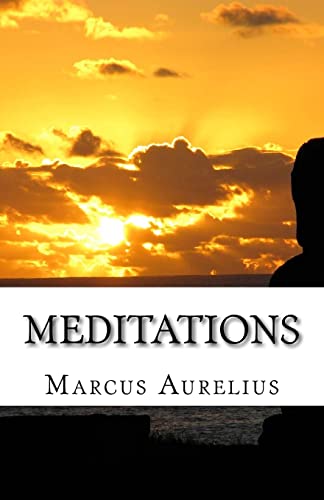
Meditations is a series of personal writings by Marcus Aurelius, Roman Emperor from 161 to 180 AD, recording his private notes to himself and ideas on Stoic philosophy. Meditations is divided into 12 books that chronicle different periods of Marcus Aurelius' historical life. Marcus Aurelius wrote the 12 books of the Meditations as a source for his own guidance and self improvement and philosophy. A central theme to Meditations is to analyze your judgment of self and others and developing a cosmic perspective. Marcus Aurelius is considered the last of the Five Good Emperors of Rome, and is also considered one of the most important Stoic philosophers. Meditations is often required textbook reading in various courses such as humanities, philosophy, and ethics.
"synopsis" may belong to another edition of this title.
Review
One measure, perhaps, of a book's worth, is its intergenerational pliancy: do new readers acquire it and interpret it afresh down through the ages? The Meditations of Marcus Aurelius, translated and introduced by Gregory Hays, by that standard, is very worthwhile, indeed. Hays suggests that its most recent incarnation--as a self-help book--is not only valid, but may be close to the author's intent. The book, which Hays calls, fondly, a "haphazard set of notes," is indicative of the role of philosophy among the ancients in that it is "expected to provide a 'design for living.'" And it does, both aphoristically ("Think of yourself as dead. You have lived your life. Now take what's left and live it properly.") and rhetorically ("What is it in ourselves that we should prize?"). Whether these, and other entries ("Enough of this wretched, whining monkey life.") sound life-changing or like entries in a teenager's diary is up to the individual reader, as it should be. Hays's introduction, which sketches the life of Marcus Aurelius (emperor of Rome A.D. 161-180) as well as the basic tenets of stoicism, is accessible and jaunty. --H. O'Billovich
From the Back Cover
The Roman emperor Marcus Aurelius Antoninus embodied in his person that deeply cherished, ideal figure of antiquity, the philosopher-king. His Meditations, written in moments snatched from military campaigns and the rigors of politics, reveal a mind of exceptional clarity and originality, and a spirit attuned to both the particulars of human destiny and the vast patterns which underlie it.
"About this title" may belong to another edition of this title.
Search results for Meditations

Seller Image
Meditations
Published by
CreateSpace Independent Publishing Platform, 2016
ISBN 10: 1537069721
ISBN 13: 9781537069722
Used
Softcover
Seller: GreatBookPrices, Columbia, MD, U.S.A.
Seller rating 5 out of 5 stars

Condition: As New. Unread book in perfect condition. Seller Inventory # 27376467
Stock Image
Meditations
Published by
Createspace Independent Publishing Platform, 2016
ISBN 10: 1537069721
ISBN 13: 9781537069722
New
Paperback / softback
Seller: THE SAINT BOOKSTORE, Southport, United Kingdom
Seller rating 5 out of 5 stars
Paperback / softback. Condition: New. This item is printed on demand. New copy - Usually dispatched within 5-9 working days. Seller Inventory # C9781537069722
Buy New
US$ 12.74
US$ 16.55 shipping
Ships from United Kingdom to U.S.A.
Ships from United Kingdom to U.S.A.
Quantity: Over 20 available
Seller Image
Meditations
Published by
CreateSpace Independent Publishing Platform, 2016
ISBN 10: 1537069721
ISBN 13: 9781537069722
New
Softcover
Seller: GreatBookPrices, Columbia, MD, U.S.A.
Seller rating 5 out of 5 stars
Condition: New. Seller Inventory # 27376467-n
Seller Image
Meditations
Published by
CreateSpace Independent Publishing Platform, 2016
ISBN 10: 1537069721
ISBN 13: 9781537069722
New
Softcover
Seller: GreatBookPricesUK, Woodford Green, United Kingdom
Seller rating 5 out of 5 stars
Condition: New. Seller Inventory # 27376467-n
Buy New
US$ 12.73
US$ 20.27 shipping
Ships from United Kingdom to U.S.A.
Ships from United Kingdom to U.S.A.
Quantity: Over 20 available
Seller Image
Meditations
Published by
CreateSpace Independent Publishing Platform, 2016
ISBN 10: 1537069721
ISBN 13: 9781537069722
Used
Softcover
Seller: GreatBookPricesUK, Woodford Green, United Kingdom
Seller rating 5 out of 5 stars
Condition: As New. Unread book in perfect condition. Seller Inventory # 27376467
Buy Used
US$ 14.43
US$ 20.27 shipping
Ships from United Kingdom to U.S.A.
Ships from United Kingdom to U.S.A.
Quantity: Over 20 available
Stock Image
Meditations (Paperback)
Published by
Createspace Independent Publishing Platform, 2016
ISBN 10: 1537069721
ISBN 13: 9781537069722
New
Paperback
Seller: CitiRetail, Stevenage, United Kingdom
Seller rating 5 out of 5 stars
Paperback. Condition: new. Paperback. Meditations is a series of personal writings by Marcus Aurelius, Roman Emperor from 161 to 180 AD, recording his private notes to himself and ideas on Stoic philosophy. Meditations is divided into 12 books that chronicle different periods of Marcus Aurelius' historical life. Marcus Aurelius wrote the 12 books of the Meditations as a source for his own guidance and self improvement and philosophy. A central theme to Meditations is to analyze your judgment of self and others and developing a cosmic perspective. Marcus Aurelius is considered the last of the Five Good Emperors of Rome, and is also considered one of the most important Stoic philosophers. Meditations is often required textbook reading in various courses such as humanities, philosophy, and ethics. This item is printed on demand. Shipping may be from our UK warehouse or from our Australian or US warehouses, depending on stock availability. Seller Inventory # 9781537069722
Buy New
US$ 18.77
US$ 50.00 shipping
Ships from United Kingdom to U.S.A.
Ships from United Kingdom to U.S.A.
Quantity: 1 available