
Items related to Back to the Front
Synopsis
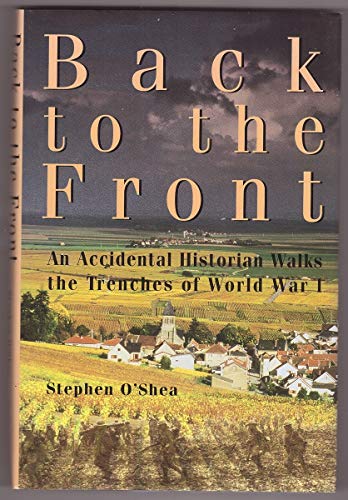
World War I has left as deep a scar on the imaginative landscape of our century as it
has on the land where it was fought. Nowhere is that more evident than on the
Western Front, a narrow swath of land in which millions of lives were lost. Believing
that "history is too important to be left to the professionals," journalist Stephen
O'Shea set out to walk the 450 miles through no-man's-land to discover for his generation
the meaning of the war. As his walk progresses, O'Shea recreates the shocking battles of the Western Front, and offers an impassioned perspective on the war, the
state of the land, and the cultivation of memory. An evocative fusion of past and present, BACKT TO THE FRONT will resonate, for all who read it, as few other books on war ever have.
"synopsis" may belong to another edition of this title.
About the Author
Toronto-born author and journalist Stephen O'Shea moved to France in the early 1980s. There, he took up journalism, shortly after completing postgraduate degrees in politics at the Université de Paris 1 (Pantheon-Sorbonne) and the prestigious Institut d'Etudes Politiques de Paris.
In 1989, Elle magazine relocated O'Shea to New York to be a senior features editor of their American edition. In 1993, he returned to Paris, where he worked as Variety's film critic, and published articles on French culture and politics for American, British, French, and Canadian magazines, including The Observer, The Times of London, Harper's Bazaar, Interview, Allure, and Mother Jones.
To research The Perfect Heresy, O'Shea moved to Perpignan in southern France in 1997, where he spent two years immersing himself in Cathar lore. In addition to The Perfect Heresy, O'Shea is also the author of the widely acclaimed Back to the Front (Walker & Company, 1997), a hiker's meditation on the trenches of World War I.
Stephen O'Shea currently lives with his wife, Jill Pearlman, and two daughters in Providence, Rhode Island.
Reviews
A Canadian journalist who has walked the weary length of WW I's western front reports movingly on his experiences and more. A Paris-based correspondent for Elle, Interview, and other periodicals, O'Shea began hiking the centerpiece combat zone of the so-called Great War almost by chance during the mid-1980s. The serpentine path (to which he returned time and again) begins around Nieuport on the Belgian coast, winds through the French countryside, and ends abruptly at the frontier of neutral Switzerland. Between the two extremes, the blood-soaked track of the trenches, from which Allied and German troops rose to slaughter one another by the millions during the 52-month conflict, twists through scores of storied venues. Cases in point range from Flanders (Ypres, Passchendaele) through Artois (ArmentiŠres, Arras, Vimy Ridge), Picardy, Champagne (Chemin des Dames, Reims), and Alsace-Lorraine (St. Mihiel, Verdun, the Argonne Forest). In his commentary as a tour guide, the author is by turns informative and censorious. Interspersing his point-to-point travelogue of abandoned redoubts, burial grounds, disputed barricades, monuments, museums, and ossuaries with short takes on the campaigns that earned hinterland villages a place in military history, he offers unsparing critiques of commanders on both sides of the fray (notably, Falkenhayn, Foch, Haig, Joffre, Nivelle, Pershing, and P‚tain). O'Shea also recalls his two Irish grandfathers, who survived the senseless carnage (as soldiers of the British Crown), albeit at considerable cost in mental and physical pain. Antiwar by conviction at the start of his explorations, he's something very like a militant pacifist at the end of a decade-long journey. A tellingly detailed account of a trek through yesteryear's killing fields, which unites past with present in affectingly evocative ways and with no small measure of art. (maps) -- Copyright ©1997, Kirkus Associates, LP. All rights reserved.
Paris-based journalist O'Shea walked the length of the Western Front of World War I during the summers from 1986 to 1995. The journey was a personal one: both his grandfathers had fought on the front lines. O'Shea began his journey in Nieuport, Belgium, and followed the remains of the trenches some 450 miles to the border of France and Switzerland. Because the tactics of war usually consisted of massed infantry assaults against machine guns and artillery, O'Shea doesn't provide much historical context. What does emerge from his narrative is a shocking description of what happened on the battlefields. Generals often began offensives that lost some 100,000 men in one month?only to begin the same process the following month. Despite the talk of glory, the war came down to crushing personal losses. The author briskly moves the narrative along, though photographs comparing the battlefields a la William Frassanito (Early Photography at Gettysburg, Thomas, 1995) would have been helpful. An engaging and thought-provoking work; recommended for history buffs.?Mark E. Ellis, Albany State Univ., Ga.
Copyright 1997 Reed Business Information, Inc.
In places the Western Front still slashes across Belgium and France, visible among the cemeteries, ossuaries, and monuments as grassy, cratered terrain, zig-zagging trenches, crumbling pillboxes and forts. O'Shea, while working in publishing trenches in Paris, grew curious about the war's physical aftermath, and in several trips gathered his observations for this sensitively nuanced tour. For preparation, he steeped himself in the war's history and got reacquainted with the trench experience of his two Irish grandfathers. Both motifs contribute to the book's structure, which unfolds geographically as O'Shea hoofs it from the sea to Switzerland, encountering formerly muddy slaughterhouses euphemized as Ypres, the Somme, or Verdun. At each battle area O'Shea summarizes what generals hoped would happen and how they seemingly never learned from what did happen, a mulish obstinacy that palpably angers him. His contemporary vignettes vividly animate the trip, as do his reflections about the meaning of monument making. With this ambulant meditation and protest against militarism, O'Shea has created a high-stature addition to the classic works about the Great War. Gilbert Taylor
"About this title" may belong to another edition of this title.
Search results for Back to the Front

Seller Image
Back to the Front
Published by
Douglas & McIntyre, Limited, 1996
ISBN 10: 1550544721
ISBN 13: 9781550544725
Used
Hardcover
Seller: Zoom Books East, Glendale Heights, IL, U.S.A.
Seller rating 5 out of 5 stars

Condition: very_good. Book is in very good condition and may include minimal underlining highlighting. The book can also include "From the library of" labels. May not contain miscellaneous items toys, dvds, etc. . We offer 100% money back guarantee and 24 7 customer service. Seller Inventory # ZEV.1550544721.VG
Seller Image
Back to the Front
Published by
Douglas & McIntyre, Limited, 1996
ISBN 10: 1550544721
ISBN 13: 9781550544725
Used
Hardcover
Seller: Zoom Books Company, Lynden, WA, U.S.A.
Seller rating 5 out of 5 stars
Condition: very_good. Book is in very good condition and may include minimal underlining highlighting. The book can also include "From the library of" labels. May not contain miscellaneous items toys, dvds, etc. . We offer 100% money back guarantee and 24 7 customer service. Seller Inventory # ZBV.1550544721.VG
Seller Image
Back to the Front: An Accidental Historian Walks the Trenches of World War 1
Published by
Douglas & McIntyre, Vancouver, 1996
ISBN 10: 1550544721
ISBN 13: 9781550544725
Used
Hardcover
First Edition
Seller: Irolita Books, Aurora, ON, Canada
Seller rating 5 out of 5 stars
Hardcover. Condition: FINE. Dust Jacket Condition: FINE. First edition. Clean, unworn copy. No writing or markings. Binding is sound and tight. New archival mylar dj cover. 24 cm. 205 pages. Additional info or photos on request. Ships in sturdy cardboard packaging, with tracking and insurance. Seller Inventory # 12239
Buy Used
US$ 19.00
US$ 2.50 shipping
Ships from Canada to U.S.A.
Ships from Canada to U.S.A.
Quantity: 1 available
Stock Image
Back to the Front
Published by
Douglas & McIntyre, Limited, 1996
ISBN 10: 1550544721
ISBN 13: 9781550544725
Used
Hardcover
Seller: ThriftBooks-Dallas, Dallas, TX, U.S.A.
Seller rating 5 out of 5 stars
Hardcover. Condition: Very Good. No Jacket. May have limited writing in cover pages. Pages are unmarked. ~ ThriftBooks: Read More, Spend Less. Seller Inventory # G1550544721I4N00
Stock Image
Back to the Front
Published by
Douglas & McIntyre, Limited, 1996
ISBN 10: 1550544721
ISBN 13: 9781550544725
Used
Hardcover
Seller: SatelliteBooks, Burlington, VT, U.S.A.
Seller rating 5 out of 5 stars
hardcover. Condition: As New. Hardcover. Near fine / near fine dust jacket. Free of any markings and no writings inside. Clear Text. Tight binding. Price sticker on back cover near bottom edge of jacket. For any additional information or pictures, please inquire. Seller Inventory # 230506014
Stock Image
Back to the Front
Published by
Douglas & McIntyre, Limited, 1996
ISBN 10: 1550544721
ISBN 13: 9781550544725
Used
Hardcover
Seller: Three Hills Books, Three Hills, AB, Canada
Seller rating 5 out of 5 stars
Hardcover. Condition: Very Good. Dust Jacket Condition: Very Good. Light scuffing on jacket. Seller Inventory # 000817
Buy Used
US$ 20.44
US$ 5.49 shipping
Ships from Canada to U.S.A.
Ships from Canada to U.S.A.
Quantity: 1 available
Seller Image
Back to the Front
Published by
Douglas & McIntyre, Vancouver BC, 1996
ISBN 10: 1550544721
ISBN 13: 9781550544725
Used
Hardcover
First Edition
Seller: Ainsworth Books ( IOBA), Chilliwack, BC, Canada
Seller rating 5 out of 5 stars
Hardcover. Condition: Near Fine. Dust Jacket Condition: Near Fine. First Edition. Only slight wear; A bright, solid book dustjacket in Mylar.; Maps; 9.1 X 6.1 X 0.9 inches; 205 pages; "World War I has left as deep a scar on the imaginative landscape of our century as it has on the land where it was fought. Nowhere is that more evident than on the Western Front, a narrow swath of land in which millions of lives were lost. Believing that "history is too important to be left to the professionals," journalist Stephen O'Shea set out to walk the 450 miles through no-man's-land to discover for his generation the meaning of the war. As his walk progresses, O'Shea recreates the shocking battles of the Western Front, and offers an impassioned perspective on the war, the state of the land, and the cultivation of memory.". Seller Inventory # 19184
Buy Used
US$ 17.50
US$ 16.00 shipping
Ships from Canada to U.S.A.
Ships from Canada to U.S.A.
Quantity: 1 available
Seller Image
Back to the Front: An Accidental Historian Walks the Trenches of World War I
Published by
Douglas & McIntyre, Vancouver, BC, 1996
ISBN 10: 1550544721
ISBN 13: 9781550544725
Used
Hardcover
First Edition
Seller: Riverwash Books (IOBA), Prescott, ON, Canada
Seller rating 4 out of 5 stars

Hardcover. Condition: Very Good. Dust Jacket Condition: Very Good. First Edition. 205 pp. Index. Spine, corners bumped. Jacket has light edgewear. The account of the author's 750 km walk through the countryside that was once the no-man's land of the First World War, a journey taken in stages between 1985 and 1995.; 8vo 8" - 9" tall. Seller Inventory # MIL1475
Buy Used
US$ 15.00
US$ 19.00 shipping
Ships from Canada to U.S.A.
Ships from Canada to U.S.A.
Quantity: Over 20 available
Stock Image
Back to the Front
Published by
Douglas & McIntyre,Canada, 1996
ISBN 10: 1550544721
ISBN 13: 9781550544725
Used
Hardcover
Seller: Russell Books, Victoria, BC, Canada
Seller rating 5 out of 5 stars
Condition: Good. Seller Inventory # FORT799788
Buy Used
US$ 14.99
US$ 19.99 shipping
Ships from Canada to U.S.A.
Ships from Canada to U.S.A.
Quantity: 1 available
Seller Image
Back to the Front: An Accidental Historian Walks the Trenches of World War I
Published by
Douglas & McIntyre, Vancouver, BC, 1996
ISBN 10: 1550544721
ISBN 13: 9781550544725
Used
Hardcover
First Edition
Signed
Seller: Riverwash Books (IOBA), Prescott, ON, Canada
Seller rating 4 out of 5 stars
Hardcover. Condition: Very Good-. Dust Jacket Condition: Very Good-. First Edition. 205 pp. Index. Maps. Spine, corners bumped. Jacket has light edgewear. Inscribed by the author on the title page. The account of the author's 750 km walk through the countryside that was once the no-man's land of the First World War, a journey taken in stages between 1985 and 1995.; 8vo 8" - 9" tall; Signed by Author. Seller Inventory # MIL2981
Buy Used
US$ 25.00
US$ 19.00 shipping
Ships from Canada to U.S.A.
Ships from Canada to U.S.A.
Quantity: 1 available