
Items related to Start & Run a Profitable Restaurant (Self-Counsel...
Start & Run a Profitable Restaurant (Self-Counsel Business Series) - Softcover
Book 17 of 25: Start & Run Business Series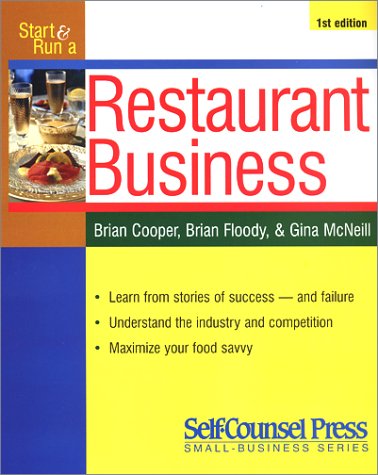
Synopsis
-Learn from stories of success- and failure -Understand the industry and competition -Maximize your food savvy
"synopsis" may belong to another edition of this title.
About the Author
Brian Cooper spent his life in the hospitality business. He managed restaurants, was an executive for major hotel chains, and as Dean Emeritus of George Brown College’s Hospitality School he created the first worldwide student chefs’ competition. Brian Floody has more than 30 years’ experience as a bar and restaurant owner, operator, consultant, and educator. His consulting company has opened more than 30 restaurants and bars, including several at EXPO ’86 in Vancouver, EXPO ’88 in Brisbane, and EXPO ’92 in Seville.
Gina McNeill has been a restaurant owner and chef, a culinary instructor, a casino hotel catering sales manager, and a freelance food stylist.
From the Back Cover
Every year hundreds of thousands of restaurants open with great expectations and every year almost as many close down. The successful restaurateur is a combination of entrepreneur, entertainer, and magician. Your success in owning a restaurant will come as a direct result of solid business practices, and your ability to entertain and satisfy your customers. Start & Run a Restaurant is a practical guide to "how to" and "how not to" proceed in this volatile business.
This book will help you maximize your food savvy, while learning from stories of success -- and failure. Topics include:
-Formulating a business plan -Budgeting and financing -Choosing a location -Designing a menu -Creating atmosphere through décor -Hiring and managing employees -Attracting customers
Start & Run a Restaurant will not only help you decide if you have what it takes to prosper as a restaurant owner but will also set you up to do so. Also includes a special chapter on pubs and bars.
Excerpt. © Reprinted by permission. All rights reserved.
Starting a restaurant involves many decisions. A prospective restaurateur must consider both the concept and the business aspect of his or her new venture. This chapter briefly highlights some important areas to think about before developing your plan for your new operation.
1. The Restaurateur as Entrepreneur and Entertainer
The successful restaurateur is a combination of entrepreneur (or businessperson) and entertainer (at times, even a magician). Your success depends on your ability to entertain your customer in your personalized theater. A restaurant or pub is simply a retail business that has been decorated and staffed to fit a specific production, as in a theater. Your menu is your script, your employees are your players, and your ability to balance finances determines the success or failure of your season.
Predicting which of the latest trends will keep your customers coming back when there are so many restaurants competing for their time and money is theater at its best. Your customers act on a daily basis as your critics, and you are wise to listen carefully to their comments. Survey your customers while they are dining in your operation; often they will provide you with valuable tips on ways to improve your operation. You can trust plates returning from customer tables, and even the garbage can be an indicator of success or failure. If customers are dissatisfied with their meal and tell you, you have a chance to make corrections and keep them as patrons. Continue to operate without making changes and you run the risk not only of losing your loyal customers, but also of them telling their friends about their negative experience with your establishment.
2. The Menu
The menu is the most important document you will ever prepare. The following are only a few of the reasons your menu is crucial to your success:
- It describes your dream to your potential customers. - It highly influences your location selection and marketing plan. - It clearly influences your décor plan. - It influences the design and layout of your kitchen and restaurant. - It determines who your customers will be and influences your employee selection. - It is a starting point for developing your pro forma income statement.
Everything, including your choice of partners and staff, is built around your choice of menu items.
If, for instance, your specialty will be the best Buffalo wings in town, your menu then necessitates a deep-fat fryer, an exhaust system, and a fire-extinguishing system in your kitchen. A casual décor usually complements such a menu, and your restaurant should be located near a family population base. Your employees skill level will be less important than it would be if you have a more sophisticated menu. You will probably have a fast turnover of customers and a low check average. One simple decision influences a great deal of your dream.
Before you look for partners to invest in your operation, prepare a draft menu for discussion. Place items on that menu only if they are within your personal capacity to prepare. Co-author Brian Cooper, in all his years of operating his own restaurants, only put items on a menu that in a pinch or in a snowstorm or whenever his cook gave him an ultimatum he could prepare himself until a replacement could be hired and trained. (For more about menus, see chapter 10, "Your Menu.")
3. Trends
It is important for you to differentiate between trends and fads. At the time of writing this book, there has been a trend toward light and healthy foods and away from deep-fried foods and heavy sauces. These trends take years to develop, and some will become part of the food culture for decades. Many restaurants, however, have bucked these trends, to their great success. On the one hand, your ability to anticipate or initiate these trends will lead you to fame and fortune. Fads, on the other hand, are short term and disappear quickly once they saturate the market or when the public tires of them. The current fad of sandwich wraps in quick-service restaurants may or may not become a trend, depending on customer support. It is critical to recognize whether your new idea is a trendsetter or merely a fad that will come and go within a season.
The restaurant business is constantly looking for new ways to draw in customers, and is therefore always changing and evolving with the trends of the day. For example, today s customer would not be impressed with the "noveau cuisine" offerings of the 1980s. Fusion was the word in the 1990s, when we saw a strong Asian influence blending with North American or Californian cuisine. This decade took multiculturalism from the streets and neighborhoods to the table. This movement is still reflected in today s menu offerings, and customers are demanding true ethnic cuisines and indigenous ingredients. They are clamoring for authentic food that represents its country s fare and flavors. Malaysian, Vietnamese, and Taiwanese menus are growing more popular than before as this trend increases.
Another trend that continues to grow as our population ages is "heart smart" menu offerings. Health food is no longer an alternative cuisine, offered only in "veggie" restaurants. Customers are demanding menu choices that are not only delicious, but are also low in both saturated fat and cholesterol and are healthy. Organic foods are now becoming mainstream as more people demand that food producers and those preparing foods act responsibly.
We have also seen a shift in where the food is prepared. The trend has been to take the kitchen out of the back of the house and bring it to center stage. Chefs are now celebrities, and the customer wants to be part of the action, often sitting at tables in full view of the kitchen. To be successful in this industry you will have to be continually prepared to grow, stay current with your clientele, and have fun!
"About this title" may belong to another edition of this title.
Search results for Start & Run a Profitable Restaurant (Self-Counsel...

Stock Image
Start & Run a Profitable Restaurant (Self-Counsel Business Series)
Seller: HPB Inc., Dallas, TX, U.S.A.
Seller rating 5 out of 5 stars

paperback. Condition: Very Good. Connecting readers with great books since 1972! Used books may not include companion materials, and may have some shelf wear or limited writing. We ship orders daily and Customer Service is our top priority! Seller Inventory # S_446453802
Stock Image
Restaurant Business
Published by
Self-Counsel Press, Incorporated, 2000
ISBN 10: 1551802821
ISBN 13: 9781551802824
Used
Softcover
Seller: Better World Books, Mishawaka, IN, U.S.A.
Seller rating 5 out of 5 stars
Condition: Good. Pages intact with minimal writing/highlighting. The binding may be loose and creased. Dust jackets/supplements are not included. Stock photo provided. Product includes identifying sticker. Better World Books: Buy Books. Do Good. Seller Inventory # 1403395-6