
Items related to The Devil And The Disappearing Sea: Or, How I Tried...
The Devil And The Disappearing Sea: Or, How I Tried To Stop The World's Worst Ecological Catastrophe - Hardcover
Synopsis
<div>Set among the ruins of the Soviet empire, this darkly comic true-crime thriller involves environmental disaster, international intrigue, and an unsolved murder. In January 2000, Rob Ferguson went to Uzbekistan to work on a project designed to save the shrinking Aral Sea. By the time he left a year later, he was under suspicion for murder, and the project had achieved almost nothing: once the world's third largest lake, researchers warn the Aral may be gone by 2020. <i>The Devil and the Disappearing Sea</i> is the true story of a well-meaning man who travels to one the earth's poorest regions in the hopes of staving off an environmental tragedy. Instead, he encounters corrupt officials, bumbling bureaucrats, anti-Western hostility, and a slew of insurmountable problems. As the project grinds to a halt, only the ancient cities, friendly people, and a sharp sense of humor keep Ferguson on the right side of sanity.</div>
"synopsis" may belong to another edition of this title.
Reviews
Starred Review. The pith of Ferguson's fascinating debut—a hybrid of sightseeing travelogue, political history lesson, dire ecological warning and unsolved murder mystery—is that the Aral Sea, once the fourth-largest inland body of water on Earth, is shrinking fast. As of a couple of years ago, the sea, which is near five politically volatile Central Asian states (Kazakhstan, Kyrgyzstan, Tajikistan, Turkmenistan, Uzbekistan), had dwindled to one-fifth its 1960 size. Estimates are that it will completely evaporate by 2020, done in by decades of inept agricultural planning, gross water mismanagement and, more recently, wasteful nongovernmental organization funding, corrupt bureaucratic infighting and intractable nationalism. In 2000, communications specialist Ferguson came to the International Fund for Saving the Aral Sea as the determined head of a Public Awareness Team, partially funded by the World Bank, that was intended to educate the region's populace about water conservation. He left a year later, overwhelmed by ineffectual oversight and anti-Western hostility—and accused of a murder he couldn't possibly have committed. His wry account of a turbulent year clearly articulates the tragic consequences of what he now deems inevitable failure—millions of acres of arable land reduced to poisoned, salty plains—with skilled reporting and detail-rich writing. Readers will finish the book knowing with certainty why the Aral Sea disaster has been described as a slow-motion Chernobyl. (May)
Copyright © Reed Business Information, a division of Reed Elsevier Inc. All rights reserved.
"About this title" may belong to another edition of this title.
Search results for The Devil And The Disappearing Sea: Or, How I Tried...

Seller Image
The Devil And The Disappearing Sea: Or, How I Tried To Stop The World's Worst Ecological Catastrophe
Published by
Raincoast Book Dist Ltd, 2005
ISBN 10: 1551925990
ISBN 13: 9781551925998
Used
Hardcover
Seller: Zoom Books Company, Lynden, WA, U.S.A.
Seller rating 5 out of 5 stars

Condition: very_good. Book is in very good condition and may include minimal underlining highlighting. The book can also include "From the library of" labels. May not contain miscellaneous items toys, dvds, etc. . We offer 100% money back guarantee and 24 7 customer service. Seller Inventory # ZBV.1551925990.VG
Seller Image
The Devil and the Disappearing Sea: A True Story About the Aral Sea Catastrophe
Published by
Raincoast Book Dist Ltd, 2005
ISBN 10: 1551925990
ISBN 13: 9781551925998
Used
Hardcover
Seller: Zoom Books East, Glendale Heights, IL, U.S.A.
Seller rating 5 out of 5 stars
Condition: good. Book is in good condition and may include underlining highlighting and minimal wear. The book can also include "From the library of" labels. May not contain miscellaneous items toys, dvds, etc. . We offer 100% money back guarantee and 24 7 customer service. Seller Inventory # ZEV.1551925990.G
Stock Image
The Devil and the Disappearing Sea : A True Story about the Aral Sea Catastrophe
Published by
Raincoast Book Distribution, 2005
ISBN 10: 1551925990
ISBN 13: 9781551925998
Used
Hardcover
First Edition
Seller: Better World Books, Mishawaka, IN, U.S.A.
Seller rating 5 out of 5 stars
Condition: Very Good. First Edition. Former library copy. Pages intact with possible writing/highlighting. Binding strong with minor wear. Dust jackets/supplements may not be included. Includes library markings. Stock photo provided. Product includes identifying sticker. Better World Books: Buy Books. Do Good. Seller Inventory # 3720882-6
Stock Image
The Devil and the Disappearing Sea : A True Story about the Aral Sea Catastrophe
Published by
Raincoast Book Distribution, 2005
ISBN 10: 1551925990
ISBN 13: 9781551925998
Used
Hardcover
First Edition
Seller: Better World Books, Mishawaka, IN, U.S.A.
Seller rating 5 out of 5 stars
Condition: Very Good. First Edition. Pages intact with possible writing/highlighting. Binding strong with minor wear. Dust jackets/supplements may not be included. Stock photo provided. Product includes identifying sticker. Better World Books: Buy Books. Do Good. Seller Inventory # 5341986-6
Stock Image
The Devil And The Disappearing Sea: Or, How I Tried To Stop The World's Worst Ecological Catastrophe
Published by
Raincoast Book Dist Ltd, 2005
ISBN 10: 1551925990
ISBN 13: 9781551925998
Used
Hardcover
Seller: ThriftBooks-Dallas, Dallas, TX, U.S.A.
Seller rating 5 out of 5 stars
Hardcover. Condition: Very Good. No Jacket. Former library book; May have limited writing in cover pages. Pages are unmarked. ~ ThriftBooks: Read More, Spend Less. Seller Inventory # G1551925990I4N10
Stock Image
Devil and the Disappearing Sea,The: Murd
Published by
Raincoast Book Dist Ltd, 2003
ISBN 10: 1551925990
ISBN 13: 9781551925998
Used
Hardcover
First Edition
Signed
Seller: The Next Page, Calgary, AB, Canada
Seller rating 3 out of 5 stars

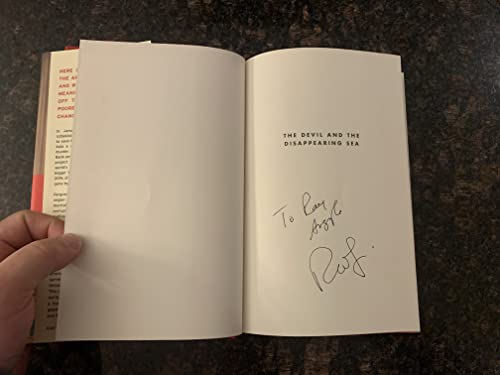
Hardcover. Condition: Very Good. First Edition 2003. First printing. Signed on Title page. Wrapped in mylar. Seller Inventory # 978155192599C
Buy Used
US$ 10.94
US$ 18.00 shipping
Ships from Canada to U.S.A.
Ships from Canada to U.S.A.
Quantity: 1 available
Stock Image
The Devil and the Disappearing Sea: A True Story About the Aral Sea Catastrophe
Seller: Russell Books, Victoria, BC, Canada
Seller rating 5 out of 5 stars
hardcover. Condition: Good. Bargain book! Seller Inventory # XB000946
Buy Used
US$ 9.99
US$ 19.99 shipping
Ships from Canada to U.S.A.
Ships from Canada to U.S.A.
Quantity: 1 available
Stock Image
The Devil and the Disappearing Sea: A True Story about the Aral Sea Catastrophe
Seller: Bahamut Media, Reading, United Kingdom
Seller rating 4 out of 5 stars

Hardcover. Condition: Very Good. This book is in very good condition and will be shipped within 24 hours of ordering. The cover may have some limited signs of wear but the pages are clean, intact and the spine remains undamaged. This book has clearly been well maintained and looked after thus far. Money back guarantee if you are not satisfied. See all our books here, order more than 1 book and get discounted shipping. Seller Inventory # 6545-9781551925998
Buy Used
US$ 25.20
US$ 9.31 shipping
Ships from United Kingdom to U.S.A.
Ships from United Kingdom to U.S.A.
Quantity: 2 available
Stock Image
The Devil and the Disappearing Sea: A True Story about the Aral Sea Catastrophe
Seller: AwesomeBooks, Wallingford, United Kingdom
Seller rating 5 out of 5 stars
Hardcover. Condition: Very Good. The Devil and the Disappearing Sea: A True Story about the Aral Sea Catastrophe This book is in very good condition and will be shipped within 24 hours of ordering. The cover may have some limited signs of wear but the pages are clean, intact and the spine remains undamaged. This book has clearly been well maintained and looked after thus far. Money back guarantee if you are not satisfied. See all our books here, order more than 1 book and get discounted shipping. Seller Inventory # 7719-9781551925998
Buy Used
US$ 29.15
US$ 5.49 shipping
Ships from United Kingdom to U.S.A.
Ships from United Kingdom to U.S.A.
Quantity: 2 available
Stock Image
The Devil and the Disappearing Sea: A True Story About the Aral Sea Catastrophe
Seller: Russell Books, Victoria, BC, Canada
Seller rating 5 out of 5 stars
hardcover. Condition: Very Good. Seller Inventory # FORT952248
Buy Used
US$ 14.99
US$ 19.99 shipping
Ships from Canada to U.S.A.
Ships from Canada to U.S.A.
Quantity: 1 available