
Items related to Guide to Weather Forecasting: All the Information You'll...
Guide to Weather Forecasting: All the Information You'll Need to Make Your Own Weather Forecast (Firefly Pocket series) - Softcover
Synopsis
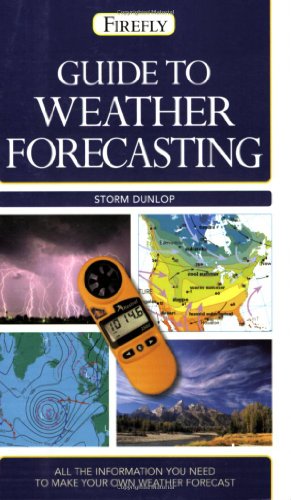
A concise guide to weather systems and weather forecasting.
As recent events have shown, weather can have very different consequences depending on where you live. b>Guide to Weather Forecasting covers every aspect of making a forecast and is a handy resource to understanding the professionals' daily weather predictions.
Storm Dunlop provides detailed information and expert explanations, including:
Guide to Weather Forecasting also covers charts, satellite images and instruments that can be used at home. With its many color photographs and diagrams, handy glossary and useful index, this is an ideal quick reference for the amateur and semiprofessional weather forecaster.
"synopsis" may belong to another edition of this title.
About the Author
Storm Dunlop is a well-known authority on meteorology and astronomy and is the author ofPractical Astronomy.
Excerpt. © Reprinted by permission. All rights reserved.
Excerpted from Chapter 1:
The Origins of Weather
The Atmosphere and the Global Circulation
It may seem a little strange to begin talking about weather forecasting by describing conditions over the whole Earth, but in fact it makes sense. Forecasting the weather requires a knowledge of the situation over a large area 'upwind' (so to speak) of the area in which you are interested. To forecast just one day ahead, professional weather forecasters in Europe, for example, need to know what is happening right across the Atlantic. Similarly, forecasters on the West Coast of North America require details of the situation across the Pacific as far as Japan. In preparing forecasts for three days ahead, forecasters need detailed information about conditions across the whole Earth, including data from the southern hemisphere and Antarctica. An understanding of the basic mechanisms driving the weather is extremely helpful for predicting what is going to happen on even a local scale.
The structure of the atmosphere
Most weather phenomena, including the majority of clouds, occur in the lowest layer of the atmosphere, the troposphere. This is extremely thin compared with the size of the Earth, which has an equatorial diameter of 7,926 mi (12,756 km) and 7,900 ml (12,714 km) measured across the poles. Yet the troposphere extends to about 11-12 mi (18-20 km) at the most (in the equatorial regions) and to just about 4.3 mi (7 km) at the poles. The level of the top of the troposphere, called the tropopause, is defined by a change in the way the temperature behaves with increasing altitude. Between the surface and the tropopause the temperature generally decreases with height -- albeit often in an irregular manner. The changes in temperature with height are extremely important for the formation of clouds, as we shall see later (p.24).
At the tropopause, the decline ceases, and the temperature tends to remain constant in the lowest region of the next layer, the stratosphere (p.5). It then starts to increase with height, reaching a maximum at an altitude of about 31 mi (50 km). This heating in the stratosphere is the result of the absorption of ultraviolet radiation from the Sun by molecules of ozone whose greatest concentration occurs at about 12-15.5 mi (20-25 km). The destruction of this ozone by manmade chemicals has led to the formation of the seasonal 'ozone holes' over the Antarctic and Arctic regions. There are few clouds in the stratosphere, although sometimes there are ice-crystal clouds in the lowermost region, including, on rare occasions, beautiful nacreous clouds (pp.51 -2).
At the top of the stratosphere, at the stratopause, which lies at an altitude of approximately 31 mi (50 km), the temperature again begins to decrease with height within the layer known as the mesosphere. The very lowest temperatures in the atmosphere (-260 to -148°F (-163 to -100°C)) are found at the top of the mesosphere, at the mesopause, which is generally at an altitude of about 53 mi (86 km) (or roughly 62 mi (100 km) over the polar regions in summer). Conditions in the mesosphere have no direct effect on the weather down at the surface, but the highest clouds in the atmosphere, noctilucent clouds (pp.52-3), occur just below the mesopause and are sometimes visible from high latitudes, in summer, in the middle of the night.
Above the mesosphere lies the outermost layer of the atmosphere, the thermosphere. The uppermost region of the mesosphere and lowest part of the thermosphere (between 40 and 620 mi (60 and 1,000 km), approximately) is also known as the ionosphere. Although this region is significant for communications because of its effects on radio waves, and is also the site of the aurorae, it, and the thermosphere in general, have little direct effect on the weather at surface level.
"About this title" may belong to another edition of this title.
Search results for Guide to Weather Forecasting: All the Information You'll...

Stock Image
Philip's Guide to Weather Forecasting
Seller: World of Books (was SecondSale), Montgomery, IL, U.S.A.
Seller rating 5 out of 5 stars

Paperback. Condition: Very Good. A concise guide to weather systems and weather forecasting. As recent events have shown, weather can have very different consequences depending on where you live. b>Guide to Weather Forecasting covers every aspect of making a forecast and is a handy resource to understanding the professionals' daily weather predictions. Storm Dunlop provides detailed information and expert explanations, including: What causes weather Weather systems and how they change Recognizing clouds and sky appearance Weather conditions, such as depressions, lows and highs, wind systems and direction, dew point, humidity, visibility, frost, anticyclones and snow The readings meteorologists use when developing a forecast Extreme weather and climate change Guide to Weather Forecasting also covers charts, satellite images and instruments that can be used at home. With its many color photographs and diagrams, handy glossary and useful index, this is an ideal quick reference for the amateur and semiprofessional weather forecaster. Seller Inventory # 00110263336
Stock Image
Philip's Guide to Weather Forecasting
Seller: World of Books (was SecondSale), Montgomery, IL, U.S.A.
Seller rating 5 out of 5 stars
Paperback. Condition: Good. A concise guide to weather systems and weather forecasting. As recent events have shown, weather can have very different consequences depending on where you live. b>Guide to Weather Forecasting covers every aspect of making a forecast and is a handy resource to understanding the professionals' daily weather predictions. Storm Dunlop provides detailed information and expert explanations, including: What causes weather Weather systems and how they change Recognizing clouds and sky appearance Weather conditions, such as depressions, lows and highs, wind systems and direction, dew point, humidity, visibility, frost, anticyclones and snow The readings meteorologists use when developing a forecast Extreme weather and climate change Guide to Weather Forecasting also covers charts, satellite images and instruments that can be used at home. With its many color photographs and diagrams, handy glossary and useful index, this is an ideal quick reference for the amateur and semiprofessional weather forecaster. Seller Inventory # 00106624668
Stock Image
Guide to Weather Forecasting: All the Information You'll Need to Make Your Own Weather Forecast (Firefly Pocket series)
Seller: Wonder Book, Frederick, MD, U.S.A.
Seller rating 5 out of 5 stars
Condition: Very Good. Very Good condition. A copy that may have a few cosmetic defects. May also contain light spine creasing or a few markings such as an owner's name, short gifter's inscription or light stamp. Seller Inventory # G15E-01608
Stock Image
Philip's Guide to Weather Forecasting
Seller: World of Books Inc, Montgomery, IL, U.S.A.
Seller rating 4 out of 5 stars

Paperback. Condition: Good. A concise guide to weather systems and weather forecasting. As recent events have shown, weather can have very different consequences depending on where you live. b>Guide to Weather Forecasting covers every aspect of making a forecast and is a handy resource to understanding the professionals' daily weather predictions. Storm Dunlop provides detailed information and expert explanations, including: What causes weather Weather systems and how they change Recognizing clouds and sky appearance Weather conditions, such as depressions, lows and highs, wind systems and direction, dew point, humidity, visibility, frost, anticyclones and snow The readings meteorologists use when developing a forecast Extreme weather and climate change Guide to Weather Forecasting also covers charts, satellite images and instruments that can be used at home. With its many color photographs and diagrams, handy glossary and useful index, this is an ideal quick reference for the amateur and semiprofessional weather forecaster. Seller Inventory # CIN1554073693G
Stock Image
Philip's Guide to Weather Forecasting
Seller: World of Books Inc, Montgomery, IL, U.S.A.
Seller rating 4 out of 5 stars
Paperback. Condition: Very Good. A concise guide to weather systems and weather forecasting. As recent events have shown, weather can have very different consequences depending on where you live. b>Guide to Weather Forecasting covers every aspect of making a forecast and is a handy resource to understanding the professionals' daily weather predictions. Storm Dunlop provides detailed information and expert explanations, including: What causes weather Weather systems and how they change Recognizing clouds and sky appearance Weather conditions, such as depressions, lows and highs, wind systems and direction, dew point, humidity, visibility, frost, anticyclones and snow The readings meteorologists use when developing a forecast Extreme weather and climate change Guide to Weather Forecasting also covers charts, satellite images and instruments that can be used at home. With its many color photographs and diagrams, handy glossary and useful index, this is an ideal quick reference for the amateur and semiprofessional weather forecaster. Seller Inventory # CIN1554073693VG
Seller Image
Guide to Weather Forecasting: All the Information You'll Need to Make Your Own Weather Forecast (Firefly Pocket series)
Seller: Greenworld Books, Arlington, TX, U.S.A.
Seller rating 5 out of 5 stars
Condition: acceptable. Fast Free Shipping â" A well-loved copy with text fully readable and cover pages intact. May display wear such as writing, highlighting, bends, folds or library marks. Still a complete and usable book. Seller Inventory # GWV.1554073693.A
Stock Image
Guide to Weather Forecasting: All the Information You'll Need to Make Your Own Weather Forecast (Firefly Pocket series)
Seller: ThriftBooks-Reno, Reno, NV, U.S.A.
Seller rating 5 out of 5 stars
Paperback. Condition: Good. No Jacket. Pages can have notes/highlighting. Spine may show signs of wear. ~ ThriftBooks: Read More, Spend Less. Seller Inventory # G1554073693I3N00
Stock Image
Guide to Weather Forecasting: All the Information You'll Need to Make Your Own Weather Forecast (Firefly Pocket series)
Seller: ThriftBooks-Dallas, Dallas, TX, U.S.A.
Seller rating 5 out of 5 stars
Paperback. Condition: Good. No Jacket. Pages can have notes/highlighting. Spine may show signs of wear. ~ ThriftBooks: Read More, Spend Less. Seller Inventory # G1554073693I3N00
Stock Image
Guide to Weather Forecasting: All the Information You'll Need to Make Your Own Weather Forecast (Firefly Pocket series)
Seller: ThriftBooks-Atlanta, AUSTELL, GA, U.S.A.
Seller rating 5 out of 5 stars
Paperback. Condition: Very Good. No Jacket. May have limited writing in cover pages. Pages are unmarked. ~ ThriftBooks: Read More, Spend Less. Seller Inventory # G1554073693I4N00
Stock Image
Guide to Weather Forecasting: All the Information You'll Need to Make Your Own Weather Forecast (Firefly Pocket series)
Seller: ThriftBooks-Phoenix, Phoenix, AZ, U.S.A.
Seller rating 5 out of 5 stars
Paperback. Condition: Good. No Jacket. Pages can have notes/highlighting. Spine may show signs of wear. ~ ThriftBooks: Read More, Spend Less. Seller Inventory # G1554073693I3N00