
Items related to Great American Cities Past and Present
Synopsis
The stunning history of the transformation of America's great cities.
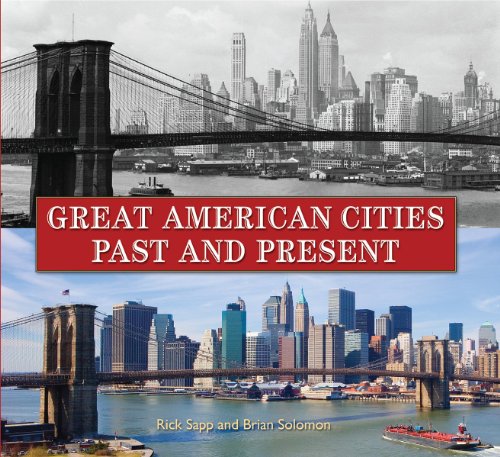
Great American Cities Past and Present is a fascinating collection of 250 large-format photographs and commentary that illustrates the dramatic changes in America's urban landscape over the last century. The images clearly show the remarkable development of such cities as Chicago, New York and Los Angeles, as they went from flourishing cities to vibrant metropolises of international significance.
Each left-hand page in the book shows a cityscape -- some are skylines, others are street scenes -- as it was 5, 20, 50 or even 100 years ago, and the facing page shows the same location as it looks today. Each visual comparison tells a compelling story, from economic busts and booms to waves of immigration to city planning gone wrong (or maybe right) to a total disregard for heritage architecture to the urban appetite for farmland. The book also chronicles the changes in styles of dress, consumerism, storefronts and public transit that accompanied the transformations.
Detailed captions describe changes such as:
- Technological advances that raised skylines to new heights
- Urban ghettoization and regeneration
- The casualties of fires, earthquakes and tornadoes
- The cultural evolution of neighborhoods
- The best and worst of American architecture
Maps also include locator keys that highlight features and buildings within the photographs. From skyline to street level, Great American Cities Past and Present gives readers a thought-provoking perspective on America's cities.
"synopsis" may belong to another edition of this title.
About the Author
Since serving with the U.S. Army, Rick Sapp has been a journalist, author and editor of such magazines as Bowhunting World and Archery Business. He lives in Gainesville, Florida.
Brian Solomon is an accomplished photographer and author with more than 30 titles to his name, including Railway Masterpieces and North American Railroad Bridges.
Reviews
This book opens with a hyperbolic paean: "people are attracted to cities, are drawn to build them, as if it is genetic code." Cities "are the great things, the wild things, the jaw-dropping wonders about which all men and women dream." Unfortunately, there's no discussion of these ideas; instead, photos of North American cities taken at different times in history highlight the changing metropolis--Jacksonville, Fla. in 1913, 1921, 2006, and 2008; Cleveland, Ohio in 1951 and 2005; Quebec in 1901 and 2005, and so on. Bigger cities get bigger spreads, but the book is admirably democratic: a city is interesting, it seems, simply because it exists and changes over time. Perhaps Sapp and Solomon are right, but their framework is lacking and reveals an endemic problem. The photo spreads feel random; why this shot and not another? Why that year? And since the book's purpose is to compare and contrast, it's disappointing that paired photos (the Flatiron area in 1915 and 2009, for example) often don't match up. One is perplexed, and, as often happens when confronted with a missed opportunity, left to consider how this promising idea could have been better executed. (Aug.)
(c) Copyright PWxyz, LLC. All rights reserved.
In the great urban boom of the twentieth century, American cities burgeoned into massive centers of commercial activity and architectural achievement. Sapp and Solomon offer precise visual documentation of this historical alteration of the face of the planet. Working with black-and-white photographs, they display panoramas from as much as a century ago, juxtaposing these with brilliantly colored vistas of present realities. The megalopolises of New York and Chicago predictably stun with the vast scales of their multiple skyscrapers and teeming avenues, yet some of the nation’s smaller cities contribute equally compelling, if less spectacular, vistas. Diminutive Butte, Montana, has seen great changes over decades, and Richmond, Virginia’s, resurrection from Civil War devastation to today’s capital could not be more striking. Text points out salient details in the growth of these cityscapes and identifies specific structures in both old and new scenes. --Mark Knoblauch
"About this title" may belong to another edition of this title.
Search results for Great American Cities Past and Present

Stock Image
Great American Cities Past and Present
Seller: Better World Books, Mishawaka, IN, U.S.A.
Seller rating 5 out of 5 stars

Condition: Good. Pages intact with minimal writing/highlighting. The binding may be loose and creased. Dust jackets/supplements are not included. Stock photo provided. Product includes identifying sticker. Better World Books: Buy Books. Do Good. Seller Inventory # GRP102290887
Stock Image
Great American Cities Past and Present
Seller: Better World Books, Mishawaka, IN, U.S.A.
Seller rating 5 out of 5 stars
Condition: Good. Former library copy. Pages intact with minimal writing/highlighting. The binding may be loose and creased. Dust jackets/supplements are not included. Includes library markings. Stock photo provided. Product includes identifying sticker. Better World Books: Buy Books. Do Good. Seller Inventory # 5893144-6
Stock Image
Great American Cities Past and Present
Published by
Firefly Books (edition First Edition), 2010
ISBN 10: 1554077451
ISBN 13: 9781554077458
Used
Hardcover
First Edition
Seller: BooksRun, Philadelphia, PA, U.S.A.
Seller rating 5 out of 5 stars
Hardcover. Condition: Fair. First Edition. With dust jacket. The item might be beaten up but readable. May contain markings or highlighting, as well as stains, bent corners, or any other major defect, but the text is not obscured in any way. Seller Inventory # 1554077451-7-1-29
Stock Image
Great American Cities Past and Present
Seller: HPB-Diamond, Dallas, TX, U.S.A.
Seller rating 5 out of 5 stars
hardcover. Condition: Very Good. Connecting readers with great books since 1972! Used books may not include companion materials, and may have some shelf wear or limited writing. We ship orders daily and Customer Service is our top priority! Seller Inventory # S_477251932
Stock Image
Great American Cities Past and Present
Seller: HPB-Emerald, Dallas, TX, U.S.A.
Seller rating 5 out of 5 stars
Hardcover. Condition: Very Good. Connecting readers with great books since 1972! Used books may not include companion materials, and may have some shelf wear or limited writing. We ship orders daily and Customer Service is our top priority! Seller Inventory # S_478942017
Stock Image
Great American Cities Past and Present
Seller: HPB Inc., Dallas, TX, U.S.A.
Seller rating 5 out of 5 stars
hardcover. Condition: Very Good. Connecting readers with great books since 1972! Used books may not include companion materials, and may have some shelf wear or limited writing. We ship orders daily and Customer Service is our top priority! Seller Inventory # S_478200773
Stock Image
Great American Cities Past and Present
Seller: ThriftBooks-Atlanta, AUSTELL, GA, U.S.A.
Seller rating 5 out of 5 stars
Hardcover. Condition: Good. No Jacket. Pages can have notes/highlighting. Spine may show signs of wear. ~ ThriftBooks: Read More, Spend Less. Seller Inventory # G1554077451I3N00
Stock Image
Great American Cities Past and Present
Seller: Better World Books Ltd, Dunfermline, United Kingdom
Seller rating 5 out of 5 stars
Condition: Very Good. Pages intact with possible writing/highlighting. Binding strong with minor wear. Dust jackets/supplements may not be included. Stock photo provided. Product includes identifying sticker. Better World Books: Buy Books. Do Good. Seller Inventory # 2678186-6
Buy Used
US$ 11.97
US$ 6.61 shipping
Ships from United Kingdom to U.S.A.
Ships from United Kingdom to U.S.A.
Quantity: 1 available
Stock Image
Great American Cities Past and Present
Seller: Robinson Street Books, IOBA, Binghamton, NY, U.S.A.
Seller rating 4 out of 5 stars

Hardcover. Condition: Very Good. Prompt Shipment, shipped in Boxes, Tracking PROVIDEDVery good copy with clean pages and dust jacket. First printing. Seller Inventory # ware334jd009
Stock Image
Great American Cities Past and Present
Seller: Your Online Bookstore, Houston, TX, U.S.A.
Seller rating 5 out of 5 stars
hardcover. Condition: New. Seller Inventory # 1554077451-11-37945956