
Items related to A is for Almanac: Complete Lessons to Teach the Use...
Synopsis
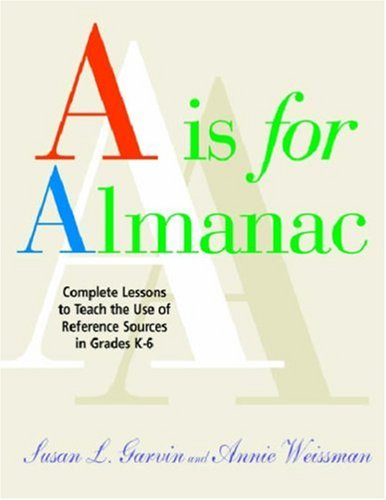
A one-stop solution for teaching reference skills in science and social studies. And higher-order thinking skills too! Chock-full of librarian perfected lessons and worksheets, this book and accompanying CD contain ready-to-go lesson plans, worksheets, activities, and more for teaching students how to use both print and electronic atlases, almanacs, dictionaries, online catalogs, and encyclopedias. You ll find lessons for each grade level, emphasizing either science or social studies. And each lesson has been developed using Madeline Hunter s EEI (Essential Elements of Instruction) lesson plan format. Lessons are well scaffolded for grade-to-grade continuity and the authors have even included high-interest games and contests to engage and motivate students. Designed to encourage collaboration between librarians and classroom teachers, the lessons can be easily correlated to state and district standards. The accompanying CD includes all of the worksheets, games, and contests, as well as posters for your library...all of which can be customized for your own collection, library layout, call numbers, and curriculum.
"synopsis" may belong to another edition of this title.
Reviews
Part 1 of this book contains 107 lesson plans, with each chapter focusing on one type of reference (encyclopedia, dictionary, thesaurus etc.). Part 2 offers 63 thematic curriculum unit lesson plans, arranged by grade level, using these resources. An accompanying CD-ROM offers templates for games and contests, worksheets, and brochures for parents. The format for the lesson plans does not include assessments (other than informal observations), independent practice, extensions for gifted students, or accommodations for those with special needs. Most of the lesson plans require the use of class sets of 15 (and sometimes 30) reference books, which is an unrealistic expectation for most school libraries. Lessons on using the encyclopedia require two sets of World Book. There are no lessons on database searching. The authors have chosen to use Wikipedia as their online encyclopedia, which is not an authoritative source of information and is not accepted as a bibliographic citation at tertiary educational institutions—or in many high schools. Telling the students that the information on Wikipedia can be added, amended, or edited by anyone with online access, as the authors suggest, while using it as an authoritative reference source, is just plain confusing to elementary students.—Jane Barrer, PS/IS 111 Adolph S. Ochs School, New York City
Copyright © Reed Business Information, a division of Reed Elsevier Inc. All rights reserved.
This book contains more than 200 lessons that librarians can use to teach information skills and the use of reference sources, both print and online. Chapters in part 1 are each dedicated to a specific reference tool such as dictionaries, atlases, and online catalogs. Each chapter includes multiple lessons for every grade, K–6. Chapters in part 2 contain curriculum units with lessons that use reference sources; for example, “Third Grade: Transportation” and “Fourth Grade: Biomes.” Organized, detailed, and student tested, these lessons would be useful for someone looking for new ways to introduce reference materials to elementary students. Many lessons require multiple or classroom sets of materials that some school libraries might not have the budget to support, but most of the lessons could be modified accordingly. --Shauna Yusko
"About this title" may belong to another edition of this title.
Search results for A is for Almanac: Complete Lessons to Teach the Use...

Stock Image
A is for Almanac: Complete Lessons to Teach the Use of Reference Sources in Grades K-6
Seller: Basi6 International, Irving, TX, U.S.A.
Seller rating 5 out of 5 stars

Condition: Brand New. New. US edition. Expediting shipping for all USA and Europe orders excluding PO Box. Excellent Customer Service. Seller Inventory # ABEOCT25-404234
Stock Image
A is for Almanac: Complete Lessons to Teach the Use of Reference Sources in Grades K-6
Seller: BennettBooksLtd, Los Angeles, CA, U.S.A.
Seller rating 5 out of 5 stars
Paperback. Condition: New. In shrink wrap. Looks like an interesting title! Seller Inventory # Q-1555706231