
Items related to Structures for Organizing Knowledge: Exploring Taxonomies,...
Synopsis
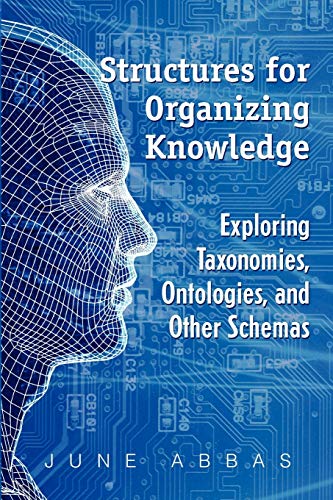
LIS professionals use structures for organizing knowledge when they catalog and classify objects in the collection, when they develop databases, when they design customized taxonomies, or when they search online. Organizing Knowledge: Exploring Taxonomies, Ontologies, and Other Schema explores and explains this basic function by looking at three questions: 1) How do we organize objects so that they make sense and are useful? 2) What role do categories, classifications, taxonomies, and other structures play in the process of organizing? 3) What do information professionals need to know about organizing behaviors in order to design useful structures for organizing knowledge? Taking a broad, yet specialized approach that is a first in the field, this book answers those questions by examining three threads: traditional structures for organizing knowledge; personal structures for organizing knowledge; and socially-constructed structures for organizing knowledge. Through these threads, it offers avenues for expanding thinking on classification and classification schemes, taxonomy and ontology development, and structures. Both a history of the development of taxonomies and an analysis of current research, theories, and applications, this volume explores a wide array of topics, including the new digital, social aspect of taxonomy development. Examples of subjects covered include: formal and informal structures; early taxonomists and their contributions; cataloging codes; classification schemes; standards and best practice; descriptive cataloging; metadata schema standards; applications of knowledge structures; classification schemes; social networking, bookmarking, and cataloging sites; tags, tagging, and folksonomies. Thought exercises, references, and a list of helpful websites augment each section. A final chapter, 'Thinking Ahead: Are We at a Crossroads?' uses 'envisioning exercises' to help LIS professionals look into the future.
"synopsis" may belong to another edition of this title.
Review
"An excellent primer on expanding one's concepts of knowledge organization, Abbas' book is important reading for library and information science students learning about the organization of knowledge, as well as library professionals working in the cataloging and metadata fields, who have both the opportunity and the expertise to revitalize knowledge-organization structures." --College and Research Libraries, July 2011
"Although primarily intended for students of library and information science, researchers in library and information science and related fields will also find this mostly theoretical and conceptually oriented book useful. In addition, the practicing library and information science professional will be able to make practical use of the book's suggestions and guidelines for organizational application...Through excellent organization and depth of coverage of the subject, the author provides the reader with a solid foundation for thinking about knowledge structures for further practical implementation." --Catholic Library World, September 2011
"This work does not disappoint and manages to stand out from the many other works in the discipline for both its thoroughness and its treatment of digital schema in the context of overall organisation of knowledge...The book is scholarly but also accessible, with many examples and illustrations provided throughout to provide real life context to the concepts described." --The Australian Library Journal, August 2011
"This work does not disappoint and managers to stand out from the many other works in the discipline for both its thoroughness and its treatment of digital schema in the context of overall organisation of knowledgeâ ¦The book is scholarly but also accessible, with many examples and illustrations provided throughout to provide real life context to the concepts described." --The Australian Library Journal, August 2011
"...a thoughtful survey of research finding and a stimulating complex of issues to ponder." --Library Resources & Technical Services, July 2011
"About this title" may belong to another edition of this title.
Search results for Structures for Organizing Knowledge: Exploring Taxonomies,...

Stock Image
Structures for Organizing Knowledge: Exploring Taxonomies, Ontologies, and Other Schema
Seller: Goodwill San Antonio, San Antonio, TX, U.S.A.
Seller rating 5 out of 5 stars

Condition: good. Seller Inventory # SANV.1555706991.G
Stock Image
Structures for Organizing Knowledge: Exploring Taxonomies, Ontologies, and Other Schema
Published by
ALA Neal-Schuman, 2010
ISBN 10: 1555706991
ISBN 13: 9781555706999
Used
paperback
First Edition
Seller: The Maryland Book Bank, Baltimore, MD, U.S.A.
Seller rating 5 out of 5 stars
paperback. Condition: Very Good. 1st Edition. Used - Very Good. Seller Inventory # 5-ZZ-1-0385
Stock Image
Structures for Organizing Knowledge: Exploring Taxonomies, Ontologies, and Other Schema
Seller: Solr Books, Lincolnwood, IL, U.S.A.
Seller rating 5 out of 5 stars
Condition: like_new. This book is in Like New condition. It appears to be NEW, but might have a minor defect. Seller Inventory # BCV.1555706991.LN
Seller Image
Structures for Organizing Knowledge
Published by
Association of College and Research Libraries, US, 2010
ISBN 10: 1555706991
ISBN 13: 9781555706999
New
Paperback
Seller: Rarewaves.com USA, London, LONDO, United Kingdom
Seller rating 5 out of 5 stars
Paperback. Condition: New. lis professionals use structures for organizing knowledge when they catalog and classify objects in the collection, when they develop databases, when they design customized taxonomies, or when they search online. Organizing Knowledge: Exploring Taxonomies, Ontologies, and Other Schema explores and explains this basic function by looking at three questions: 1) How do we organize objects so that they make sense and are useful? 2) What role do categories, classifications, taxonomies, and other structures play in the process of organizing? 3) What do information professionals need to know about organizing behaviors in order to design useful structures for organizing knowledge? Taking a broad, yet specialized approach that is a first in the field, this book answers those questions by examining three threads: traditional structures for organizing knowledge; personal structures for organizing knowledge; and socially-constructed structures for organizing knowledge. Through these threads, it offers avenues for expanding thinking on classification and classification schemes, taxonomy and ontology development, and structures. Both a history of the development of taxonomies and an analysis of current research, theories, and applications, this volume explores a wide array of topics, including the new digital, social aspect of taxonomy development. Examples of subjects covered include: formal and informal structures; early taxonomists and their contributions; cataloging codes; classification schemes; standards and best practice; descriptive cataloging; metadata schema standards; applications of knowledge structures; classification schemes; social networking, bookmarking, and cataloging sites; tags, tagging, and folksonomies. Thought exercises, references, and a list of helpful websites augment each section. A final chapter, 'Thinking Ahead: Are We at a Crossroads?' uses 'envisioning exercises' to help LIS professionals look into the future. lis professionals use structures for organizing knowledge when they catalog and classify objects in the collection, when they develop databases, when they design customized taxonomies, or when they search online. Organizing Knowledge: Exploring Taxonomies, Ontologies, and Other Schema explores and explains this basic function by looking at three questions: 1) How do we organize objects so that they make sense and are useful? 2) What role do categories, classifications, taxonomies, and other structures play in the process of organizing? 3) What do information professionals need to know about organizing behaviors in order to design useful structures for organizing knowledge? Taking a broad, yet specialized approach that is a first in the field, this book answers those questions by examining three threads: traditional structures for organizing knowledge; personal structures for organizing knowledge; and socially-constructed structures for organizing knowledge. Through these threads, it offers avenues for expanding thinking on. Seller Inventory # LU-9781555706999
Buy New
US$ 111.60
Free Shipping
Ships from United Kingdom to U.S.A.
Ships from United Kingdom to U.S.A.
Quantity: 1 available
Stock Image
Structures for Organizing Knowledge
Published by
Neal-Schuman Publishers Inc, 2010
ISBN 10: 1555706991
ISBN 13: 9781555706999
New
Softcover
First Edition
Seller: Kennys Bookshop and Art Galleries Ltd., Galway, GY, Ireland
Seller rating 5 out of 5 stars
Condition: New. Num Pages: 249 pages, illustrations. BIC Classification: GL. Category: (G) General (US: Trade). Dimension: 226 x 152 x 15. Weight in Grams: 431. . 2010. 1st Edition. Paperback. . . . . Seller Inventory # V9781555706999
Buy New
US$ 101.14
US$ 10.47 shipping
Ships from Ireland to U.S.A.
Ships from Ireland to U.S.A.
Quantity: 1 available
Seller Image
Structures for Organizing Knowledge : Exploring Taxonomies, Ontologies, and Other Schema
Seller: GreatBookPrices, Columbia, MD, U.S.A.
Seller rating 5 out of 5 stars
Condition: New. Seller Inventory # 11516626-n
Stock Image
Structures for Organizing Knowledge
Published by
MP-ALA American Library Assoc, 2010
ISBN 10: 1555706991
ISBN 13: 9781555706999
Used
PAP
Seller: PBShop.store UK, Fairford, GLOS, United Kingdom
Seller rating 5 out of 5 stars
PAP. Condition: Used - Very Good. Used - Like New Book. Shipped from UK. Established seller since 2000. Seller Inventory # P1-9781555706999
Buy Used
US$ 109.76
US$ 5.50 shipping
Ships from United Kingdom to U.S.A.
Ships from United Kingdom to U.S.A.
Quantity: 1 available
Stock Image
Structures for Organizing Knowledge: Exploring Taxonomies, Ontologies, and Other Schema
Print on DemandSeller: Revaluation Books, Exeter, United Kingdom
Seller rating 5 out of 5 stars
Paperback. Condition: Brand New. 1st edition. 249 pages. 8.90x5.80x0.70 inches. In Stock. This item is printed on demand. Seller Inventory # __1555706991
Buy New
US$ 103.32
US$ 13.21 shipping
Ships from United Kingdom to U.S.A.
Ships from United Kingdom to U.S.A.
Quantity: 2 available
Seller Image
Structures for Organizing Knowledge : Exploring Taxonomies, Ontologies, and Other Schema
Seller: GreatBookPrices, Columbia, MD, U.S.A.
Seller rating 5 out of 5 stars
Condition: As New. Unread book in perfect condition. Seller Inventory # 11516626
Seller Image
Structures for Organizing Knowledge : Exploring Taxonomies, Ontologies, and Other Schema
Seller: GreatBookPricesUK, Woodford Green, United Kingdom
Seller rating 5 out of 5 stars
Condition: New. Seller Inventory # 11516626-n
Buy New
US$ 106.27
US$ 19.82 shipping
Ships from United Kingdom to U.S.A.
Ships from United Kingdom to U.S.A.
Quantity: Over 20 available