Priest Turned Therapist Treats Fear of God: Poems - Softcover
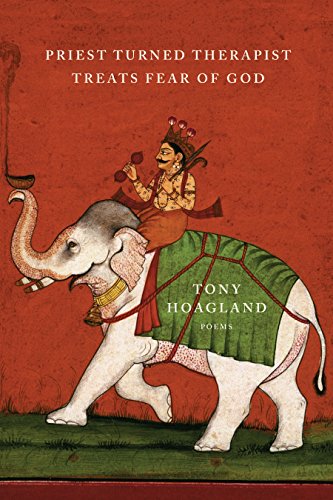
Hoagland, Tony

  • 4.31 out of 5 stars
    516 ratings by Goodreads
 
9781555978075: Priest Turned Therapist Treats Fear of God: Poems

Synopsis

“Hoagland’s verse is consistently, and crucially, bloodied by a sense of menace and by straight talk.” ―The New York Times

My heroes are the ones who don’t say much.
They don’t hug people they just met.
They don’t play louder when confused.
They use plain language even when they listen.

Wisdom doesn’t come to every Californian.
Chances are I too
will die with difficulty in the dark.

If you want to see a lost civilizaton,
why not look in the mirror?
If you want to talk about love, why not begin
with those marigolds you forgot to water?

―from “Real Estate”

Tony Hoagland’s poems interrogate human nature and contemporary culture with an intimate and wild urgency, located somewhere between outrage, stand-up comedy, and grief. His new poems are no less observant of the human and the worldly, no less skeptical, and no less amusing, but they have drifted toward the greater depths of open emotion. Over six collections, Hoagland’s poetry has gotten bigger, more tender, and more encompassing. The poems in Priest Turned Therapist Treats Fear of God turn his clear-eyed vision toward the hidden spaces―and spaciousness―in the human predicament.

"synopsis" may belong to another edition of this title.

About the Author

Tony Hoagland is the author of five previous poetry collections, including Application for Release from the Dream and What Narcissism Means to Me, a finalist for the National Book Critics Circle Award. He lives in Santa Fe, New Mexico.

Excerpt. © Reprinted by permission. All rights reserved.

Priest Turned Therapist Treats Fear of God

Poems

By Tony Hoagland

Graywolf Press

Copyright © 2018 Tony Hoagland
All rights reserved.
ISBN: 978-1-55597-807-5

Contents

I.,
Entangle,
A Walk around the Property,
The Romance of the Tree,
Happy and Free,
Which Would You Prefer, a Story or an Explanation?,
Nobility,
No Thank You,
Proof of Life,
Distant Regard,
Priest Turned Therapist Treats Fear of God,
II.,
In the Waiting Room with Leonard Cohen,
Ten Questions for the New Age,
Ten Reasons Why We Cannot Seem to Make Progress,
Epistle of Momentary Generosity,
A Short History of Modern Art,
Theater Piece,
Couture,
An Ordinary Night in Athens, Ohio,
Inexhaustible Resource,
Achilles,
Examples of Justice,
Better Than Expected,
III.,
The Truth,
Frog Song,
Scotch Tape,
Playboy,
Dinner Guest,
Rain-Father,
Moment in the Conversation,
Marriage Song,
Trying to Keep You Happy,
Taking My Medicine,
The Third Dimension,
The Classics,
IV.,
Upward,
Good People,
Cause of Death: Fox News,
Real Estate,
Legend,
Data Rain,
Confusion of Privilege,
Hope,
I Have Good News,
Into the Mystery,


CHAPTER 1

ENTANGLE


Sometimes I prefer not to untangle it.
I prefer it to remain disorganized,

because it is richer that way
like a certain shrubbery I pass each day on Reba Street

in an unimpressive yard, in front of a house that seems unoccupied:
a chest-high, spreading shrub with large white waxy blossoms —

whose stalks are climbed and woven through simultaneously
by a different kind of vine with small magenta flowers

that appear and disappear inside the maze of leaves
like tiny purple stitches.

The white and purple combination of these species,
one seeming to possibly be strangling the other,

one possibly lifting the other up-it would take both
a botanist and a psychologist to figure it all out,

— but I prefer not to disentangle it,
because it is more accurate.

My ferocious love, and how it repeatedly is trapped
inside my fear of being sentimental;

my need to control even the kindness of the world,
rejecting gifts for which I am not prepared;

my apparently inextinguishable notion
that I am moving toward a destination

— I could probably untangle it
yet I prefer to walk down Reba Street instead

in the sunlight and the wind, with no mastery
of my feelings or my thoughts,

purple and ivory and green, not understanding what I am
and yet in certain moments remembering, and bursting into tears,

somewhat confused as the vines run through me
and flower unexpectedly.


A WALK AROUND THE PROPERTY

There are too many characters in this book I'm reading.
I can't keep track of them all.
How can I care who marries who, or what they wear?
Nevertheless, each time one disappears, I feel a brief, sharp grief,
knowing they will not return.

This is how a boat drifts out to sea from shore.
It gets distracted and detached, pulled this way and that by currents.
Eventually, not even pain can guide it home.

I will tell you this right now: Cincinnati
has not been a great success for me.
My allergic reaction to small talk has ensured
that I don't get asked to parties anymore.
My deep curiosity about other people has gone unslaked.

How did Ellen, who hates to be touched, get pregnant?
Who is Sam in love with? Is Emily gay?
What does my neighbor do at 3 a.m., when his office light is on?
Was I wrong to think of life as work?

"Sing me a song about the world!"
says the therapist, as he looks out at the thunder and the rain,
a little glum about his only half-effective science.
He has no cured clients.

The moon shines down from the black November sky.
The tide rises like a sweeping, white-ruffed arm,
erasing all the pages that have come before.
The evidence accumulates that nobody is watching over us,

and gradually, as the streets and houses drift toward night,
all the words inside them close their eyes;
the sentences coil up like snakes and sleep.

It's just me now and my famous aching heart
under the stars — my heart that keeps moving like a searchlight
in its longing for the hearts of other people,
who in a sense, already live there, in my heart,

and keep it turning.


THE ROMANCE OF THE TREE

It wasn't the dream of the enormous spruce tree
to be turned into fifty reams of paper
then stacked and cut and bound into 4? X 6? format pages,

and printed with the sentences
of a seething hot romance novel
called Summertime Nurses.

Season after season, while the tree was growing tall,
while it breathed and swayed among its brethren other trees,
it wasn't dreaming of becoming the delivery device

for a steamy bedroom episode
in which the small deft hands of someone named Brittany
"unbuttoned her jeans with feverish impatience."

Oh tree, you were part of the forest for years,
bending and straightening and bending
like the mast of a great ship —
tasting the earth with your long dark roots.

That was a different story indeed
from the one printed on page 38
in which the exchange student from Norway

enters the dark lounge of the Carterville Inn,
and just stands there like Apollo by the Budweiser sign
inflaming the entire female populace of Tweedy County.

When the tree was cut down and hauled away to the mill
to be turned into Summertime Nurses,
we lost part of our Eden

worth more than a paperback;
the tree, swaying all day in the sun,
rocked and pushed by the wind,

yielding and tousled under the white clouds,
with all of its arms outstretched,
all of its mouths wide open.


HAPPY AND FREE

I should not have gotten the tattoo that says
May All Beings Be Happy and Free on my left arm,
running from the inside of my elbow to the wrist
in 20 pt. Verdana sans-serif type.

My serotonin level that day was so elevated
that it deceived me
into an optimistic feeling that I was finally
ready to be pure. I have been happy in that way before

and you would think I would have learned by now
that I inevitably return to earth
like a leaky, gradually deflating helium balloon.

Now I see that my great tattoo might better have been
a customized sweatshirt purchased online for twenty dollars,
that said Short Attention Span,
or University of Repetitive Emotion.

How quickly things pass. How long mistakes last.
How unrealistic I am when left to my own devices.
When I rolled up my shirt sleeve at the tattoo emporium
to have that sentence stenciled into my pale flesh

I was getting into a relationship
I could not possibly sustain.
May All Beings Be Happy and Free — what a fitting punishment
for the hubris of my passing and unstable self-esteem!

And yet, it is my life, mine to squander as I will.
— That is a kind of freedom, I suppose.
And I have a story, which is still
unfinished;

that makes me kind of happy, too.


WHICH WOULD YOU PREFER,
A STORY OR AN EXPLANATION?


I am interested, said Madeline, in people's ability to live their lives
  in fragments.
Two ex-husbands, three jobs in seven years, one daughter,
  a geranium, and a certain TV
    show.

I used to think I'd reach a certain age, said Madeline,
and my heart would settle down, like a tired dog.

Yoga at the Y on Tuesdays;
then wild gusts of anger while driving home.

Reading an interview with Allan Bloom, she learns
that "the pursuit of happiness is a particularly American form of
  nihilism."

"Oh yeah, now you tell me," she says.

"I can't tell the difference between inner peace and mild
  depression,"
writes her friend from Philadelphia, in small blue script
on the back of a postcard of Chagall.

Dawn arrives on the horizon with its spreading rosy light.
Sometimes beauty serves as a kind of anesthetic.
The world provides evidence for almost anything.
Which would you prefer: a story or an explanation?

In the next two years, Madeline will have a love affair,
visit Bali and return, develop endometrial cancer,

and reconnect with her childhood Catholic faith,
worth more to her than anything.

Even at the bottom of the self, even in illness and despair;
in hubris, ecstasy and gloom,

the chick can be heard inside the shell,
pecking to get out. Pecking and pecking.


NOBILITY

In the 3,000 letters written by Virginia Woolf between 1930 and
  1941,
she does not once express anxiety about the size of her rear end.

"To have aesthetics," says Robert, "is to be a snob.
To be above certain things — even parts of yourself."

Aldous Huxley on his deathbed, unable to speak,
writes on a white pad to Evelyn, his wife: the note:
  "100 micrograms mescaline, IM."

She nods and brings it back in an hour —
I tell this story several times to Kath, until I am sure she gets my
  point.

Walking in Jackson Park, I find a great two-hundred-year-old oak,
extending its huge dark limbs in all directions, like an antler
  or a chandelier.

I stand and stare at it, as at a letter in an alphabet I have forgotten.
But I am a creature who still has not learned to read
— not even to worship, not even to live without dishonesty.

The nurse's aide says, "Did we have a bowel movement today,
  Mr. Mandela?"
and he looks at her with so much tolerance and calm,
it is like the sea looking back at the land.

In the cancer clinic waiting room, the patients are mostly quiet.
Sometimes they talk about the football game,
  or the weather predicted for
    tomorrow.


NO THANK YOU

Wisdom isn't scarce; it
never was. The average bookshelf
of a Psych major named James
at Cumberland Community College
will yield all the wisdom

that was ever necessary
to end war, teach kindness,
face death,
sprout honesties

like flowers, fashion
codes of understanding for a
working world.
We have

everything we need,
don't know what the
hell it is, don't want it, won't
remind each other, refuse
to listen.

What makes it worse
are the constant bulletins
from all those liars who keep saying,
  We are looking

for solutions — Getting
close to — Poised
to make the
breakthrough — Any day now.

  Not true. We

already have chosen the strange
garments of confusion
that we will die in; we love
the thrill of enemies;
we burn

through beauty like it was
wrapping paper;
we breathe
the smoke of our distraction
like it was oxygen.

So this morning,
I will just
walk into the woods off Marsden Lane,
seize a clump of dirt and pine-straw
in my fist,
and kneel,

in a manner no different from
any peasant in a jerkin
in the fourteenth century
asking for salvation —

saying, Preserve me, God,
at least
from the pretense
that I am searching.

I am lost by choice
and
all the evidence suggests
I relish it.


PROOF OF LIFE

Those small cuts and infections on my hands from splinters and
  thorns
that show I have been working out of doors this week.

The maddening peculiar purgatory
of Bob Seger and the Silver Bullet Band playing "Against the Wind"

continuously for three days inside my head,
until on the fourth day it finally stops.

The sound of clothes going around in the dryer
at the other end of the house.

Wanting from a very young age
not to be a zombie sleepwalking through time.

Leaving people, and being left by them.
This catch-and-release version of life.

The kidnappers send out a photograph of the hostage, grimacing,
holding up a newspaper from yesterday.

They call this "proof of life."
It means the captive is still alive.

The day is blue with one high white cloud
like a pilgrim going to Canterbury.

There is a bird half-hidden in the shrub outside.
Something he has eaten has made his chest feathers red.


DISTANT REGARD

If I knew I would be dead by this time next year
I believe I would spend the months from now till then
writing thank-you notes to strangers and acquaintances,

telling them, "You really were a great travel agent."
Or "I never got the taste of your kisses out of my mouth."
Or "Watching you walk across the room was part of my
  destination."

It would be the equivalent, I think,
of leaving a chocolate wrapped in shiny foil
on the pillow of a guest in a nice hotel —

"Hotel of earth, where we resided for some years together,"
I start to say — before I realize it is a terrible cliché, and stop,
and then go on, forgiving myself in a mere split second

because now that I'm dying, I just go
forward like water, flowing around obstacles
and second thoughts, not getting snagged, just continuing

with my long list of thank-yous
which seems to naturally expand
to include sunlight and wind,

and the aspen trees which seethe and shimmer in the yard
as if grateful for being soaked last night
by the beautiful irrigation system

invented by an individual
to whom I am quietly grateful.
Outside it is autumn, the philosophical season,

when cold air sharpens the intellect;
the hills are red and copper in their shaggy majesty.
The clouds blow overhead, like governments and years.

It took me a long time to understand the phrase "distant regard,"
but I am grateful for it now,
and I am grateful for my heart,

that turned out to be good, after all;
and grateful for my mind,
to which, in retrospect, I can see

I have never been sufficiently kind.


PRIEST TURNED THERAPIST
TREATS FEAR OF GOD


For once the weatherman was right:
cold morning, cloudy afternoon;
tomorrow the city will be buried
under tons of fine white snow.

Why not just turn the radio off
and make up your own news?
"The President today in Washington
took off his shirt for reporters
to show his big muscles and hairy back."

He said the CEO of China has made him very mad;
he's going to beat the stuffing
out of that no-good Jap.

Then he said that little boy with cancer
rescued from the avalanche
is what makes this country so darn great.

In other news, Ignorance Industry scientists
have recorded a decrease in the quality of ignorance.
There are more ignorant people than ever,
but the totality of ignorance continues to decline.
What does it mean?

Here are our other leading stories:
Unidentified Rich Man Elected President;
San Francisco Yoga Tragedy: Three People Hugged to Death;
Priest Turned Therapist Treats Fear of God.


In Hollywood, fifty movie stars have pledged
not to use their swimming pools
until world thirst is ended.

To keep it short:
Diet Celebrity Money Pregnancy Explosion
It all seemed pretty much business as usual.
That's why we were happy to be indoors,
sipping our green mint tea;

sitting by the window,
and watching the sky fall down.

CHAPTER 2

IN THE WAITING ROOM WITH LEONARD COHEN


In the hospital waiting room, seated in my plastic chair,
I think about Leonard Cohen and start quietly to cry.
I'm glad no one is watching, because I can see

the childish indulgence of it all-the displacement of my personal
  self-pity
onto the cadaverous Canadian singer
whom one critic called "the world's leading producer
  of songs advocating suicide."

Yet it comes from somewhere deep, this sobbing
sympathy for Leonard Cohen,
and I don't care if it's dishonest, there is nourishment

in these wet tears. I sense
I'm irrigating my own dirty life
with something clean and fresh, like rain, from far away.

Still, crying is violent and weird and hard.
It is like pulling something free from something else
that doesn't want to give it up,
and keeps on pulling back with a wheezing, ripping sound.

Outside the window,
it's not quite sleeting in the gray morning
and I see umbrellas popping open far below;

the sidewalks slowly growing dark and stained with wet,
as cabs speed through the gloom with headlights on.

I'm not doing that well in this waiting room today,
but I'm glad that Leonard Cohen is here,
because I feel like I'm stuck half inside and half out

of one of his songs —
a place where angels have not been seen in years;
where ugliness presents itself with a kind of roguish charm.

In the reflection of the window,
I see his face — his furrowed mouth, the wet black eyes
and that great curved hatchet of a nose:

an expert witness on the death of God;
a master at the art of being broken
in order to be made.

Who would have imagined?
Me in the hospital, with Leonard Cohen,
and still too ignorant to die;

still trying to learn a few of these fundamental things
before the pallbearers arrive:

What Grief Is Good For;
What Imagination Can and Cannot Do.
How to work with this suspicion
that I am the one responsible

for letting the dove out of the coffin.


TEN QUESTIONS FOR THE NEW AGE

Why does someone who takes the name Buffalo Vision, for example,
after his weekend ayahuasca workshop

always seem to have an unwarranted confidence
that he is going to end up at the Happy Hunting Ground?

If Seymour Eagle Mountain marries Western River Woman — fine.
But why do they have to name their daughter Blueberry, or Lake?

Then they send her to suffer at a Waldorf School
where she majors in birch bark and folk dance

and years later has to hire a life coach to help her fill out college
  applications,
as she painstakingly writes an autobiographical essay

on the theme of how certain so-called sentient beings
can inflict their embarrassing illusions upon another.

Do you get what I'm talking about?
About the hazards of playing at innocence?

Walt Disney made some good movies,
but would you really get five sayings from The Lion King

tattooed on your forearm for practical reference
as you ship out to Iraq?

Which brings me to my actual subject, a man I will call Connor,
whom I met at a rest stop right after his second vision quest;

who wore a feather in his hat, was fifty-five, well-fed,
and lived with his mom in Carson City; who

plays his guitar at open mikes and plans on a serious musical career
as soon as he gets more experience.

Connor, who prefers to be called by his true name, Iron Bear.
Whenever I encounter the New Age still in its original diapers,

I confess that I blush down to my deepest roots,
for I, too, am its scornful, not entirely grown-up child;

when I was twenty, I learned to play "Blowin' in the Wind" on a
  wooden flute;
I made bracelets out of hemp and polished quartz, and gave them
  away;

I had a girlfriend who freely expressed her opinion
that people born in Bangladesh had probably incarnated there

to work out their issues with poverty.

Why does the New Age seem so often like a patient in intensive
  care,
in a delicate condition, requiring giant infusions

of illusion and charity to stay alive,

while the rest of us keep waiting for the day it might get tough
  enough
to be successfully transplanted into the real world?

Getting back to Connor, still living with his mom, on an allowance,
  in Carson City:

nothing can stop him

from going to the open mike every Thursday night and singing his
  heart out,
or from signing his letters Blessings, from Iron Bear, Poet and Seer,
aka Connor
.

Pretend for a moment that you are a philanthropist whom I am
asking for a donation to a charitable program

to rehabilitate wandering middle-aged children like the ones I am
  describing.

What funds can you offer? What advice might you have for me?

What chance do you think there is for Connor to ever grow up,
much less to find a happy ending?

On the other hand, isn't it some kind of ultimate foolishness
to scold cheerful people who in their way are the pilgrims of our
  time

about the folly of their happiness?
I ask you — what kind of folly is that?


(Continues...)
Excerpted from Priest Turned Therapist Treats Fear of God by Tony Hoagland. Copyright © 2018 Tony Hoagland. Excerpted by permission of Graywolf Press.
All rights reserved. No part of this excerpt may be reproduced or reprinted without permission in writing from the publisher.
Excerpts are provided by Dial-A-Book Inc. solely for the personal use of visitors to this web site.

"About this title" may belong to another edition of this title.

Other Popular Editions of the Same Title

9781780374789: Priest Turned Therapist Treats Fear of God

Featured Edition

ISBN 10:  178037478X ISBN 13:  9781780374789
Publisher: Bloodaxe Books Ltd, 2019
Softcover