
Items related to The Science Times Book of Language and Linguistics
Synopsis
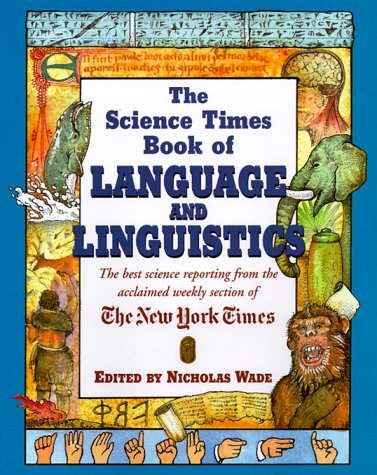
Examines the evolution of human and animal language within various cultures and species and how it is acquired and processed
"synopsis" may belong to another edition of this title.
About the Author
Nicholas Wade, a science reporter for The New York Times, was the editor of the Science Times from 1990 through 1996. He is also the author of The Ultimate Experiment, The Nobel Duel, Betrayers of the Truth (with William J. Broad), and A World Beyond Healing, and editor of the Science Times books published by the Lyons Press.
From the Back Cover
In the latest book in the series, editor Nichols Wade and the award-winning New York Times journalists explore the mysterious roots of language.Every culture has language, and we have long considered our ability to articulate to be what makes human beings unique in the animal world. It now appears certain that animals have fairly complex ways of communicating as well. Times reporters examine findings that shed light on animal "language," from the subsonic songs of the African elephants that can travel up to two miles through the ground to the rich rhyming schemes of the humpback whales.Our own species' development of language capacity remains a fascinating study. Did Neanderthals have spoken language? Which of the earliest cultures had written language? Among the tales herein are the search for the hypothetical mother tongue from which all languages are descended; linguists' reconstruction of lost languages; and archaeologists' discovery of 4,000-year-old Caucasian mummy remains in China that suggest astonishing possibilities.The human brain and how it acquires language is a constant source of scientific interest. Articles on the ways in which babies learn language, laughter's role in communication, how music works in the brain, how brain disorders affect language development, and how men and women use language differently are just some of the tantalizing research covered. The Science Times Book of Language and Linguistics is sure to captivate history buffs, animal lovers, students, and anyone who has an interest in language and culture. (71/4 X 91/2, 212 pages, illustrations)
Reviews
Most humans intuit that it is language that distinguishes them from all other creatures. Unanimity dissolves, however, on trying to define language, whether the subtopic is language's origins, acquisition, neurology, or possession by other animals. The vibrant cacophony of opinions about language echoes through these recently published New York Times articles. Disagreements in language research can be intense, especially over such questions as, What root language preceded Indo-European? "Nostratic," according to some linguists; unknowable nonsense, retort the skeptics. Can chimpanzees be coaxed to communicate, as Emily Savage-Rumbaugh pursues at her Georgia compound? Reporters can always get a quotable "no" from linguists Noam Chomsky or Stephen Pinker. Do men's and women's brains process language differently? The very question irks the equality minded, but studies pour out on the matter nonetheless. The Times reporters perform admirably in framing controversies and condensing jargon for readers embarking on an exploration of the current state of language research. Gilbert Taylor
"About this title" may belong to another edition of this title.
Search results for The Science Times Book of Language and Linguistics

Stock Image
The Science Times Book of Language and Linguistics
Seller: Once Upon A Time Books, Siloam Springs, AR, U.S.A.
Seller rating 4 out of 5 stars

hardcover. Condition: Acceptable. This is a used book. It may contain highlighting/underlining and/or the book may show heavier signs of wear . It may also be ex-library or without dustjacket. This is a used book. It may contain highlighting/underlining and/or the book may show heavier signs of wear . It may also be ex-library or without dustjacket. Seller Inventory # mon0003563640
Stock Image
The Science Times Book of Language and Linguistics
Published by
The Globe Pequot Publishing Group, Inc., 2000
ISBN 10: 155821934X
ISBN 13: 9781558219342
Used
Hardcover
Seller: Better World Books: West, Reno, NV, U.S.A.
Seller rating 5 out of 5 stars

Condition: Good. Pages intact with minimal writing/highlighting. The binding may be loose and creased. Dust jackets/supplements are not included. Stock photo provided. Product includes identifying sticker. Better World Books: Buy Books. Do Good. Seller Inventory # 54557157-75
Stock Image
The Science Times Book of Language and Linguistics
Published by
The Globe Pequot Publishing Group, Inc., 2000
ISBN 10: 155821934X
ISBN 13: 9781558219342
Used
Hardcover
Seller: Better World Books: West, Reno, NV, U.S.A.
Seller rating 5 out of 5 stars
Condition: Good. Former library copy. Pages intact with minimal writing/highlighting. The binding may be loose and creased. Dust jackets/supplements are not included. Includes library markings. Stock photo provided. Product includes identifying sticker. Better World Books: Buy Books. Do Good. Seller Inventory # 38420805-6
Stock Image
The Science Times Book of Language and Linguistics
Seller: HPB-Ruby, Dallas, TX, U.S.A.
Seller rating 5 out of 5 stars
hardcover. Condition: Very Good. Connecting readers with great books since 1972! Used books may not include companion materials, and may have some shelf wear or limited writing. We ship orders daily and Customer Service is our top priority! Seller Inventory # S_471116832
Stock Image
The Science Times Book of Language and Linguistics
Seller: Wonder Book, Frederick, MD, U.S.A.
Seller rating 5 out of 5 stars
Condition: Very Good. Very Good condition. Very Good dust jacket. A copy that may have a few cosmetic defects. May also contain light spine creasing or a few markings such as an owner's name, short gifter's inscription or light stamp. Seller Inventory # O14M-01113
Seller Image
The Science Times Book of Language and Linguistics
Published by
Lyons Pr, New York, NY, 2000
ISBN 10: 155821934X
ISBN 13: 9781558219342
Used
Hardcover
First Edition
Seller: True Oak Books, Highland, NY, U.S.A.
Seller rating 5 out of 5 stars
Hardcover. Condition: Very Good. Dust Jacket Condition: Very Good. First Edition; First Printing. 193 pages; B&W illustrations. Very Good condition. No noteworthy defects. No markings.; - Your satisfaction is our priority. We offer free returns and respond promptly to all inquiries. Your item will be packaged with care and ship on the same or next business day. Buy with confidence. Seller Inventory # HVD-47401-OS-0
Stock Image
The Science Times Book of Language and Linguistics
Seller: SHIMEDIA, Brooklyn, NY, U.S.A.
Seller rating 4 out of 5 stars
Condition: New. Satisfaction Guaranteed or your money back. Seller Inventory # 155821934X
Stock Image
THE SCIENCE TIMES BOOK OF LANGUA
Seller: BennettBooksLtd, Los Angeles, CA, U.S.A.
Seller rating 5 out of 5 stars
Condition: New. New. In shrink wrap. Looks like an interesting title! 1.34. Seller Inventory # Q-155821934X
Stock Image
The Science Times Book of Language and Linguistics
Seller: BennettBooksLtd, Los Angeles, CA, U.S.A.
Seller rating 5 out of 5 stars
Hardcover. Condition: New. In shrink wrap. Looks like an interesting title! Seller Inventory # Q-155821934x