
Items related to Little Crow to the Rescue / El Cuervito al rescate
Synopsis
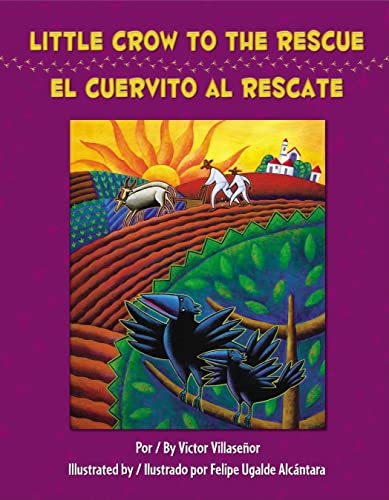
"When his father teaches him to beware of the tricky human beings, who try to hit birds with rocks, Little Crow shares an idea which causes all the crows to proclaim him a genius and alters their future."
"synopsis" may belong to another edition of this title.
About the Author
VICTOR VILLASEÑOR is the author of two bilingual picture books for children, The Frog and His Friends Save Humanity / La rana y sus amigos salvan a la humanidad and Mother Fox and Mr. Coyote / Mamá Zorra y don Coyote. He is also the author of numerous acclaimed titles for adults, including Burro Genius: A Memoir (Rayo, 2004); Macho (Arte Público Press, 2003), which was chosen by the New York Public Library for its distinguished list of Books for the Teen Age; Walking Stars (Piñata Books, 2003); Thirteen Senses (Harper-Collins, 2001); Rain of Gold (Arte Público Press, 1991); and the non-fiction Jury: The People vs. Juan Corona (Little, Brown, and Company, 1977). He is also the writer of screenplays, most notably the award-winning The Ballad of Gregorio Cortez.
FELIPE UGALDE ALCÁNTARA was born in Mexico City in 1962. He studied Graphic Communication at the National School of Art in Mexico’s National University, where he later taught an illustration workshop. He has been an illustrator and designer for children’s books, textbooks, and educational games for fifteen years. He has taught illustration workshops for children and professionals, and has participated in several exhibitions in Mexico and abroad.
Reviews
Grade 2-4–In this traditional tale, recounted by a father to his son, a crow warns his offspring about the treachery of humankind. He explains that, despite all that they have learned about survival from animals in the wild, humans cannot be trusted to remember the debt they owe to them. As Father Crow lectures on, he warns the youngster against letting a farmer who has bent down and picked up a rock get close enough to throw it. Little Crow draws his own conclusions. It would be wise, he tells his father, if the birds were to fly away any time they spot people. To this day, a flock of birds will take to the sky rather than let a human stray too close. The story comes full circle with the man explaining, So, you see mijo, this is why you can never catch a crow. The English and Spanish texts are presented on the same page, separated by a small picture. Both texts are grammatically correct and well crafted. The colorful stylized illustrations resemble patchwork quilts or stained glass.
Copyright © Reed Business Information, a division of Reed Elsevier Inc. All rights reserved.
PreS-Gr. 3. Villasenor shares a childhood story, passed down from his great-grandfather. A boy tries to catch the crows eating the chicken feed, but the birds always take wing. The boy's father tells of a father crow and his son, perched at the side of a cornfield. Father Crow tells Little Crow that, despite crows' love for humans, people show little affection in return. Father Crow's advice: fly away if you ever see a human pick up a rock. Although Little Crow watches and learns from his father, he adds his own spin to his father's advice. Alcantara's intensely colored, stylized art shows a natural world full of bright sunlight, richly shadowed crow feathers, and backgrounds with subtle layers of color. The Spanish translation is thoughtfully done, appropriately colloquial, and resembles the English in its pacing. The text isn't particularly lyrical in either language; the book's strength lies in its traditional origins, its striking illustrations, and the overall message that, occasionally, children can teach their parents a thing or two. Julie Kline
Copyright © American Library Association. All rights reserved
"About this title" may belong to another edition of this title.
Search results for Little Crow to the Rescue / El Cuervito al rescate

Stock Image
Little Crow to the Rescue / El Cuervito al rescate (English and Spanish Edition)
Seller: Orion Tech, Kingwood, TX, U.S.A.
Seller rating 5 out of 5 stars

hardcover. Condition: Very Good. Felipe Ugalde Alcántara (illustrator). Seller Inventory # 1558854304-2-36114841
Stock Image
Little Crow to the Rescue/el Cuervito al Rescate
Seller: Better World Books, Mishawaka, IN, U.S.A.
Seller rating 5 out of 5 stars
Condition: Good. Felipe Ugalde Alcántara (illustrator). Bilingual. Former library copy. Pages intact with minimal writing/highlighting. The binding may be loose and creased. Dust jackets/supplements are not included. Includes library markings. Stock photo provided. Product includes identifying sticker. Better World Books: Buy Books. Do Good. Seller Inventory # GRP102733428
Stock Image
Verdi:; Requiem.
Published by
Cambridge University Press, 2010
ISBN 10: 1558854304
ISBN 13: 9781558854307
Used
Paperback
Seller: Orrin Schwab Books, Providence, UT, U.S.A.
Seller rating 4 out of 5 stars

Paperback. Condition: Very Good-. Glossy softbound covers. Light shelf wear to the edges of the covers.; Cambridge Music Handbooks; 5.5 X 0.32 X 8.5 inches; 115 pages. Seller Inventory # 47459
Stock Image
Verdi: Requiem (Cambridge Music Handbooks)
Published by
Cambridge University Press, 2010
ISBN 10: 1558854304
ISBN 13: 9781558854307
Used
paperback
Seller: HPB-Movies, Dallas, TX, U.S.A.
Seller rating 5 out of 5 stars
paperback. Condition: Very Good. Connecting readers with great books since 1972! Used books may not include companion materials, and may have some shelf wear or limited writing. We ship orders daily and Customer Service is our top priority! Seller Inventory # S_471800598
Stock Image
Little Crow to the Rescue / El Cuervito al rescate (English and Spanish Edition)
Seller: BooksByLisa, Highland Park, IL, U.S.A.
Seller rating 5 out of 5 stars
Hardcover. Condition: New. Illustrated by Felipe Ugalde Alcántara (illustrator). PHOTO AND VIDEO OF PAGES TAKEN TO SHOW CONDITION PRIOR TO SHIPPING; Stored newPHOTOS EMAILED FOR MORE SPECIFICS WHEN REQUESTED; Book. Book. Seller Inventory # 16275
Stock Image
Little Crow To The Rescue/El Cuervito al Rescate
Seller: ThriftBooks-Atlanta, AUSTELL, GA, U.S.A.
Seller rating 5 out of 5 stars
Hardcover. Condition: Very Good. No Jacket. Felipe Ugalde Alcántara (illustrator). Former library book; May have limited writing in cover pages. Pages are unmarked. ~ ThriftBooks: Read More, Spend Less. Seller Inventory # G1558854304I4N10
Stock Image
Little Crow to the Rescue / El Cuervito al rescate (English and Spanish Edition)
Seller: GridFreed, San Diego, CA, U.S.A.
Seller rating 5 out of 5 stars
Hardcover. Condition: New. Felipe Ugalde Alcántara (illustrator). In shrink wrap. Looks like an interesting title! Seller Inventory # 100-34876
Stock Image
Little Crow to the Rescue / El Cuervito al rescate
Seller: SHIMEDIA, Brooklyn, NY, U.S.A.
Seller rating 4 out of 5 stars
Condition: New. Felipe Ugalde Alcántara (illustrator). Satisfaction Guaranteed or your money back. Seller Inventory # 1558854304
Stock Image
Little Crow to the Rescue / El Cuervito al rescate (English and Spanish Edition)
Seller: BennettBooksLtd, Los Angeles, CA, U.S.A.
Seller rating 5 out of 5 stars
Hardcover. Condition: New. Felipe Ugalde Alcántara (illustrator). In shrink wrap. Looks like an interesting title! Seller Inventory # Q-1558854304