
Items related to The Forgotten Pollinators
Synopsis
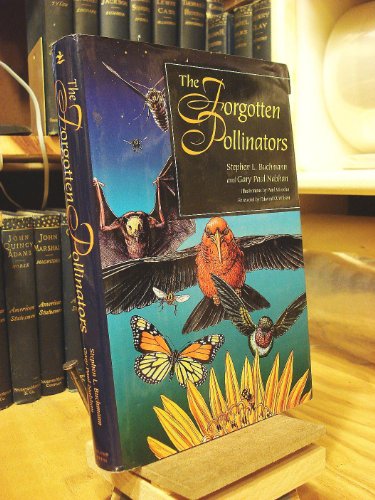
Consider this: Without interaction between animals and flowering plants, the seeds and fruits that make up nearly eighty percent of the human diet would not exist.In The Forgotten Pollinators, Stephen L. Buchmann, one of the world's leading authorities on bees and pollination, and Gary Paul Nabhan, award-winning writer and renowned crop ecologist, explore the vital but little-appreciated relationship between plants and the animals they depend on for reproduction -- bees, beetles, butterflies, hummingbirds, moths, bats, and countless other animals, some widely recognized and other almost unknown.Scenes from around the globe -- examining island flora and fauna on the Galapagos, counting bees in the Panamanian rain forest, witnessing an ancient honey-hunting ritual in Malaysia -- bring to life the hidden relationships between plants and animals, and demonstrate the ways in which human society affects and is affected by those relationships. Buchmann and Nabhan combine vignettes from the field with expository discussions of ecology, botany, and crop science to present a lively and fascinating account of the ecological and cultural context of plant-pollinator relationships.More than any other natural process, plant-pollinator relationships offer vivid examples of the connections between endangered species and threatened habitats. The authors explain how human-induced changes in pollinator populations -- caused by overuse of chemical pesticides, unbridled development, and conversion of natural areas into monocultural cropland-can have a ripple effect on disparate species, ultimately leading to a "cascade of linked extinctions."
"synopsis" may belong to another edition of this title.
About the Author
Stephen L. Buchmann is research entomologist at the Carl Hayden Bee Research Center and adjunct professor at the University of Arizona.
Reviews
Pollinators are the Rodney Dangerfields of the animal world: They just don't get no respect. So claim entomologist Buchmann (Hayden Bee Research Center) and Nabhan (Director of science/Arizona-Sonora Desert Museum) in this at once delightful and disturbing tour d'horizon of those for whom the flowers bloom. ``One in every three mouthfuls of food we eat, and of beverages we drink'' is served up to us by pollinators, notes E.O. Wilson in his introduction. Butterflies are out there working for us, as are the hummingbirds and fig wasps, pygmy gliders and panurgine bees, carrying pollen to stigma, allowing seeds to set. Pollination is one of nature's vital processes, fine-tuned and mesmeric in its endless cycles, feedback loops, checks and balances. But as in so many other instances, humans are busy as the bees disrupting the process, bombing pollinators with pesticides, fragmenting their habitat, cutting off the nectar corridors, such that the ``current rate of species loss constitutes a biodiversity crisis of unprecedented proportions.'' Buchmann provides the hard science of the pollinators' world: flower stalk architecture and nectar chemistry and flowering sequences; Nabhan contributes a felicitous dose of pleasing prose, framed as anecdotal remembrances: He's never happier than when poking about in a sere landscape, following the monarch butterflies on their winter migration, taking stock of the floral pantries. While this book can only be considered a preliminary investigation, trends indicate that pollinators may be getting ever more limited in supply as their world shrinks around them. Buchmann and Nabhan make the case for increased wildlands, intact forests, an ecological approach that prevents pollinator habitat from becoming islands, thus coffins, in a developed landscape. A cautionary tale: Kill the pollinators and you might as well kill yourself. Another of nature's elegant loops. (b&w illustrations) (Author tour) -- Copyright ©1996, Kirkus Associates, LP. All rights reserved.
YA. Over 30 years ago Rachel Carson predicted a silent spring, when "no bees droned among the blossoms" and fruitless falls, autumns in which "there was no pollination and there would be no fruit." She gave two reasons: the poisoning of pollinating insects by herbicides and pesticides, and the destruction of habitat. This book explores the vital relationship between plants and their pollinators and how depletion of these pollinators threatens the plants that the planet depends upon for sustenance and diversity. The authors have traveled extensively throughout the world studying insects, birds, and animals in their role as pollinators. They present an entertaining account of the information gathered in their travels, studies pertaining to the present worldwide status of the pollinators and the plants they pollinate, their predictions for the future, and their recommendations to avert the loss of pollinators and their habitats. The chapters on the monarch butterfly and the honeybee are most outstanding. The book can be read for general knowledge, as well for science and ecology research.?Judy McAloon, Potomac Library, Prince William County, VA
Copyright 1997 Reed Business Information, Inc.
Popular environmental literature has generally overlooked the role of pollinators?animals such as bees, beetles, butterflies, moths and bats. In fact, our information on pollinator-plant interaction may be the weakest link in understanding how ecosystems function, say the authors. This book is the centerpiece of a public-awareness campaign based at the Arizona-Sonora Desert Museum. Buchmann, a leading authority on pollination, and Nabhan (The Desert Smells Like Rain) explore this vital link between plants and their pollinators. It is a disturbing story of disappearing insects and diminishing plant reproduction, owing to overuse of pesticide and fragmented habitat. The authors combine anecdotes from the field with discussions of ecology, entomology, botany, crop science and the economics of pollination. Stories range from the Virgin River in Utah to the Galapagos and a honey-gathering ritual in Malaysia. Their studies show that wildland protection is fundamental to sustaining agricultural productivity. This important addition to the environmental bookshelf is enlivened by Mirocha's delightful drawings.
Copyright 1996 Reed Business Information, Inc.
Entomologist Buchmann and crop ecologist Nabhan (Enduring Seeds, LJ 3/1/89) investigate the relationships between plants and their pollinators in these stories of field research. Since most of us fail to notice the importance of pollinators, the authors remind us that one-third of the food we eat comes from animal-pollinated plants. The authors describe the ecological and economic effects of habitat destruction and present some ideas for improving the situation. While bees and beekeeping are discussed at some length, this book points out that birds, mammals, and lizards as well as insects are all documented pollinators. Written in a lively, conversational style, this book is intended for a wide audience and is recommended for both public and academic libraries. Readers interested in the "how" of pollination should also examine the close-up color photography of John Brackenbury's recent Insects and Flowers (LJ 11/1/95).?William H. Wiese, Iowa State Univ. Lib., Ames
Copyright 1996 Reed Business Information, Inc.
Nearly everyone is familiar with Rachel Carson's alarming prediction of a "silent spring," but few remember that she also predicted a "fruitless fall." This dire phenomenon is inevitable: if the bees, bats, butterflies, birds, and beetles that pollinate plants go extinct, the plant species they fertilize will die, too. What we're really seeing in the loss of biodiversity is the "extinction of ecological relationships" between plants and animals. Nature is, after all, interaction and mutuality. Buchmann, a research entomologist, and Nabhan, author of eight books, including The Geography of Childhood (1994), and director of science at the Arizona-Sonora Desert Museum, offer their own form of mutualism in this eye-opening and, thanks to illustrations by Paul Mirocha, eye-pleasing book. Buchmann and Nabhan take turns relating their fascinating observations of the habits of various pollinators in such diverse locales as Utah's Virgin River watershed and the Galapagos Islands in an effort to convey a sense of what exactly is at risk: nothing less than our sources of nutrition--ultimately, our very lives. Donna Seaman
"About this title" may belong to another edition of this title.
Search results for The Forgotten Pollinators

Stock Image
The Forgotten Pollinators
Published by
Princeton University Press, 1996
ISBN 10: 1559633522
ISBN 13: 9781559633529
Used
Hardcover
Seller: World of Books (was SecondSale), Montgomery, IL, U.S.A.
Seller rating 5 out of 5 stars

Hardback. Condition: Good. Mirocha, Paul (illustrator). This work looks at the human impact on plants and the animals they depend upon for reproduction. As an increasing number of species are erased by pesticides or habitat disruption, 80 per cent of the human diet is threatened. Seller Inventory # 00110770113
Seller Image
The Forgotten Pollinators
Seller: Bay State Book Company, North Smithfield, RI, U.S.A.
Seller rating 5 out of 5 stars
Condition: good. Mirocha, Paul (illustrator). The book is in good condition with all pages and cover intact, including the dust jacket if originally issued. The spine may show light wear. Pages may contain some notes or highlighting, and there might be a "From the library of" label. Boxed set packaging, shrink wrap, or included media like CDs may be missing. Seller Inventory # BSM.1GGP8
Seller Image
The Forgotten Pollinators
Seller: Greenworld Books, Arlington, TX, U.S.A.
Seller rating 5 out of 5 stars
Condition: very_good. Mirocha, Paul (illustrator). Fast Free Shipping â" Very Good condition book with a firm cover and clean pages. Shows normal use and some light wear or limited notes markings. A solid, nice copy to enjoy. Seller Inventory # GWV.1559633522.VG
Stock Image
The Forgotten Pollinators
Seller: ThriftBooks-Dallas, Dallas, TX, U.S.A.
Seller rating 5 out of 5 stars
Hardcover. Condition: Good. No Jacket. Mirocha, Paul (illustrator). Pages can have notes/highlighting. Spine may show signs of wear. ~ ThriftBooks: Read More, Spend Less. Seller Inventory # G1559633522I3N00
Stock Image
The Forgotten Pollinators
Seller: ThriftBooks-Dallas, Dallas, TX, U.S.A.
Seller rating 5 out of 5 stars
Hardcover. Condition: Fair. No Jacket. Mirocha, Paul (illustrator). Readable copy. Pages may have considerable notes/highlighting. ~ ThriftBooks: Read More, Spend Less. Seller Inventory # G1559633522I5N00
Stock Image
The Forgotten Pollinators
Seller: ThriftBooks-Atlanta, AUSTELL, GA, U.S.A.
Seller rating 5 out of 5 stars
Hardcover. Condition: Very Good. No Jacket. Mirocha, Paul (illustrator). May have limited writing in cover pages. Pages are unmarked. ~ ThriftBooks: Read More, Spend Less. Seller Inventory # G1559633522I4N00
Stock Image
The Forgotten Pollinators
Published by
Princeton University Press, 1996
ISBN 10: 1559633522
ISBN 13: 9781559633529
Used
Hardcover
Seller: World of Books Inc, Montgomery, IL, U.S.A.
Seller rating 4 out of 5 stars

Hardback. Condition: Good. Mirocha, Paul (illustrator). This work looks at the human impact on plants and the animals they depend upon for reproduction. As an increasing number of species are erased by pesticides or habitat disruption, 80 per cent of the human diet is threatened. Seller Inventory # CIN1559633522G
Stock Image
The Forgotten Pollinators
Published by
Island Press, 1996
ISBN 10: 1559633522
ISBN 13: 9781559633529
Used
Hardcover
First Edition
Seller: Better World Books, Mishawaka, IN, U.S.A.
Seller rating 5 out of 5 stars
Condition: Very Good. Mirocha, Paul (illustrator). 1st Edition. Pages intact with possible writing/highlighting. Binding strong with minor wear. Dust jackets/supplements may not be included. Stock photo provided. Product includes identifying sticker. Better World Books: Buy Books. Do Good. Seller Inventory # 4020247-6
Seller Image
The Forgotten Pollinators
Published by
Island Press, 1996
ISBN 10: 1559633522
ISBN 13: 9781559633529
Used
Hardcover
First Edition
Seller: Southampton Books, Sag Harbor, NY, U.S.A.
Seller rating 5 out of 5 stars
Hardcover. Condition: Very Good. Mirocha, Paul (illustrator). First Edition. First Edition, First Printing. Published by Island Press, 1996. Octavo. Hardcover. Book is very good. Dust jacket is very good. Seller Inventory # 514656
Stock Image
The Forgotten Pollinators
Published by
Chicago, Island Press, 1996., 1996
ISBN 10: 1559633522
ISBN 13: 9781559633529
Used
Hardcover
Seller: Virginia Martin, aka bookwitch, Concord, CA, U.S.A.
Seller rating 5 out of 5 stars
Hardcover. Condition: Very Good. Dust Jacket Condition: Good. Paul Mirocha (illustrator). Royal octavo, hardcover, VG in lightly edgeworn blue pictorial dj. Foreword by Edward Wilson. Consider this: Without interaction between animals and flowering plants, the seeds and fruits that make up nearly eighty percent of the human diet would not exist. Most of the honey bees have died due to perticides and other causes. Reviving them is critical to our agriculture economy. 292 pp. including index. Book. Seller Inventory # 67941