
Items related to One Day in September
Synopsis
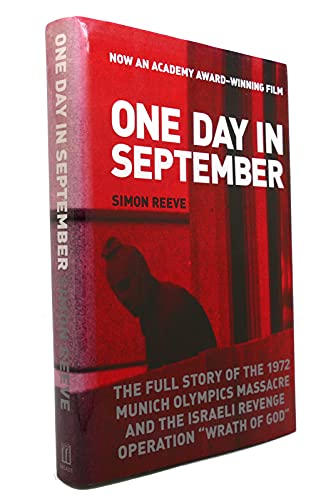
The dramatic and definitive account of the 1972 Munich Olympics massacre and the resulting 20-year Israeli Operation Wrath of God one of the most clinical revenge missions in modern history. The book covers the siege and massacre of 11 Israeli athletes and officials. It questions whether the Israelis were killed by Palestinian militants or inept German police snipers. Hundreds of millions of people watched events unfold on live television, and the consequences reverberate around the Middle East to this day.
"synopsis" may belong to another edition of this title.
About the Author
Simon Reeve is a bestselling author and an award-winning television presenter. His book The New Jackals: Ramzi Yousef, Osama bin Laden and the future of terrorism, which warned of apocalyptic terrorist attacks, was the first in the world on bin Laden and al Qaeda. Originally published in 1998 it has been a New York Times bestseller. Simon has contributed to other studies into organised crime, terrorism, biological warfare and corruption. His most recent book is One Day in September: the story of the 1972 Munich Olympics massacre. The movie of the same name, narrated by the actor Michael Douglas, won the Oscar for best feature documentary. In recent years Simon has been followed around little-known regions of the world by BBC camera crews making two major television series. In Meet the Stans , Simon visited the Central Asian states of Kazakhstan, Uzbekistan, Tajikistan and Kyrgyzstan. For the five-part BBC series Places That Don t Exist , Simon travelled to and through a group of unrecognised nations countries so obscure they don t officially exist. Among the destinations visited were Somaliland, Transdniestria, Nagorno-Karabkh, Ajaria and South Ossetia. The Daily Telegraph said it was: "an exemplary series…riveting…eye-opening…remarkable…superb". The series won a prestigious award from the One World Broadcasting Trust "for outstanding contribution to greater world understanding".
Reviews
Adult/High School-A comprehensive and unsettling account of a horrific occurrence that shocked millions in 1972. The Summer Olympics were held in (West) Germany for the first time since 1936, amid hopes for an open, nonmilitaristic competition. Early on the morning of September 5th, eight mem-bers of a PLO faction called Black Septem-ber snuck into the Olympic Village and stormed the men's residence, seizing 11 Is-raeli athletes and coaches. Two were killed immediately, and the remaining nine (along with five of the terrorists) were slain less than 24 hours later in a badly bungled rescue at-tempt at F�rstenfeldbruck airport. Reeve's book originated with research conducted for an Oscar-winning documentary, but the vol-ume goes beyond the film to present many disturbing and previously unknown facts. While the film focuses on the massacre itself, the text covers acts of retaliation and cover-up that continued for years afterward. Indeed, one vital source of information is an investigative report, the existence of which was denied by German officials for 20 years, and came to light only through the persistent ac- tions of family members of the murdered ath-letes. Despite the regrettable omission of an index, Reeve's book is an important one since it deals with many issues-terrorism, anti-Semitism and other forms of racism, and Middle East unrest.-Dori DeSpain, Fairfax County Public Library, VA
Copyright 2001 Cahners Business Information, Inc.
Excerpt. © Reprinted by permission. All rights reserved.
Chapter One It was 4.30 a.m. on the morning of 5 September 1972, when a small posse of shadowy figures arrived on the outskirts of the Olympic Village in Munich and made their way silently to the six-foot perimeter fence supposed to offer protection to the thousands of athletes sleeping within. Creeping through the darkness carrying heavy sports bags, the group made for a length of the fence near Gate 25A, which was locked at midnight but left unguarded. The 35-year-old leader of the small troop, Luttif Issa, a.k.a. Issa , had carefully chosen the point at which his men were to enter the village. On previous nights he had seen athletes climbing the fence near Gate 25A while returning drunk from late-night parties. Security was lax and none of the athletes had been stopped. So Issa dressed his seven colleagues in tracksuits, reasoning that if guards saw them they would assume they were just sportsmen returning to their quarters. Jamal Al-Gashey, at 18 one of the younger members of the group, remembers the tension building as they approached the fence. There they came across a few drunk American athletes returning to their beds by the same route. They had been forced to leave the village in secret for their night out, Al-Gashey remembered. We could see they were Americans ... and they were going to go over the [fence] as well. Issa quickly decided the foreign athletes could give his group cover if they helped each other over the fence. We got chatting, said Al-Gashey, and then we helped each other over. Al-Gashey lifted one of the US team up onto the fence, which was topped not by barbed wire but small round cones, and then the American turned and helped to pull Al-Gashey up and over. Several officials, including six German postmen on their way to the temporary post office in the Village Plaza, saw between eight and 12 people in two groups with sports bags climbing the fence at around 4.10 a.m. As Issa had assumed, none of these passers-by challenged them because they thought the fence-climbers were just athletes returning home. We walked for a while with the American athletes, Al-Gashey recounted, then said goodbye. The group split up and stole through the sleeping Village to a drab three-storey block on Connollystrasse, one of three broad pedestrianized streets, adorned with shrubbery and fountains, snaking from east to west through the Village. Even if the unarmed Olympic guards or the Munich police had been alerted it would probably have been too late. The eight men were terrorists from Black September, an extremist faction within the Palestinian Liberation Organization. The fedayeen ( fighters for the faith ) were carrying Kalashnikov assault rifles and grenades, hidden under clothing in the sports bags , and they were fully prepared to fight their way to their target: 31 Connollystrasse, the building in the heart of the Olympic Village that housed the Israeli delegation to the Olympic Games. New entrants were about to make their mark on the XXth Olympiad.
"About this title" may belong to another edition of this title.
Search results for One Day in September

Stock Image
One Day in September
Seller: ThriftBooks-Atlanta, AUSTELL, GA, U.S.A.
Seller rating 5 out of 5 stars

Hardcover. Condition: Good. No Jacket. Pages can have notes/highlighting. Spine may show signs of wear. ~ ThriftBooks: Read More, Spend Less. Seller Inventory # G1559705477I3N00
Stock Image
One Day in September
Seller: ThriftBooks-Dallas, Dallas, TX, U.S.A.
Seller rating 5 out of 5 stars
Hardcover. Condition: Very Good. No Jacket. May have limited writing in cover pages. Pages are unmarked. ~ ThriftBooks: Read More, Spend Less. Seller Inventory # G1559705477I4N00
Stock Image
One Day in September
Seller: ThriftBooks-Atlanta, AUSTELL, GA, U.S.A.
Seller rating 5 out of 5 stars
Hardcover. Condition: Very Good. No Jacket. Missing dust jacket; May have limited writing in cover pages. Pages are unmarked. ~ ThriftBooks: Read More, Spend Less. Seller Inventory # G1559705477I4N01
Stock Image
One Day in September
Seller: ThriftBooks-Atlanta, AUSTELL, GA, U.S.A.
Seller rating 5 out of 5 stars
Hardcover. Condition: Very Good. No Jacket. May have limited writing in cover pages. Pages are unmarked. ~ ThriftBooks: Read More, Spend Less. Seller Inventory # G1559705477I4N00
Stock Image
One Day in September: The Full Story of the 1972 Munich Olympics Massacre and the Israeli Revenge Operation, Wrath of God
Seller: World of Books (was SecondSale), Montgomery, IL, U.S.A.
Seller rating 5 out of 5 stars
Hardback. Condition: Fair. At 4:30 a.m. on September 5, 1972, a band of Palestinian terrorists took eleven Israeli athletes and coaches hostage at the Summer Olympics in Munich. More than 900 million viewers followed the chilling, twenty-hour event on television, as German authorities desperately negotiated with the terrorists. Finally, late in the evening, two helicopters bore the terrorists and their surviving hostages to Munich's little-used Furstenfeldbruck airfield, where events went tragically awry. Within minutes all of the Israeli athletes, five of the terrorists, and one German policeman were dead. Why did the rescue mission fail so miserably? And why were the reports compiled by the German authorities concealed from the public for more than two decades? Reeves takes on a catastrophe that permanently shifted the political spectrum with a fast-paced narrative that covers the events detail by detail. Based on years of exhaustive research, One Day in September is the definitive account of one of the most devastating and politically explosive tragedies of the late twentieth century, one that set the tone for nearly thirty years of renewed conflict in the Middle East. Seller Inventory # 00105809974
Stock Image
One Day in September : The Full Story of the 1972 Munich Olympics Massacre and the Israeli Revenge Operation
Seller: Better World Books: West, Reno, NV, U.S.A.
Seller rating 5 out of 5 stars
Condition: Very Good. 1st U.S. ed. Former library copy. Pages intact with possible writing/highlighting. Binding strong with minor wear. Dust jackets/supplements may not be included. Includes library markings. Stock photo provided. Product includes identifying sticker. Better World Books: Buy Books. Do Good. Seller Inventory # 9579090-6
Stock Image
One Day in September : The Full Story of the 1972 Munich Olympics Massacre and the Israeli Revenge Operation
Seller: Better World Books, Mishawaka, IN, U.S.A.
Seller rating 5 out of 5 stars
Condition: Good. 1st U.S. ed. Former library copy. Pages intact with minimal writing/highlighting. The binding may be loose and creased. Dust jackets/supplements are not included. Includes library markings. Stock photo provided. Product includes identifying sticker. Better World Books: Buy Books. Do Good. Seller Inventory # 2685091-6
Stock Image
One Day in September: The Full Story of the 1972 Munich Olympics Massacre and the Israeli Revenge Operation, Wrath of God
Seller: World of Books Inc, Montgomery, IL, U.S.A.
Seller rating 4 out of 5 stars

Hardback. Condition: Fair. At 4:30 a.m. on September 5, 1972, a band of Palestinian terrorists took eleven Israeli athletes and coaches hostage at the Summer Olympics in Munich. More than 900 million viewers followed the chilling, twenty-hour event on television, as German authorities desperately negotiated with the terrorists. Finally, late in the evening, two helicopters bore the terrorists and their surviving hostages to Munich's little-used Furstenfeldbruck airfield, where events went tragically awry. Within minutes all of the Israeli athletes, five of the terrorists, and one German policeman were dead. Why did the rescue mission fail so miserably? And why were the reports compiled by the German authorities concealed from the public for more than two decades? Reeves takes on a catastrophe that permanently shifted the political spectrum with a fast-paced narrative that covers the events detail by detail. Based on years of exhaustive research, One Day in September is the definitive account of one of the most devastating and politically explosive tragedies of the late twentieth century, one that set the tone for nearly thirty years of renewed conflict in the Middle East. Seller Inventory # CIN1559705477A
Seller Image
One Day in September: The Full Story of the 1972 Munich Olympics Massacre and the Israeli Revenge Operation, Wrath of God
Seller: BoundlessBookstore, Wallingford, United Kingdom
Seller rating 5 out of 5 stars
Hardcover. Condition: Good. Little wear to boards. Content is clean. Good DJ with little wear. Seller Inventory # 9999-999108296122
Buy Used
US$ 10.34
US$ 9.33 shipping
Ships from United Kingdom to U.S.A.
Ships from United Kingdom to U.S.A.
Quantity: 1 available
Stock Image
One Day in September: The Full Story of the 1972 Munich Olympics Massacre and the Israeli Revenge Operation, Wrath of God
Seller: WorldofBooks, Goring-By-Sea, WS, United Kingdom
Seller rating 5 out of 5 stars
Paperback. Condition: Very Good. The book has been read, but is in excellent condition. Pages are intact and not marred by notes or highlighting. The spine remains undamaged. Seller Inventory # GOR005224624
Buy Used
US$ 13.12
US$ 7.49 shipping
Ships from United Kingdom to U.S.A.
Ships from United Kingdom to U.S.A.
Quantity: 1 available