
Synopsis
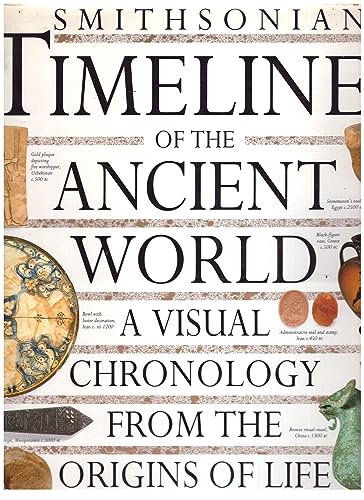
Tracks the advance of history from human origins to the Renaissance in all parts of the world simultaneously, through specially designed time charts featuring full-color photographs of fascinating artifacts from a diversity of cultures. 35,000 first printing.
"synopsis" may belong to another edition of this title.
Reviews
More than 1,800 full-color illustrations illuminate this oversize chronology spanning the period from prehistory to the time of Columbus. It enables readers to see at a glance what events have taken place in different parts of the world during a specific time period. Scholars from the Smithsonian Institution were contributors and reviewers of the work; hence, the title.
The aim of Smithsonian Timelines is to present the human story from earliest times to 1500 A.D. This timespan is divided into 18 chapters, each with a series of maps, large-scale time charts, and special-feature pages.
Each chapter begins with an introduction that highlights important aspects of the period. Maps of five regions of the globe emphasize a special topic for that period, such as irrigation canals in the Americas or incense trade in the Middle East. The time charts are divided into the same five regions: the Americas, East Asia and Australasia, the Middle East and South Asia, Europe, and Africa, each color coded for easy identification. The five regions are examined under four themes: "Food and Environment," "Shelter and Architecture," "Technology and Innovation," and "Art and Ritual." Following the time charts, two-page features explore topics that reflect a region, culture, issue, or theme, for example, "Urban Life in Ephesus" or "Pueblo Villages." In addition to photographs are drawings in which artists have reconstructed buildings and sites of the featured time period, with the assistance of archaeological evidence. A subject index brings together topics found on several time charts (e.g., animals in art).
This beautiful reference book offers both children and adults an opportunity to travel back in time and follow the course of human achievement in various regions of the world. It should be a part of reference sections in every public library and all school libraries (elementary through high school) to browse or use as a research tool. Academic libraries should consider purchase, too.
This engaging illustrated chronology of human and natural history from the beginning of life on earth to A.D. 1500 combines the intellectual and material resources of the Smithsonian Institution with the strong graphics of the publisher. The large-format volume presents its content uniformly in grid fashion in four parts comprising 18 chapters. The illustrations are impressive, numbering 1400 photos and 400 maps, all in color. Chapters display their information under four horizontal headings: food/environment, shelter, technology, and art in a two-page spread; geographic areas (continents) are given in vertical columns. Each chapter opens with a brief narrative and appropriate illustrations of the topic and offers a special feature (e.g., Neanderthals, origin of food production, Olmecs, art of Classical Greece). Timelines invites comparison with Past Worlds: The Times Atlas of Archaeology (Hammond, 1988). The two present much of the same information, but Timelines 's success lies in its at-a-glance visual presentation of past eras and major geographic regions. The editor-in-chief is a noted Cambridge scholar. Recommended for school and most public libraries.
- Harry E. Whitmore, formerly with Univ. of Maine, Augusta
Copyright 1993 Reed Business Information, Inc.
"About this title" may belong to another edition of this title.
Search results for Smithsonian Timelines of the Ancient World

Stock Image
Smithsonian Timelines of the Ancient World
Seller: World of Books (was SecondSale), Montgomery, IL, U.S.A.
Seller rating 5 out of 5 stars

Condition: Acceptable. Item in acceptable condition! Textbooks may not include supplemental items i.e. CDs, access codes etc. Seller Inventory # 00094010056
Stock Image
Smithsonian Timelines of the Ancient World
Seller: ThriftBooks-Dallas, Dallas, TX, U.S.A.
Seller rating 5 out of 5 stars
Hardcover. Condition: Fair. No Jacket. Missing dust jacket; Readable copy. Pages may have considerable notes/highlighting. ~ ThriftBooks: Read More, Spend Less. Seller Inventory # G1564583058I5N01
Seller Image
Smithsonian Timelines of the Ancient World
Seller: Dream Books Co., Denver, CO, U.S.A.
Seller rating 5 out of 5 stars
Condition: good. Gently used with minimal wear on the corners and cover. A few pages may contain light highlighting or writing, but the text remains fully legible. Dust jacket may be missing, and supplemental materials like CDs or codes may not be included. May be ex-library with library markings. Ships promptly! Seller Inventory # DBV.1564583058.G
Stock Image
Smithsonian Timelines of the Ancient World
Seller: New Legacy Books, Annandale, NJ, U.S.A.
Seller rating 5 out of 5 stars
hardcover. Condition: Good. The dust jacket shows normal wear. Fast shipping and order satisfaction guaranteed. A portion of your purchase benefits Non-Profit Organizations, First Aid and Fire Stations! Seller Inventory # mon0000094064
Stock Image
Smithsonian Timelines of the Ancient World
Seller: Wonder Book, Frederick, MD, U.S.A.
Seller rating 5 out of 5 stars
Condition: Very Good. Very Good condition. Good dust jacket. A copy that may have a few cosmetic defects. May also contain light spine creasing or a few markings such as an owner's name, short gifter's inscription or light stamp. Bundled media such as CDs, DVDs, floppy disks or access codes may not be included. NOT AVAILABLE FOR SHIPMENT OUTSIDE OF THE UNITED STATES. Seller Inventory # N14B-03892
Stock Image
Smithsonian Timelines of the Ancient World : A Visual Chronology from the Origins of Life to A. D. 1500
Published by
Dorling Kindersley Publishing, Incorporated, 1993
ISBN 10: 1564583058
ISBN 13: 9781564583055
Used
Hardcover
Seller: Better World Books: West, Reno, NV, U.S.A.
Seller rating 5 out of 5 stars
Condition: Good. 1 Edition. Former library copy. Pages intact with minimal writing/highlighting. The binding may be loose and creased. Dust jackets/supplements are not included. Includes library markings. Stock photo provided. Product includes identifying sticker. Better World Books: Buy Books. Do Good. Seller Inventory # 2691130-6
Stock Image
Smithsonian Timelines of the Ancient World : A Visual Chronology from the Origins of Life to A. D. 1500
Published by
Dorling Kindersley Publishing, Incorporated, 1993
ISBN 10: 1564583058
ISBN 13: 9781564583055
Used
Hardcover
Seller: Better World Books: West, Reno, NV, U.S.A.
Seller rating 5 out of 5 stars
Condition: Very Good. 1 Edition. Pages intact with possible writing/highlighting. Binding strong with minor wear. Dust jackets/supplements may not be included. Stock photo provided. Product includes identifying sticker. Better World Books: Buy Books. Do Good. Seller Inventory # 8454999-6
Stock Image
Smithsonian Timelines of the Ancient World : A Visual Chronology from the Origins of Life to A. D. 1500
Published by
Dorling Kindersley Publishing, Incorporated, 1993
ISBN 10: 1564583058
ISBN 13: 9781564583055
Used
Hardcover
Seller: Better World Books: West, Reno, NV, U.S.A.
Seller rating 5 out of 5 stars
Condition: Good. 1 Edition. Pages intact with minimal writing/highlighting. The binding may be loose and creased. Dust jackets/supplements are not included. Stock photo provided. Product includes identifying sticker. Better World Books: Buy Books. Do Good. Seller Inventory # GRP102384842
Stock Image
Smithsonian Timelines of the Ancient World : A Visual Chronology from the Origins of Life to A. D. 1500
Published by
Dorling Kindersley Publishing, Incorporated, 1993
ISBN 10: 1564583058
ISBN 13: 9781564583055
Used
Hardcover
Seller: Better World Books, Mishawaka, IN, U.S.A.
Seller rating 5 out of 5 stars
Condition: Good. 1 Edition. Pages intact with minimal writing/highlighting. The binding may be loose and creased. Dust jackets/supplements are not included. Stock photo provided. Product includes identifying sticker. Better World Books: Buy Books. Do Good. Seller Inventory # GRP102384842
Stock Image
TIMELINES OF THE ANCIENT WORLD: A VISUAL CHRONOLOGY.
Seller: Terra Firma Books, San Diego, CA, U.S.A.
Seller rating 5 out of 5 stars
Hardcover. Condition: Very Good. Dust Jacket Condition: Very Good. Originally $50. 256pp. Gret images all in color! No name or writing. CLEAN! Seller Inventory # 006707