
Items related to Reader's Block
Synopsis
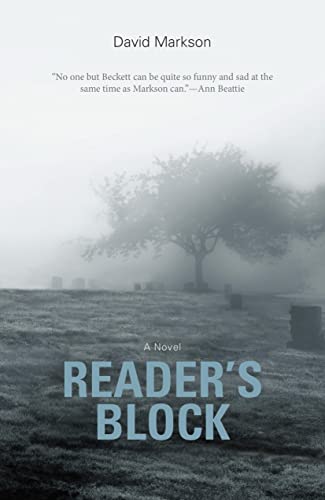
In this spellbinding, utterly unconventional fiction, an aging author who is identified only as Reader contemplates the writing of a novel. As he does, other matters insistently crowd his mind - literary and cultural anecdotes, endless quotations attributed and not, scholarly curiosities - the residue of a lifetime's reading which is apparently all he has to show for his decades on earth. Out of these unlikely yet incontestably fascinating materials - including innumerable details about the madness and calamity in many artists' and writers' lives, the eternal critical affronts, the startling bigotry, the countless suicides - David Markson has created a novel of extraordinary intellectual suggestiveness. But while shoring up Reader's ruins with such fragments, Markson has also managed to electrify his novel with an almost unbearable emotional impact. Where Reader ultimately leads us is shattering.
"synopsis" may belong to another edition of this title.
About the Author
David Markson's novel Wittgenstein's Mistress was acclaimed by David Foster Wallace as "pretty much the high point of experimental fiction in this country." His other novels, including Reader's Block, Springer's Progress, and Vanishing Point, have expanded this high reputation. His novel The Ballad of Dingus Magee was made into the film Dirty Dingus Magee, which starred Frank Sinatra, and he is also the author of three crime novels. Born in Albany, New York, he has long lived in New York City.
Reviews
Now in his 60s, Markson continues to blossom as an experimental novelist. His early work, Springer's Progress, published in the mid 1970s, carried the seeds of the collage technique that the much-praised Wittgenstein's Mistress put to such great effect and which in his latest has resulted in a book often dreamed about by the avant-garde but never seen. "A novel of intellectual reference and allusion, so to speak, minus much of the novel?" asks Markson's narrator, called The Reader. "Or perhaps not a novel? Is he in some way thinking of an autobiography?" "Or does the absence of a narrative progression... possibly render it even a poem of sorts? Not to add avec exactly 333 interspersed unattributed quotations awaiting annotation?" Reader's Block asks all these questions, and the lucky reader will not care a whit, for what Markson accomplishes, despite his doubts, is an utterly fascinating document that in itself is a small education in the history of Western literature, seen through the eyes of a gravely impassioned litterateur. The quotations from his reading that have become Markson's signature are so remarkably sustaining that the book, despite its lack of narrative, is hard to put down: the fate of Auden's royalties (Chester Kallman's dentist father's second wife); the suicide of Adrienne Rich's husband; Conrad's verdict on Moby-Dick ("not a single sincere line"); the Sappho fragment, "Raise high the roof beam, carpenters." The collection of these fragments, which also include a list of nearly a hundred writers deemed anti-Semitic and another list of author suicides, invests this work with a terribly mordant tone and gives Markson's meditation on the novel form a fresh urgency. This is a playful book with dead serious concerns. As The Reader wanders through the life of his extraordinary reading, the endeavor of novel-writing is subtly repositioned as perhaps something that lies about life and needn't.
Copyright 1996 Reed Business Information, Inc.
From the erudite Markson (Wittgenstein's Mistress, 1990, not reviewed; etc.): a terse, modernist novel implying that history is over, the arts finished--yet offering extended, Beckett- like pleasures. ``Reader'' is the speaker here, and he speaks about ``Protagonist.'' Plot and event? ``Someone nodded hello to Reader on the street yesterday'' pretty much takes care of the action side of things. More crucially, Reader declares that ``I am growing older. I have been in hospitals,'' and asks, ``Do I wish to put certain things down?'' Indeed he does: and the remainder of the book consists of Reader's aphoristic recollections of a lifetime of--well, reading. As these ``memories'' accumulate, Reader does have other questions--whether, as novelist, he should have ``Protagonist'' live on a beach or beside a cemetery (and if a cemetery, who is the woman Protagonist sees coming there each day to mourn?). Other questions include the familiar ``What is a novel in any case?'' Reader conjectures that he's creating ``in some peculiar way. . . an autobiography,'' and asks whether it's ``Nonlinear? Discontinuous? Collage-like?'' (Answers: Yes, yes, and yes.) ``Protagonist has come to this place because he had no life back there at all,'' explains Reader as he continues with his indefatigable, funny, often terribly wrenching tapestry of facts both known and obscure (``Vachel Lindsay committed suicide by drinking Lysol''), quotations homely and exotic (``O lente, lente currite, noctis equi!''), opinions of all literary sorts (``On the evidence, Shakespeare's small Latin was plainly more than that''), and assertions in a continuing refrain ``Arnold Toynbee was an anti-Semite''). A novel, in all, for the ultra-readerly only, though in its own way often deeply melancholy, suggestive, and moving. ``Nothing bores me more than political novels and the literature of social intent, Nabokov said'' is followed by ``Bare ruined choirs, where late the sweet birds sang.'' Nabokov speaks for Markson's aesthetic aims, while Shakespeare synopsizes the personal wistfulness and deep sorrow permeating this remarkable book. -- Copyright ©1996, Kirkus Associates, LP. All rights reserved.
The principal question to ask when reading Markson's (Wittgenstien's Mistress, Dalkey Archive, 1995. reprint) latest book is, "What genre is this?" This is an important question because one's expectations are shaped to a great extent by conventional donnees. These conventions may be stretched by the author, but it is important that their essence remains. Markson's book is not a novel, which requires plot and character development. Rather, it is a prose poem with varying rhythms that examines, among other things, idiosyncratic attitudes about various artists and their possible inclination about anti-Semitism and suicide. The world view presented is solipsism. As the author himself says, "In the end one experiences only one's self. Said Nietzche. Nonlinear. Discontinuous. Collage-like. An assemblage. Wastebasket." This series of sentences?more than anything else?represents this work. It is intensely personal, with nothing really universal presented about the human condition, and as such has a very limited appeal.?Michael Boylan, Marymount Univ., Arlington, Va.
Copyright 1996 Reed Business Information, Inc.
"About this title" may belong to another edition of this title.
Search results for Reader's Block

Stock Image
Reader's Block
Seller: World of Books (was SecondSale), Montgomery, IL, U.S.A.
Seller rating 5 out of 5 stars

Paperback. Condition: Good. In this spellbinding, utterly unconventional fiction, an aging author who is identified only as Reader contemplates the writing of a novel. As he does, other matters insistently crowd his mind - literary and cultural anecdotes, endless quotations attributed and not, scholarly curiosities - the residue of a lifetime's reading which is apparently all he has to show for his decades on earth. Out of these unlikely yet incontestably fascinating materials - including innumerable details about the madness and calamity in many artists' and writers' lives, the eternal critical affronts, the startling bigotry, the countless suicides - David Markson has created a novel of extraordinary intellectual suggestiveness. But while shoring up Reader's ruins with such fragments, Markson has also managed to electrify his novel with an almost unbearable emotional impact. Where Reader ultimately leads us is shattering. Seller Inventory # 00110348538
Stock Image
Reader's Block
Seller: World of Books Inc, Montgomery, IL, U.S.A.
Seller rating 4 out of 5 stars

Paperback. Condition: Good. In this spellbinding, utterly unconventional fiction, an aging author who is identified only as Reader contemplates the writing of a novel. As he does, other matters insistently crowd his mind - literary and cultural anecdotes, endless quotations attributed and not, scholarly curiosities - the residue of a lifetime's reading which is apparently all he has to show for his decades on earth. Out of these unlikely yet incontestably fascinating materials - including innumerable details about the madness and calamity in many artists' and writers' lives, the eternal critical affronts, the startling bigotry, the countless suicides - David Markson has created a novel of extraordinary intellectual suggestiveness. But while shoring up Reader's ruins with such fragments, Markson has also managed to electrify his novel with an almost unbearable emotional impact. Where Reader ultimately leads us is shattering. Seller Inventory # CIN1564781321G
Stock Image
Reader's Block
Seller: ThriftBooks-Dallas, Dallas, TX, U.S.A.
Seller rating 5 out of 5 stars
Paperback. Condition: Good. No Jacket. Pages can have notes/highlighting. Spine may show signs of wear. ~ ThriftBooks: Read More, Spend Less. Seller Inventory # G1564781321I3N00
Stock Image
Reader's Block
Seller: ThriftBooks-Dallas, Dallas, TX, U.S.A.
Seller rating 5 out of 5 stars
Paperback. Condition: Fair. No Jacket. Readable copy. Pages may have considerable notes/highlighting. ~ ThriftBooks: Read More, Spend Less. Seller Inventory # G1564781321I5N00
Seller Image
Reader's Block
Seller: clickgoodwillbooks, Indianapolis, IN, U.S.A.
Seller rating 4 out of 5 stars
Condition: acceptable. Used - Acceptable: All pages and the cover are intact, but shrink wrap, dust covers, or boxed set case may be missing. Pages may include limited notes, highlighting, or minor water damage but the text is readable. Item may be missing bundled media. Seller Inventory # CSIV.1564781321.A
Stock Image
Reader's Block
Published by
Dalkey Archive, 1996
ISBN 10: 1564781321
ISBN 13: 9781564781321
Used
paperback
First Edition
Seller: Books From California, Simi Valley, CA, U.S.A.
Seller rating 4 out of 5 stars
paperback. Condition: Very Good. First Edition. First edition. Seller Inventory # mon0004251273
Stock Image
Reader's Block
Published by
Dalkey Archive Press December 2014, 2014
ISBN 10: 1564781321
ISBN 13: 9781564781321
Used
Trade Paperback
Seller: A Cappella Books, Inc., Atlanta, GA, U.S.A.
Seller rating 5 out of 5 stars
Trade Paperback. Condition: Very Good. 'Hypnotic . . . a profoundly rewarding read.' Kurt Vonnegut. Seller Inventory # 402707
Stock Image
Reader's Block (American Literature (Dalkey Archive))
Seller: Revaluation Books, Exeter, United Kingdom
Seller rating 5 out of 5 stars
Paperback. Condition: Brand New. second edition. 193 pages. 8.75x5.50x0.75 inches. In Stock. Seller Inventory # 1564781321
Buy New
US$ 166.02
US$ 13.23 shipping
Ships from United Kingdom to U.S.A.
Ships from United Kingdom to U.S.A.
Quantity: 1 available