
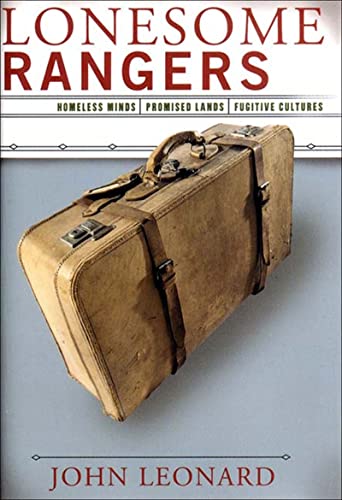
Items related to Lonesome Rangers: Homeless Minds, Promised Lands, Fugitive...
Synopsis
John Leonard, "the fastest wit in the East" (The New York Times Book Review), is back with the offbeat, wide-ranging style that earned his last book, When the Kissing Had to Stop, a place among the Voice Literary Supplement's "25 Favorites of 1999." Now, with an eye to the social and political experience of writers, Leonard adopts a broad definition of exile.
He addresses Robert Putnam's Bowling Alone, where exile manifests itself in solitary bowling, a reflection of a declining sense of community. He considers Salman Rushdie as rock'n'roll Orpheus, who―after ten years in fatwa-enforced exile―bears a striking resemblance to his continually disappearing characters. And Leonard also explores Primo Levi's exile of survival, Bruce Chatwin's self-imposed exile in travel, as well as the work of Saul Bellow, Ralph Ellison, Phillip Roth, Barbara Kingsolver, and Don DeLillo, among others.
As always, Leonard's writing jumps off the page, engaging the reader in what the Washington Post calls his "laugh-out-loud magic with words."
"synopsis" may belong to another edition of this title.
About the Author
John Leonard, "the fastest wit in the East" (The New York Times Book Review), is back with the offbeat, wide-ranging style that earned his last book, When the Kissing Had to Stop, a place among the Voice Literary Supplement's "25 Favorites of 1999." Now, with an eye to the social and political experience of writers, Leonard adopts a broad definition of exile.
He addresses Robert Putnam's Bowling Alone, where exile manifests itself in solitary bowling, a reflection of a declining sense of community. He considers Salman Rushdie as rock'n'roll Orpheus, who―after ten years in fatwa-enforced exile―bears a striking resemblance to his continually disappearing characters. And Leonard also explores Primo Levi's exile of survival, Bruce Chatwin's self-imposed exile in travel, as well as the work of Saul Bellow, Ralph Ellison, Phillip Roth, Barbara Kingsolver, and Don DeLillo, among others.
As always, Leonard's writing jumps off the page, engaging the reader in what the Washington Post calls his "laugh-out-loud magic with words."
Reviews
A CBS and NPR commentator, New York magazine reviewer and literary editor for the Nation, Leonard (This Pen for Hire, etc.) has also worked as editor of the New York Times Book Review. This collection of 27 essay-reviews, most previously published in the Nation, seems oddly defenseless without the buttressing context of the magazine, since each one remains oriented toward pub-date-driven summings up. Subjects range from late or gray writers Arthur Koestler (Leonard lifts part of his subtitle from the Koestler bio he reviews), Mary McCarthy, Elizabeth Hardwick and Saul Bellow, along with Commentary editor Norman Podhoretz, to Harvard political scientist Robert D. Putnam and novelists Bambara, DeLillo, Kingsolver, Powers and Rushdie. Everywhere in these pages are attempts at liveliness: "Once upon a time, I was a Wunderkind. Now I'm an old fart"; "Picasso was nasty, brutish, and short, but he changed the way we saw the world." While effective in giving a blunt quick take on careers or pieces of writing, Leonard's commonsense approach obscures more than it reveals, as when, for example, he gives a free pass to the late writer Bruce Chatwin, who lied until the end about his AIDS infection: "... I am not so presumptuous as to instruct a stranger on how to die heroically. We didn't know about Rock Hudson in advance, so why should we have known about Bruce Chatwin? Who says writers have a higher obligation than actors? Or politicians?" Even though this book fails to deliver the coherent moral or aesthetic vision that would live up to the profundity of the subtitle, Leonard's infectious energy and love for reading and writing come through clearly. (Feb. 28)Forecast: Despite Leonard's high profile, this diffuse book has no clear hook, as Nation readers will have seen the pieces before, and Leonard's rattling style works less well between hard covers. Viewers of Leonard's Sunday Morning segments may account for some sales if they run across the book.
Copyright 2002 Cahners Business Information, Inc.
In a world of cacophonous talking heads posing as "cultural commentators," what a treat it is to encounter the real thing. Through numerous journalistic gigs (including editor of the New York Times Book Review), Leonard has never failed to be both entertaining and enlightening. In his latest collection of essays, loosely united around the theme of writers in exile, he leapfrogs from Primo Levi to Mary McCarthy, to Eugene V. Debs, and even to Robert D. Putnam, author of that bible of the executive retreat, Bowling Alone. Displaying a phrasemaker's flair unmatched among contemporary critics, Leonard gives Putnam the lambasting he so deserves, defends McCarthy against the sniping of her contemporaries, and tells Podhoretz what readers of Making It have long believed: "It's okay, Norman, all of it--wanting money, status, power, fame. But what makes you think it's so brave to say so out loud?" Whatever his topic, Leonard reminds us that criticism can be stylish and substantive, that it can bring books and life together, and that, best of all, it can be damn funny. Bill Ott
Copyright © American Library Association. All rights reserved
The wise-cracking, pun-loving Leonard (When the Kissing Had To Stop) is also one of our most serious cultural critics. The former editor of the New York Times Book Review and the literary coeditor of the Nation, he is now a commentator on CBS Sunday Morning. Using a jazzy hyper-language full of lists, names, and new words, Leonard shows how he has remained true to the ideals of his youth; his leftist bias shows clearly and brightly. These essays, which mostly examine books and authors but take on many aspects of U.S. culture, were published between 1997 and 2001, mainly in the Nation. The memoir notes that begin and end the book are especially good, as are Leonard's essays on Norman Podhoretz, Philip Roth, Richard Powers, and Bob Dylan. Other authors discussed include Elizabeth Hardwick, Toni Cade Bambara, Jachym Topol, Jeremy Rifkin, and Marguerite Young. Great fun in the Leonard style; recommended for literature collections. Gene Shaw, NYPL
Copyright 2002 Cahners Business Information, Inc.
"About this title" may belong to another edition of this title.
Search results for Lonesome Rangers: Homeless Minds, Promised Lands, Fugitive...

Stock Image
Lonesome Rangers: Homeless Minds, Promised Lands, Fugitive Cultures
Seller: HPB-Ruby, Dallas, TX, U.S.A.
Seller rating 5 out of 5 stars

hardcover. Condition: Very Good. Connecting readers with great books since 1972! Used books may not include companion materials, and may have some shelf wear or limited writing. We ship orders daily and Customer Service is our top priority! Seller Inventory # S_475104726
Stock Image
Lonesome Rangers: Homeless Minds, Promised Lands, Fugitive Cultures
Published by
New Press, New York, NY, 2002
ISBN 10: 156584694X
ISBN 13: 9781565846944
Used
Hardcover
Seller: 2Vbooks, Derwood, MD, U.S.A.
Seller rating 5 out of 5 stars
Hard cover. Condition: Fine in fine dust jacket. Sewn binding. Cloth over boards. With dust jacket. 318 p. Audience: General/trade. No previous owner's name. Clean, tight pages. No bent corners. No remainder mark. HC 423. Seller Inventory # Alibris.0055422
Stock Image
Lonesome Rangers: Homeless Minds, Promised Lands, Fugitive Cultures
Published by
The New Press February 2002, 2002
ISBN 10: 156584694X
ISBN 13: 9781565846944
Used
Hardcover
Seller: Inquiring Minds, Saugerties, NY, U.S.A.
Seller rating 4 out of 5 stars

Hardcover. Condition: Used - Very Good. Seller Inventory # 495082
Stock Image
Lonesome Rangers: Homeless Minds, Promised Lands, Fugitive Cultures
Seller: Strand Book Store, ABAA, New York, NY, U.S.A.
Seller rating 4 out of 5 stars
Hardcover. Condition: Good. Collection of essays on the literature of exile by the former editor of the 'New York Times Book Review.'. Seller Inventory # 556590
Seller Image
Lonesome Rangers: Homeless Minds, Promised Lands, Fugitive Cultures
Published by
The New Press, 2002
ISBN 10: 156584694X
ISBN 13: 9781565846944
Used
Hardcover
First Edition
Seller: Southampton Books, Sag Harbor, NY, U.S.A.
Seller rating 5 out of 5 stars
Hardcover. Condition: Like New. First Edition. First Edition, First Printing. Not price-clipped. Published by The New Press, 2002. Octavo. Hardcover. Book is like new. Dust jacket is like new.100% positive feedback. 30 day money back guarantee. NEXT DAY SHIPPING! Excellent customer service. Please email with any questions. All books packed carefully and ship with free delivery confirmation/tracking. All books come with free bookmarks. Ships from Sag Harbor, New York. Seller Inventory # 387684
Seller Image
Lonesome Rangers: Homeless Minds, Promised Lands, Fugitive Cultures
Published by
The New Press, New York, New York, U.S.A., 2002
ISBN 10: 156584694X
ISBN 13: 9781565846944
Used
Hardcover
First Edition
Seller: Kenneth A. Himber, Lebanon, NJ, U.S.A.
Seller rating 5 out of 5 stars
Hardcover. Condition: As New. Dust Jacket Condition: As New. First Edition. Book is a clean tight unmarked copy. Seller Inventory # 014780
Stock Image
Lonesome Rangers: Homeless Minds, Promised Lands, Fugitive Cultures
Seller: SHIMEDIA, Brooklyn, NY, U.S.A.
Seller rating 4 out of 5 stars
Condition: New. Satisfaction Guaranteed or your money back. Seller Inventory # 156584694X
Stock Image
Lonesome Rangers: Homeless Minds, Promised Lands, Fugitive Cultures
Seller: BennettBooksLtd, Los Angeles, CA, U.S.A.
Seller rating 5 out of 5 stars
hardcover. Condition: New. In shrink wrap. Looks like an interesting title! Seller Inventory # Q-156584694x