Items related to The Muted Conscience: Moral Silence and the Practice...
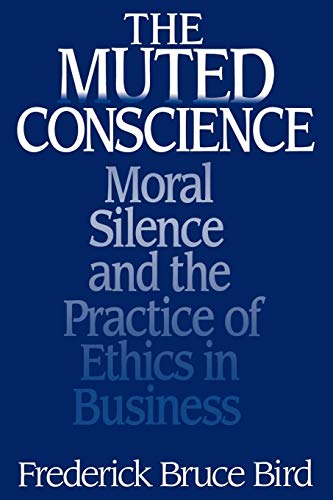

t's not that most businesspeople lack moral convictions. Rather, they tend not to voice them and are inattentive when others ^Udo. Bird sees this behavior as moral silence, deafness, and blindness, and, following this analogy to the senses, he argues that the practice of ethics is a form of communication. Thus, instead of focusing on specific moral issues, Bird examines the things that stifle communication about moral issues―factors that have a costly impact on business. His book presents a new view of ethics, in which ethics can be construed as a practical social activity, not a utopian concept to be contemplated in the abstract. With numerous examples and case studies from business life and a logical, sensible analysis of what causes moral silence, deafness, and blindness, Bird's book will be challenging reading not only for professionals and academics in various fields of business, but also for their colleagues in philosophy, religion, and the social sciences.
The author begins by discussing the nature of moral silence in contemporary business and asks what kind of problem it is. He examines what it means to voice or not voice moral convictions and what it means to be inattentive or deaf to moral issues. He continues the analogy into moral blindness―the problem of not perceiving moral issues clearly. From there he explores the consequences of moral silence, deafness, and blindness and traces their causes to a variety of cultural, individual, and organizational factors, all of them interconnected. The book concludes with a way in which businesspeople and others can understand ethics as a social activity in which everyone can and must participate. Bird sees the practice of ethics as a form of conversation, a way in which people establish and maintain agreements among themselves, and in doing so help each other overcome their sensory incapacitations. Bird provides ways in which this can be done, from the use of workshops on interpersonal skills to seminars on conflict resolution―tools and aids that are already prevalent in organizations but that have not, until now, been seen as facilitators of moral awareness and action.
"synopsis" may belong to another edition of this title.
Book Description:
About the Author:
A new approach to understanding the nature of ethics and ethical decision making, not only in the context of business, but also in other life contexts.
rd /f Frederick /i Bruce/b FREDERICK BRUCE BIRD is Professor of Comparative Ethics at Concordia University, Montreal, where he teaches in both the management and religion departments and directs the doctoral program in religion./e He holds advanced degrees from Harvard Divinity School and the Graduate Theological Union and has authored or coauthored several previous books on management, business, and ethics.
"About this title" may belong to another edition of this title.
- PublisherPraeger
- Publication date2002
- ISBN 10 1567205941
- ISBN 13 9781567205947
- BindingPaperback
- Number of pages280
Buy New
Learn more about this copy
US$ 49.37
Shipping:
US$ 4.00
Within U.S.A.
Top Search Results from the AbeBooks Marketplace
Stock Image
The Muted Conscience: Moral Silence and the Practice of Ethics in Business
Seller:
Rating

Book Description Paperback. Condition: new. New. Fast Shipping and good customer service. Seller Inventory # Holz_New_1567205941
Buy New
US$ 49.37
Convert currency
Stock Image
The Muted Conscience: Moral Silence and the Practice of Ethics in Business
Seller:
Rating
Book Description Paperback. Condition: new. New Copy. Customer Service Guaranteed. Seller Inventory # think1567205941
Buy New
US$ 50.14
Convert currency
Stock Image
The Muted Conscience: Moral Silence and the Practice of Ethics in Business
Published by
Bloomsbury Academic
(2002)
ISBN 10: 1567205941
ISBN 13: 9781567205947
New
Softcover
Quantity: 1
Seller:
Rating
Book Description Condition: new. Seller Inventory # FrontCover1567205941
Buy New
US$ 50.22
Convert currency
Stock Image
The Muted Conscience: Moral Silence and the Practice of Ethics in Business
Seller:
Rating
Book Description Condition: New. Seller Inventory # ABLIING23Mar2811580059809
Buy New
US$ 65.62
Convert currency
Stock Image
THE MUTED CONSCIENCE: MORAL SILE
Seller:
Rating

Book Description Condition: New. New. In shrink wrap. Looks like an interesting title! 0.85. Seller Inventory # Q-1567205941
Buy New
US$ 68.24
Convert currency
Stock Image
The Muted Conscience Moral Silence and the Practice of Ethics in Business
Print on Demand
Seller:
Rating
Book Description PAP. Condition: New. New Book. Shipped from UK. THIS BOOK IS PRINTED ON DEMAND. Established seller since 2000. Seller Inventory # L0-9781567205947
Buy New
US$ 72.72
Convert currency
Seller Image
The Muted Conscience: Moral Silence and the Practice of Ethics in Business [Soft Cover ]
Print on Demand
Seller:
Rating
Book Description Soft Cover. Condition: new. This item is printed on demand. Seller Inventory # 9781567205947
Buy New
US$ 75.71
Convert currency
Stock Image
The Muted Conscience
Published by
ABC-Clio, Incorporated
(2002)
ISBN 10: 1567205941
ISBN 13: 9781567205947
New
Softcover
Quantity: 4
Seller:
Rating
Book Description Condition: New. pp. 280. Seller Inventory # 262222832
Buy New
US$ 75.20
Convert currency
Stock Image
The Muted Conscience (Paperback)
Published by
Bloomsbury Publishing Plc, Westport
(2002)
ISBN 10: 1567205941
ISBN 13: 9781567205947
New
Paperback
Quantity: 1
Seller:
Rating
Book Description Paperback. Condition: new. Paperback. t's not that most businesspeople lack moral convictions. Rather, they tend not to voice them and are inattentive when others ^Udo. Bird sees this behavior as moral silence, deafness, and blindness, and, following this analogy to the senses, he argues that the practice of ethics is a form of communication. Thus, instead of focusing on specific moral issues, Bird examines the things that stifle communication about moral issuesfactors that have a costly impact on business. His book presents a new view of ethics, in which ethics can be construed as a practical social activity, not a utopian concept to be contemplated in the abstract. With numerous examples and case studies from business life and a logical, sensible analysis of what causes moral silence, deafness, and blindness, Bird's book will be challenging reading not only for professionals and academics in various fields of business, but also for their colleagues in philosophy, religion, and the social sciences.The author begins by discussing the nature of moral silence in contemporary business and asks what kind of problem it is. He examines what it means to voice or not voice moral convictions and what it means to be inattentive or deaf to moral issues. He continues the analogy into moral blindnessthe problem of not perceiving moral issues clearly. From there he explores the consequences of moral silence, deafness, and blindness and traces their causes to a variety of cultural, individual, and organizational factors, all of them interconnected. The book concludes with a way in which businesspeople and others can understand ethics as a social activity in which everyone can and must participate. Bird sees the practice of ethics as a form of conversation, a way in which people establish and maintain agreements among themselves, and in doing so help each other overcome their sensory incapacitations. Bird provides ways in which this can be done, from the use of workshops on interpersonal skills to seminars on conflict resolutiontools and aids that are already prevalent in organizations but that have not, until now, been seen as facilitators of moral awareness and action. It's not that most businesspeople lack moral convictions. Rather, they tend not to voice them and are inattentive when others do. Bird sees this behavior as moral silence, deafness, and blindness, and, following this analogy to the senses, he argues that the practice of ethics is a form of communica Shipping may be from multiple locations in the US or from the UK, depending on stock availability. Seller Inventory # 9781567205947
Buy New
US$ 80.15
Convert currency
Stock Image
The Muted Conscience: Moral Silence and the Practice of Ethics in Business
Published by
Bloomsbury 3PL
(2002)
ISBN 10: 1567205941
ISBN 13: 9781567205947
New
Softcover
Quantity: > 20
Seller:
Rating
Book Description Condition: New. PRINT ON DEMAND Book; New; Fast Shipping from the UK. No. book. Seller Inventory # ria9781567205947_lsuk
Buy New
US$ 69.03
Convert currency